Caliente Means Hot
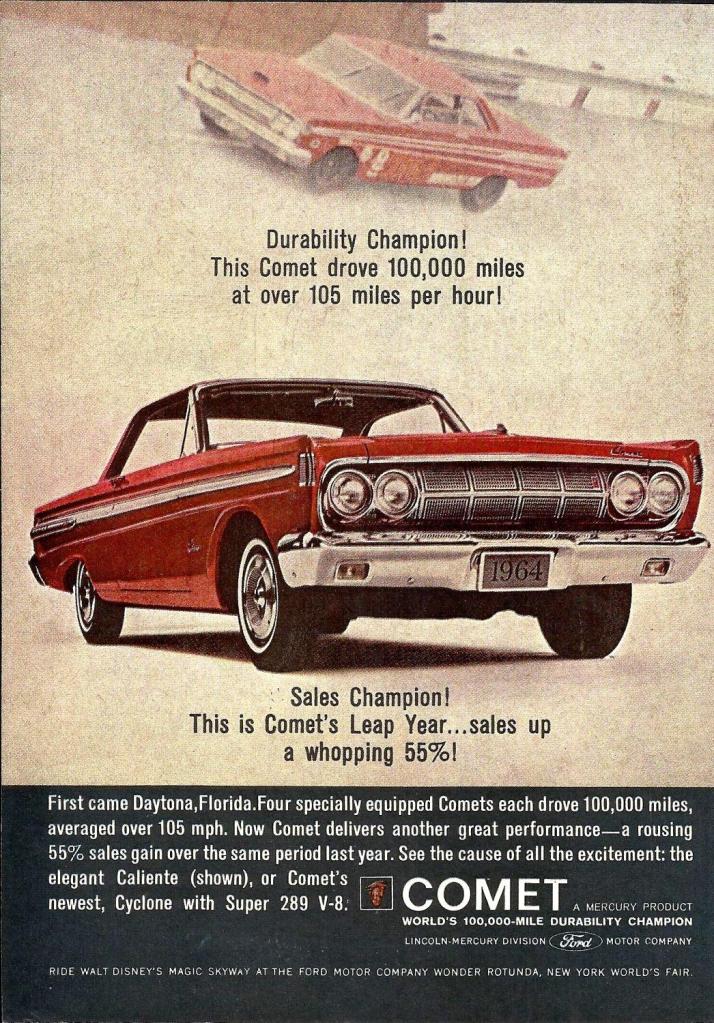
In the Fall of 1963, Beatlemania was sweeping the land. Meanwhile, Ford’s Lincoln-Mercury Division was engaged in a spectacular stunt to prove the power and endurance of it’s sporty 289 V-8 equipped Comet Caliente. Five Comets would attempt to circle the high banks of Daytona Motor Speedway for 40 days and nights at over 100 miles an hour.
To accomplish this incredible feat, Mercury fitted its version of the Ford 289 “D”-Code engine with a slightly larger 4 barrel carburetor. (Ford would not allow them to use its more powerful solid-lifter “K” Code 289. Though the Mercury engine fell short of the High Performance Ford HiPo engine’s 271 horsepower, they called it a “K”-Code anyway.) The five cars used in the record attempt were equipped with beefier suspensions, roll bars and heavy-duty 3-speed manual transmissions. They pitted for driver changes and maintenance every two hours. Four of the five Calientes managed to complete the 100,000 miles without incident. The fifth had a broken valve spring, causing it not qualify for the record. It was repaired and set its own record for 10,000 miles at 124.421 miles an hour. The trial was slowed by two tropical storms in the area. About a hundred people; drivers, mechanics, timers and NASCAR officials participated in the affair. Mercury followed up the achievement with an ad campaign touting the slogan, “100,000 Miles at 100 Miles an Hour!’ (Actually, the fastest car averaged 108 MPH.)
Ford made its fabulous small block Windsor engine as used in the record-setting Comets from the 1962 model year to 2002. Displacements ranged from 221 to 351 cubic inches. The most desirable versions were the high performance units like the Ford’s “real” “K”-Code” 289 engine with its 271 horsepower. These are mostly found in 1964 1/2-1967 Mustangs. Carroll Shelby modified the “K”-code to 306 Horsepower and fitted them in his Shelby Mustangs. Another highly sought after version of the Windsor engine is the 1969-70 Boss 302. This engine featured the better breathing cylinder heads from from Ford’s Cleveland engine series. It was rated at a modest 290 horsepower due to insurance considerations. Another great performance version of the Windsor was the High Output 5.0 used primarily in Mustangs from 1987-1993. These engines were very popular and helped end the “Malaise Era” where American cars suffered from a lack of performance. Sadly the miss-labeled “K”-Code engines used on ’64 Comets aren’t really all that desirable unless they are in one of the five 100K cars.
I have owned a bunch of Windsor small-blocks: An original 221, two 260’s, two 289’s, three 302’s, an HO 5.0 (302 CID) and two 351’s. One of the 289’s powered three different cars. The Achille’s heel of the early versions of the Windsors were their wimpy timing chains. They stretch and fail beginning at about 80,000 miles. This was made worse on the early engines which had a resin-fiber bottom timing gear to reduce engine noise. Typically, a worn timing chain will jump one tooth on start-up. The engine will still run, but the ignition and valve timing will be off. If not replaced it will jump again. This time the valves will collide with the pistons leading to a catastrophic engine failure. I got really good at replacing timing sets on all those Windsor engines. One of the few that never needed replacement was the High Output 5.0 on our ’89 Mustang LX. If you find an early Windsor small block with the original timing set, be careful when you change it. Early engines had a spacer on the front of the cam that is not used with most aftermarket timing gears. Neglect to remove it and your new timing chain will eat up your aluminum timing cover. (Don’t ask me why I know this.)
REFERENCES:
Hemmings, December 24, 2015. 1964 Mercury Comets crush or set over 100 national and world speed… | Hemmings
Moneymaker at Mustangs and More: 1964 Mercury HiPo 289 engine VIN code??? – Mustangsandmore Forums
Main Menu: http://www.azrockdodger.com
 Outlaws, Outrages and Outright Lies
Talk about a long drive! They did sleep, right? I really never thought of the Comet as more than a decent car. This changed my mind!
LikeLike