Medfield Massachusetts, February 21, 1676.
King Philips War 1675-76
Alerted by the sound of gunfire, Henry Adams carefully approached the door to his house. King Philip’s War had been raging since the previous year and there was reason for caution. Other settlements, like Mendon and Lancaster, had been attacked, emptied and torched by the warring tribes of New England. Militia troops rushing to retaliate had been ambushed and massacred. Now Medfield, reinforced by troops from Boston and Cambridge, stood on the exposed frontier of the Massachusetts Bay Colony.
To keep residents safe from attack, five sturdy garrison houses had been fortified and garrisoned. The safest of these was a formidable two-story stone house of seventy feet in length. The town had also purchased a “Greate Gunne”, or cannon, to be used in its defense. Men worked their fields with their muskets by their sides. They slept with their arms and even brought them to prayer meetings. Medfield was ready. Or so they thought.
Henry Adams, a Lieutenant in the local militia, realized the danger of staying in his exposed house, but his home and nearby mill had to be protected. He wisely sent his wife Elizabeth and their younger children to stay in the better protected garrison house of Reverend Wilson. Two of his older children remained overnight in the Adams house.
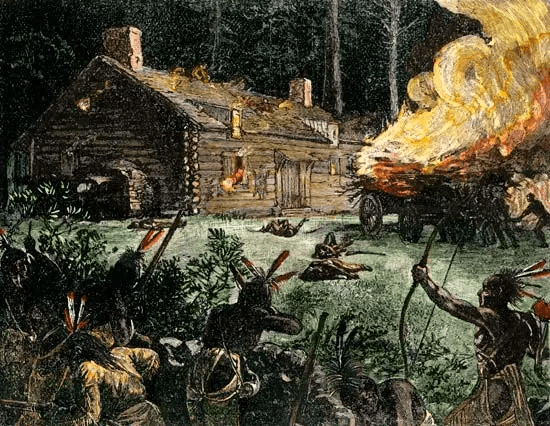
Sometime before dawn, several hundred native warriors crept undetected into the town. They began setting fire to buildings while training their weapons on the doors of houses waiting for the occupants to emerge. The first warning of attack came when Samuel Morse noticed an Indian hiding in his barn. Morse quietly collected his family and they fled to safety as his house and barn went up in flames. The fires caused other settlers to emerge from their houses to see what was the matter. The attackers began shooting at them. This alerted the rest of the town. Pandemonium reigned as the widely dispersed militia men tried to organize a defense.
Henry Adams lifted his latch and opened the door to see his mill going up in smoke. Before he could react, a shot rang out. The ball struck him in the neck. He fell dead in the doorway. His two children somehow managed to escape to the safety of one of the garrison houses as the carnage spread throughout the little community.
More settlers fell defending their homes or running for safety. The Wood brothers, Jonathan and Eleazer, were caught and scalped. Eleazer somehow survived. Johnathan’s wife gave birth to a child during the attack. She died, but the orphaned child survived. After hiding his wife and children, Isaac Chenery returned to protect his property. Shouting, “Come on boys, there they are!” His single-handed charge at the attackers saved his home and barn. Ten-year-old Mary Thurston was captured by the Indians, never to be heard from again. At Ninety-Nine years of age Jonathan Fussell was too old to run or fight. He burned to death in his daughter’s house.
Compounding the tragedy of the Adams family was an accident involving Henry’s wife, Elizabeth. She had taken ill during the battle and was lying in bed in the upstairs loft of Reverend Wilson’s house. Downstairs, a musket in the hands of Captain Jacobs of the Boston contingent accidentally discharged. The ball went through the floor and struck Mrs. Adams. She died the next night.
The scattered soldiers of the garrison houses struggled to regroup and drive the attackers off. The sound of their Greate Gunne is believed to have made the crucial difference in scaring off the invaders.
In all, the massacre left seventeen Medfield residents and militia men dead and one missing. Most of the houses and barns of the town had been burned. The war would rage on until the leader of the Wampanoag confederation, King Philip, fell in battle six months later. In terms of the percentage of population killed, it is said to have been the deadliest war in American history.
Devastating as the war was, the colonists learned some valuable lessons from it. A hundred years later they would put aside religious, ethnic and regional differences to forge a new nation. Three descendants of Henry’s father would serve as Presidents of that nation.
The tribes of New England did not fare so well after the war. The colonists now needed Indian land and hunting grounds more than they needed the friendship, trade and expertise of these first Americans. Pushed off their lands and decimated by the White Man’s diseases and vices, many of the tribes, both friendly and hostile, would fade from the pages of history.
Henry and Elizabeth Adams were my ancestors on my Grandmother Pansy (Schempp) Wilson’s side.
SOURCES:
Hometown Weekly. “This Old Town: Medfield under attack” By Richard DeSorgher. February 17, 2016.
King Philip’s War. George Ellis & John Morris. The Grafton Press. New York. (1906).
Soldiers of the Massachusetts Bay Colony in King Philip’s War (Indian War of 1675-1676) George M. Bodge (abt 1870)
LDT May 16, ‘23
Main Menu: http://www.azrockdodger.com
 Outlaws, Outrages and Outright Lies