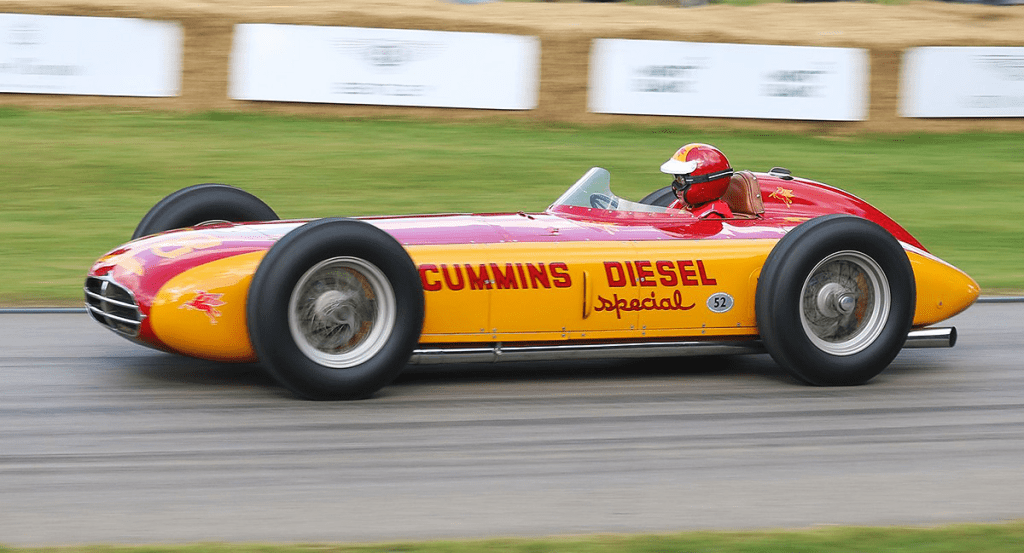
One car in the storied history of the Indianapolis 500 Race stands out for its improbable powerplant. In 1952, Fred Agabashian drove an Indy race car powered by a Cummins Diesel engine. Cummins had been fielding Diesel Indy cars off-and-on since 1931 with limited success. By 1952 Cummins had refined its engines to the point where they were producing impressive horsepower numbers. They decided to go all out for the 1952 race to promote their brand. It would be the stuff that legends are made of. Fuel-injected and turbo-charged, the engine was at the cutting edge of Diesel technology. The use of aluminum castings helped keep the weight manageable. It produced over 400 horsepower at 4500 RPM.
Cummins commissioned Kurtis-Craft to build a car around their massive six-cylinder diesel engine. This was during the era that virtually all Indy cars were powered by the four-cylinder Offenhauser gasoline engine. Kurtis looked at the towering height of the diesel and concluded that it would not work in the traditional configuration of their Indy car chassis. It had too much frontal area which would increase drag. They came up with a creative solution for the problem. They would lay the engine on its side. This not only reduced drag, but it lowered the center of gravity and shifted the weight bias to improve the car’s handling in the corners.
Then Cummins hired Freddie Agabashian to drive the car. In practice, Fred discovered that the 400-horsepower behemoth performed remarkably well. So well, in fact, that he laid off the throttle a bit to keep officials and other competitors from sizing up the threat it posed. Though they saw the car as interesting, no one thought it would be competitive on race day.
Everyone was astonished when Agabashian put the Cummins Diesel on the pole for the 1952 race with a blistering 138.010 MPH qualifying run. Was the era of Offy-powered racecars over? Time would tell.
Unfortunately, the race did not go as well as qualifying. Agabashian started and ran well, but he found that the Diesel car didn’t accelerate as quickly as his competitors. Still, he was running in a comfortable 5th place when disaster struck on lap 71. A build-up of rubber debris from the track caused the turbo-charger to seize. The innovative car was out of the race.
After the 1952 race the sponsoring body, USAC, tweaked the rules to make sure no Diesel-powered car would ever again grace the field at the famous “Brickyard” track. It was not until 2019 that a Cummins Diesel would spin around the Indy track. All five of the Cummins-powered cars that had raced at Indy from 1931 to 1952 appear in an impressive parade lap of vintage Indy cars before the race began.
Though I have never seen the Cummins Diesel #28 car that raced at Indy in 1952, I have seen its driver. Freddy Agabashian retired from racing in 1958 and took a job as spokesman for the Champion Spark Plug Company. He came to my High School about 1959 for a school assembly. I think his topic was automotive safety, but I was enthralled with his racing anecdotes. I also listened to him during the many years he served as a color commentator on the radio broadcasts of “the greatest spectacle in racing.” Though Freddy “Agravatin’” Agabashian died in 1989. His famous Diesel race car lives on. Still owned by Cummins, it can be seen at various vintage racing events and is often loaned to museums.
LDY May 27, ‘23
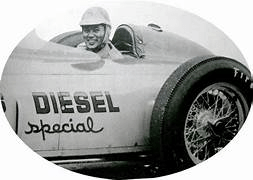
Indianapolis Motor Speedway, 1952
Main Menu: http://www.azrockdodger.com
 Outlaws, Outrages and Outright Lies