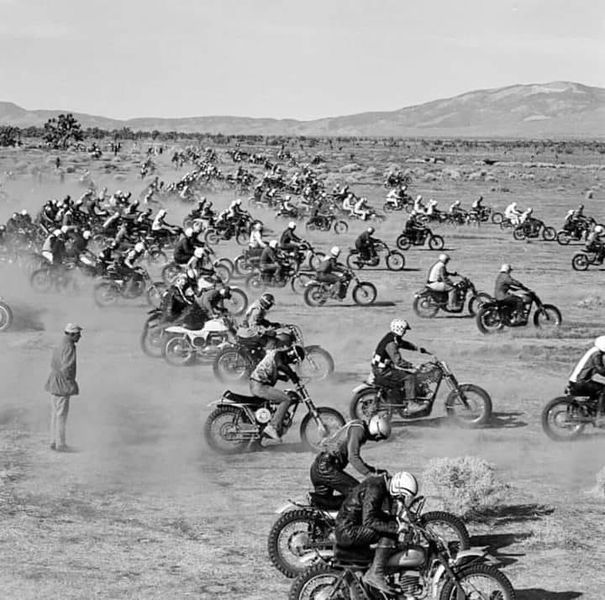
TeThe line of bikes stretches for hundreds of yards. How many? Hundreds, maybe thousands. One of the greatest spectacles in racing is about to begin. Men, kids, even women are astride a kaleidoscope of colorful machines. Bright jerseys and worn leathers topped by every variety of crash helmet ever produced. They wait, silent, tense, their anxious breath fogging the lenses of their goggles.
Each rider has a foot poised at the kick-starter. An open hand covers the clutch lever. Fingers flex at the throttle. The engines have gone silent. All talk has ceased. The riders scan the horizon. They have already picked their lines for the first 50 yards. After that they will read the terrain on the fly.
Off in the distance the smoke bomb is lit. Riders suck in their breath as a tiny wisp of black smoke appears. It gets bigger. The bomb is five miles off. It tells them where they will pick up the marked trail. Officials scan the line as the starter raises his pistol. Nerves make stomachs churn. Riders look left and right. Will the novice on the right try to take their line?
Boom! The gun goes off.
Riders stomp furiously at their kick starters. Engines fire. Throttles are twisted, gears engaged, clutches released. They are off, handlebars clashing. A few are left in the dust, their loaded-up machines wont start. They must control their excitement to clear the excess fuel. No one wins a desert race at the start.
Riders dodge rocks and pucker bushes while seeking better lines. A rock sends someone flying. The faster riders on the bigger bikes have shot out front. A few riders are down. A bike has died. Already. Each bike spews a rooster tail of dust behind it. Those who follow too closely get pelted by tiny bits of sand and rock. The noise and the dust are horrendous. The race becomes a cacophony of chaos. The assembledge has turned into a jumbled mass of motorcycles, each trying to avoid other riders and the hazards of the trail. The dicing begins. Passes are made. The field begins to string out.
The riders pass by the bomb. It is a pile of old tires. They make a smoky fire. There the riders pick up the trail. They know Las Vegas is out there somewhere. It’s just 120 miles away. The trail is marked by red arrows on white cardboard squares. Straight, right, left. The arrow that points down means danger. The rider must figure out what kind. A drop-off, a bed of rocks, a canyon. Rider beware!
An ancient Triumph desert sled wallows in a sand wash while a kid on a Hodaka skims by on top of the sand. More crashes, more broken bikes. The sight of spectators spells danger. They only congregate where riders crash. The guy pointing the fancy camera at the riders wants to sell them a picture. A Jesus Freak holds up a sign. John 3:16. Something to think about. Later, of course. There’s a race to run.
There is a steady climb up the face of some mountains. The trail gets narrower. There are fewer riders to pass. The pack has sorted itself out. You won’t catch the hot shoes in front and the slow-pokes won’t catch you. You pass only broken bikes and downed riders. The injuries aren’t serious, so you keep going. The sweep crew will be by soon.
There are checkpoints at various spots along the course. Each one has its own unique mark for the tank cards. Riders who miss the checkpoints are lost. No one cuts the course. The alternative routes are all dozens of miles longer.
Bikes quit for a variety of reasons. A flat front tire will get the rider to the next pit stop. Without a spare tube and tire irons a flat on the rear ends the race. Broken chains are fixed with spare links. A pair of vice grips serves as a shifter. The steep hills can fry a clutch. Parts fall off. Engines expire due to seized bearings and pistons. Ignitions fail. Plugs foul. The fuel filter gets blocked. A rock holes a crankcase. Sometimes it gets fixed with duct tape. Too many broken spokes cause a bike to hop breaking more spokes. Broken frames and suspensions are rare. Dirt bikes are tough. Some of their riders aren’t.
Beyond the crest of the mountains the trail enters a narrow boulder strewn canyon. Riders pick their way carefully. A broken toe can end their day. The canyon goes on forever. The guys on big heavy bikes struggle. The zippy little trail bikes gain some positions.
The mouth of the canyon reveals a grand vista. That’s Vegas 50 miles away. The speed increases. For a while the trail follows the interstate. People gawk from their cars. The riders cross under the freeway, then back again. More passes are made. More bikes die. The riders who are left in the race all know their stuff.
A pit stop comes up. Riders scan the crowd looking for familiar faces or their numbered gas cans. They skid to a stop. Those with pit crews guzzle Gatorade while their friends and wives refuel them. Others search for gas cans. All are off in a flash.
The next challenge isn’t an obstacle at all. At the state line there is a dry lakebed. It is 5 miles long. It is more suited to a Bonneville streamliner than a dirt bike. The larger machines regain their advantage flashing by the smaller, bikes that passed them in the canyon. No one has a speedometer, but it is flat out across the lake. The big bore bikes top 80. The little bikes have their throttles pegged. Some bikes are jetted too lean. Their white hot pistons seize, ending their run. The smarter riders feather their throttles as bigger bikes flash by. They are in a different class, so it really doesn’t matter.
The finish line is at the outskirts of Vegas. The bikes are funneled into a narrow corridor so there are no final passes. A course worker takes each scorecard. They are stacked on a metal pole. The first card is the overall winner. The class winers may not know they won until they read next week’s “Cycle News.” Trophies will be mailed. Those who finished have conquered the desert. Regardless of position, they are winners.
Their eyes and nostrils burning from the dust, the exhausted riders wait for word on their companions. The race isn’t over until all are accounted for. It’s nearly dark as the last rider comes in. He has a big, grimy smile on his face. The chase crew works into the night to get everyone out safely. A helicopter picks up an injured rider who had to be carried out of the canyon. There’s another race next weekend at Lompoc.
LDT September 8, ’24
EPILOGUE
The Days of mass starts in the desert are long over. The last running of the Barstow to Vegas race was in 1974. There were 3200 competitors in 2 waves. The race was not held again due to environmental considerations. The remaining desert races are mostly held in Nevada, Arizona, and Mexico. These races use staggered starts, no more than 4 riders at a time. Finishing order is determined by time on the course. These races are not nearly as exciting as the mass starts of the old days.
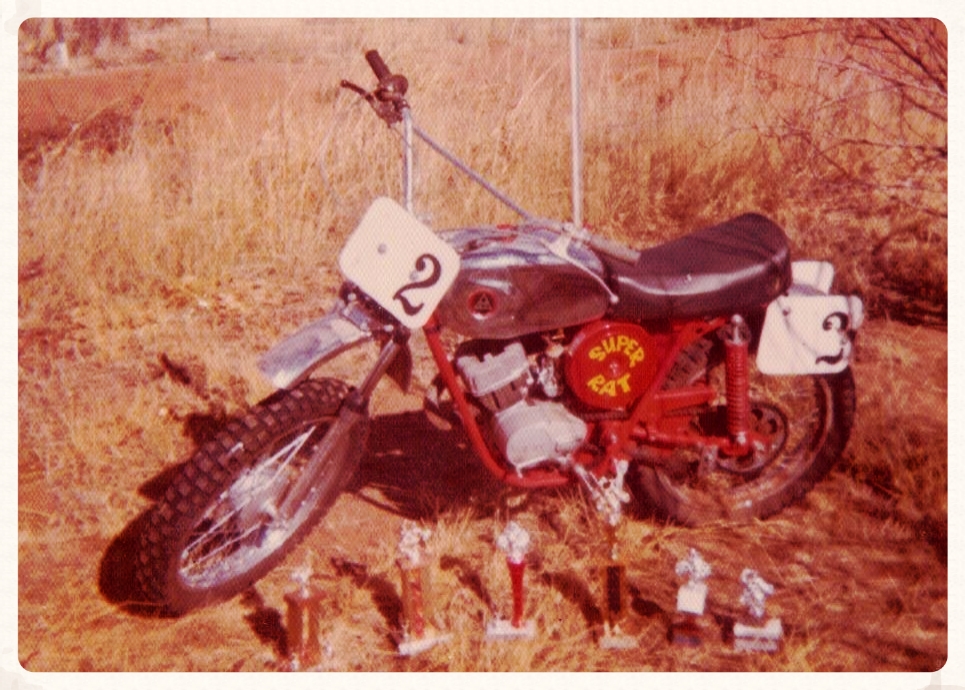
I was fortunate to run in the 1973 Baker to Vegas race which used 2/3 of the previous year’s Barstow to Vegas course. Pictured is the Hodaka Super Rat I rode that day. The large trophy in the center is from that race.xt.
Main Menu– http://www.azrockdodger.com
 Outlaws, Outrages and Outright Lies