John Brown’s Body
A lot can happen in a week. At 4:30 AM on April 12, 1861, the guns of the Confederate States of America opened a bombardment on Fort Sumter. The fort had been designed to defend Charleston Harbor from attacks by sea. It’s defenses were pointed the wrong way, and it was still under construction. Fort Sumter was defended by Major Robert Anderson and 127 men of the 1st US Artillery. Attacking Anderson was his former West Point student and protégé P.T. Beauregard. Overly cautious, Anderson took several hours before ordering his guns to return fire. The Union’s response was ineffective. After 34 hours of constant bombardment, Anderson surrendered Fort Sumter. The Civil War had begun.
An alarmed Abraham Lincoln resolved to put down what he saw as an insurrection. He called for 75.000 volunteers to serve 90 days, the maximum allowed under the existing law. Everyone assumed the rebellion would be over by then. Unhampered by U.S. laws, the Confederacy called for 100,000 volunteers. Four more states, including Virginia, seceded.
By Sunday, April 14th, the news of Fort Sumter’s fall had flashed across the telegraph lines to far-off Appanoose County, where it caused great excitement and apprehension. As Reuben and his family arrived at the Methodist-Episcopal Church in Centerville, they found worried parishioners gathered outside to discuss the news. A group of young men began singing a song that seemed written for the occasion.
John Brown’s body lies a-moldering in the grave; moldering in the grave, moldering in the grave….
Reuben had met John Brown in Kansas. Brown had moved his violent anti-slavery operation to Linn County before Reuben left. Luckily, the old man took sick and caused no trouble at first. Reuben and some of the men from the Sugar Creek Militia had once visited Brown at his fort. Despite his past bloodthirsty actions, the abolitionist seemed kindly and soft-spoken. He only got testy when someone suggested that non-violence might be the path to healing the divisions of Bleeding Kansas. Brown’s continued militancy had caused militia leader James Montgomery to keep his distance from him.
Brown made one final raid into Missouri in December of 1858, killing a slave-owner and freeing about a dozen slaves. Then he disappeared for several months as he plotted his next move to end slavery.
Brown’s plot turned out to be a bold one. He would raid the arsenal at Harper’s Ferry, Virginia, steal its guns, and arm the local slaves for a rebellion.
As the song went,
“He captured Harper’s Ferry, with his nineteen men so few,
And frightened “Old Virginny” till she trembled through and through….”
Brown had, indeed, captured the arsenal at Harper’s Ferry in October of 1859. The raid was a poorly planned disaster. Brown recruited only 2 local slaves for his rebellion. Eleven of his men, including 2 of his sons, were killed. Brown and 6 others were captured. As the song continued,
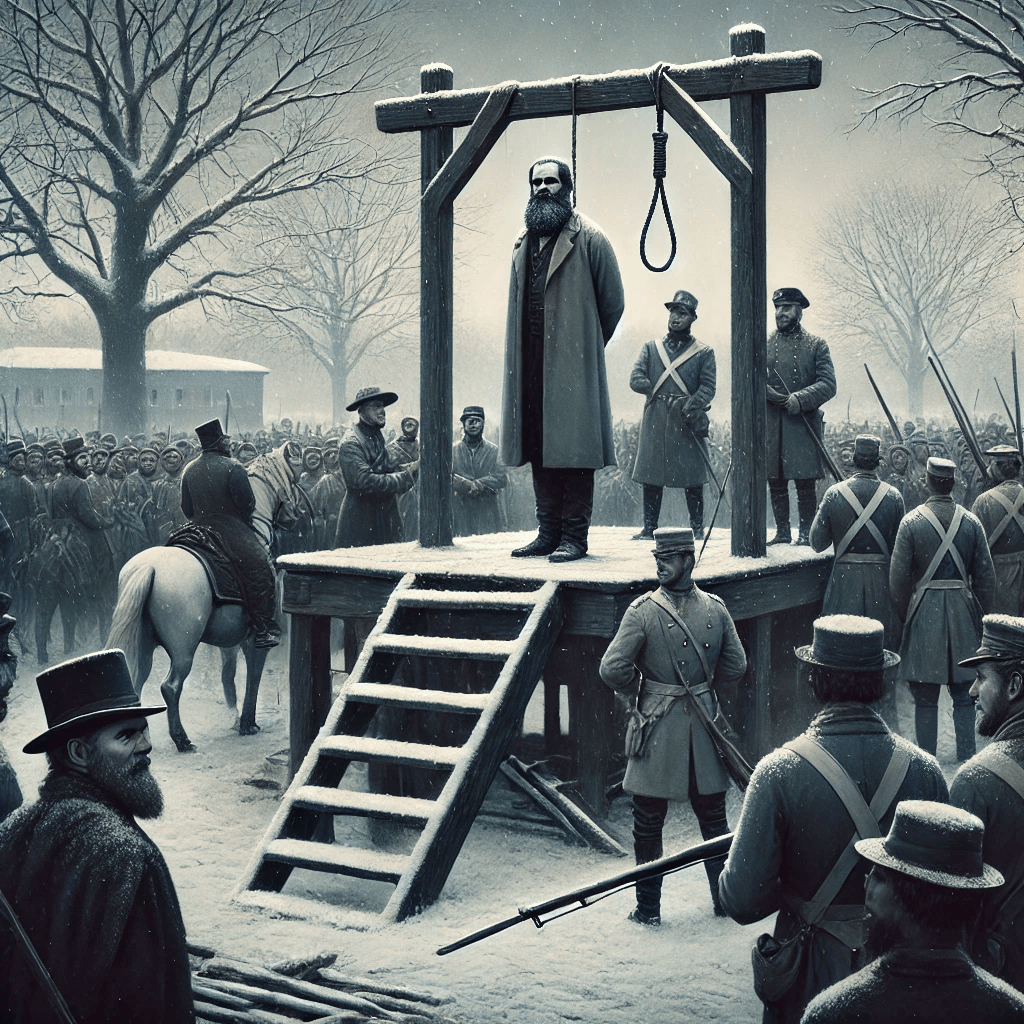
“They hung him for a traitor, themselves a traitor crew,
Brown’s raid had thoroughly alarmed the South. The slave states’ greatest fear was a repeat of the slave rebellion led by Nat Turner in 1831. They now had proof that Northern Abolitionists were willing to promote even larger rebellions. Worse yet, the new President, Abraham Lincoln, seemed sympathetic to the Abolitionists. The South didn’t trust in his assurances that he only wanted to contain slavery to the states where it had taken root. His election so alarmed them that 11 slave states eventually seceded from the Union. Brown’s raid, Lincoln’s election, and Fort Sumter had finally ignited America’s most devastating war.
As the couple entered the church, they heard a new verse to the song,
“We’ll hang Jeff Davis to a sour apple tree, sour apple tree, sour apple tree….”
“Hang Jeff Davis?” Margaret asked as they took their seats. “Will there be a war?”
“I reekin so,” Reuben responded. “Hopefully, a short one.”
Uncle Jacob’s sermon was more militant than ever before. The Union was broken. Men were going to die. He offered a prayer for a quick resolution to the crisis. After the service, the men gathered, as planned, for their baseball game. This time, the Country Boys did a little better. They lost by a score of 5 to 0.
A few days later, Lincoln’s proclamation calling for the mobilization of the 75,000 volunteers appeared in the papers. He pointed out the gravity of the situation, accusing the secessionist states of opposing and obstructing the execution of the nation’s laws. The 75,000 volunteers, he proclaimed, would be used to “suppress said combinations and cause the laws to be duly executed.” Iowa was to provide one regiment to support the effort.
He called on “all loyal citizens to favor, facilitate, and aid this effort to maintain the honor, the integrity, and the existence of the National Union, and the perpetuity of popular government; and to redress wrongs already long enough endured.”
He explained that the first service of the forces would be to recover the forts and property seized by the rebel states. He promised care in avoiding unnecessary harm to peaceful citizens and commanded the Rebels to disperse peaceably. He gave them 20 days to comply. It was not to be.
By the next Sabbath, thousands of men had answered Lincoln’s call for volunteers. The Iowa quota for a regiment of 1000 men had filled up before anyone in Appanoose County could enlist. Reverend DeLay’s sermon was gloomy. Unless the South folded to Lincoln’s demands, men were going to die. A special offering was taken to purchase personal items for Iowa’s volunteers.
That afternoon, the Country Boys scored their first two runs against the Centerville Nine. They still lost by a score of 4 to 2. The post-game discussion centered on the rebellion.
“I can’t wait to get at them damn Rebels,” said one of the players.
“I’ve a notion to go to Missouri and see if I can join one of their regiments,” said another.
“Calm down,” Reuben responded. “If this turns into a real war, you’ll have plenty of opportunity to die for your country. With luck, the South will back down like they did in Kansas.”
“But first, they need to be taught a lesson. They can’t just go about seizing Federal property,” someone said.
“Like I say, they’ll probably back off. If they don’t, it will be a long, bloody war,” Reuben countered.
“Well have them outgunned and outmanned!’ exclaimed another man.
“Don’t be so sure of that. Remember that our armory at Harper’s Ferry is in Virginia. The Rebel state militias have thousands of surplus US muskets. They can make modern rifles at some of the arsenals they took over. They likely got dozens of spiked guns at the forts they seized. Now, Jeff Davis is asking for more volunteers than Lincoln requested. If there’s a war, it won’t be no cakewalk,” cautioned Reuben.
“We can lick ‘em!| shouted a chorus of men.
“Maybe so, but some of us will die in the process.”
After the post-game discussion broke up, Reuben loaded Margaret and the children into the wagon.
“The boys sure seem to want a war,” he told Margaret.
“God, I hate that. We had enough of that in Kansas. It’s hell not knowing when someone will show up during the night with a torch.”
“Let me remind you that Kansas just got admitted to the Union as a free state. We did that.”
“Was it worth it?” Margaret asked, her voice quaking. “We could have all been killed.”
“The country is better for it. So far, it looks like Missouri will stay in the Union. That makes us safer here on the border with them.”
“I suppose so. But I don’t want my man going off to war again.”
“I’ll only go if I have to.”
Behind them, the remaining players began to sing John Brown’s Body again. Their voices seemed increasingly militant. The lines from the chorus struck Reuben and Margaret as prophetic.
He has gone to be a soldier in the army of the Lord,
His soul is marching on.
Glory, glory, hallelujah! Glory, glory, hallelujah!
Glory, glory, hallelujah! his soul is marching on!
A few months later, John Brown’s Body, would be rewritten by Julia Ward Howe. It became The Battle Hymn of the Republic. That song would inspire the young men of the North to “die to make men free.”
Index: Unbowed: The Story of a Civil War cavalryman– Unbowed: The Saga of a Civil War Cavalryman-Index – Outlaws, Outrages and Outright Lies
 Outlaws, Outrages and Outright Lies