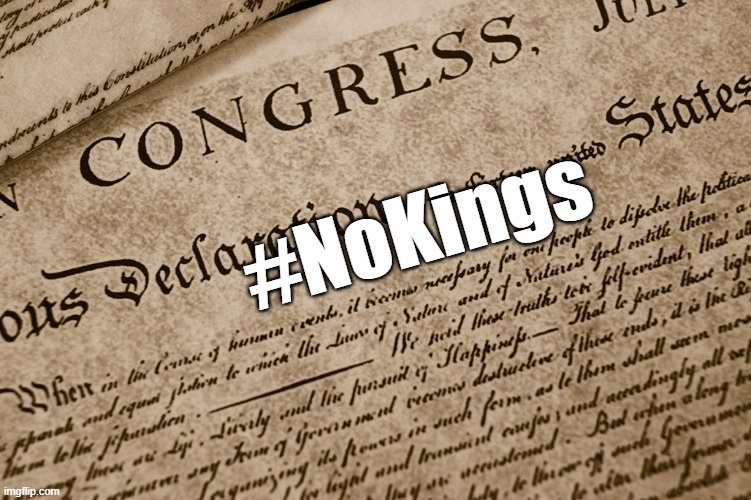
The founding Fathers directed the Declaration of Independence at King George III. Much of it could still apply to our current leadership: “The history … is a history of repeated injuries and usurpations, all having in direct object the establishment of an absolute Tyranny over these States.” “He has refused his Assent to Laws, the most wholesome and necessary for the public good.” “He has endeavoured to prevent the population of these States; for that purpose obstructing the Laws for Naturalization of Foreigners; refusing to pass others to encourage their migrations hither,..” “He has obstructed the Administration of Justice…” “He has made Judges dependent on his Will alone for the tenure of their offices…” “For cutting off our Trade with all parts of the world…” “He is at this time transporting large Armies..to compleat the works of death, desolation, and tyranny, already begun with circumstances of Cruelty & Perfidy scarcely paralleled in the most barbarous ages” “He has excited domestic insurrections amongst us…” “A Prince, whose character is thus marked by every act which may define a Tyrant, is unfit to be the ruler of a free people.”
Declaration of Independence. In Congress. July 4, 1776
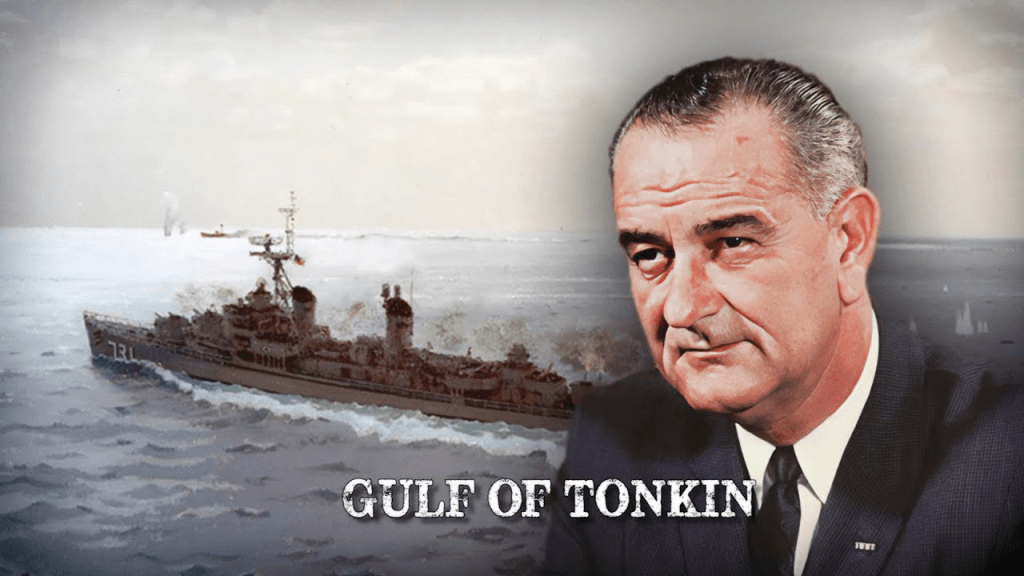
Of all the lies they told us, Tonkin was the first,
That night, a war was started with an errant burst.
Who knew that night in August would send us off to war,
That night, the music died, and we heard the cannons roar.
In the Tonkin Gulf, there’s no light to cut the gloom,
Just a watching eye from within the radar room.
Static on the radio, swells sloshing to and fro,
Liberty in Tokyo was not so long ago.
A lonely watch makes a sailor’s nerves go tight,
Blips upon a screen can cause an awful fright.
They saw the ghosts approaching, with their guns ablaze,
Some saw torpedoes churning through the ocean waves.
From the decks of Maddox and the Turner Joy,
They fired at the shadows, determined to destroy.
Through the night, they fired about 300 rounds,
Though they claimed some hits, no debris was found.
Both ships fired wildly, the Maddox took a hit,
Back in Washington, Lyndon had a fit.
He asked the US Congress if they would authorize,
The use of deadly force, for MacNamara’s lies.
We said that we were winning as we made the thunder roll.
But soon, the body bags would reveal an awful toll.
And somehow it didn’t matter just how hard we fought,
The blood and the sorrow seemed to be for naught.
It seems to me that God-damn war was cursed,
Of all the lies they told us, Tonkin was the worst.
LDT March 11, ‘26
NOTE: The infamous Tonkin Gulf Incident was the basis for our involvement in the Vietnam War. There were actually two incidents. On the night of 2 August, 1964, three North Vietnamese patrol boats mistook the destroyer Maddox for a South Vietnamese vessel infiltrating troops into the North. They attacked the Maddox. She wasn’t harmed and drove off the attackers. Not wanting to go to war with the US, the North Vietnamese quickly apologized for the incident. Unfortunately, that was not the end.
Two nights later, the Maddox was joined by the C. Turner Joy in the same waters. Mistaken signal intelligence and radar blips led both ships to fire on imaginary targets. The Joy hit the Maddox, causing no harm. The ships reported they sank the enemy boats.
Though there was no evidence that the second attack ever happened, President Johnson used this non-event to get Congress to pass the Tonkin Gulf Resolution. By March 1965, we were landing ground troops in the quagmire known as Vietnam.
The sentry paused a second while the call was repeated down the line. Then he pivoted and resumed the short beat of his post. This gave Reuben a chance to study his features in the gathering twilight. He was clad in a rumpled grey uniform with a splash of dirty butternut on the cuffs and collar. This told Reuben the man was a regular soldier, not a Home Guard.
Not knowing his name, the men called him The Hawk in recognition of his narrow, hooked nose. The Hawk’s shaggy beard was gray, and his shoulders stooped. His eyes were sad and sunken. There were rings around them from too much strain or lack of sleep. He limped slightly and lacked a couple of fingers on his left hand. Reuben concluded that he must be an invalid, a man sent to the home front to recover from wounds. He remained on duty because the Rebels needed every man they could muster. He could still do rear-echelon work like guarding prisoners. If he were lucky, he’d stay there until the war was over.
The Hawk’s rebel uniform hung limply on his stooped frame. The knees of his britches were patched. His elbow protruded from a hole in the sleeve of the arm that grasped the sling of his rifle. Like most southern rifles, it was a British Enfield. It had likely been exchanged for cotton in the Bahamas and smuggled past the blockade. The damn Brits would do anything to keep the cotton mills of Birmingham humming, thought Reuben.
And what of the Enfield? A good, solid rifle, but like all muzzle-loaders, slow to load. Thirty seconds would be a good reloading time for an experienced marksman in the dark. The woods were only thirty yards past the sentry’s post. At best, he could only shoot one of the three men in the escape party. The odds of that happening in the darkness of the quarter moon were low. Besides, the Hawk would be tired at the end of his watch.
Reuben wondered whether the Hawk was a true believer in the Southern Cause or some dirt-poor farmer conscripted into the Rebel Army. At any rate, he was far less dangerous than the teenage military cadets who guarded other parts of the camp. These fresh-faced kids were eager to brag that they had shot a Yankee. A weary old-timer might fulfill his duty to the Confederacy by aiming high.
Reuben looked for signs in the man’s expression. He seemed calm and collected. He also had a look of sadness. His movements were slow and deliberate as he shuffled back and forth. He didn’t look around much.
After a few trips back and forth on his route, his turnabout coincided with the sentry to his left. The other man spoke.
“Got a chew?”
“Wot did ya say?”
“GOT A CHEW?”
That was a solid gold clue. The sentry was hard of hearing. Maybe he had served in an artillery battery.
Reuben began to assess the odds and form a strategy. How often did his path meet that of his comrades at the end of each cycle? Could their footsteps be heard in the quiet of the night? Could their escapes be timed for when both sentries had their backs turned?
As the camp settled in for the night, Reuben edged closer to the Dead Line. He could now hear the footsteps of the sentries on their well-beaten paths. The sound ebbed and flowed as the guards approached and separated from each other. Lying low, he could barely make out their profiles against the sky in the dim moonlight.
Toward midnight, Reuben ended his study of the Hawk and his post. He returned to the rude dugout he shared with his co-conspirators.
“Mah name is Zeb Tomkins, and I’ve bin a-travelin’ a hard road.” Reuben said, looking up at the old man on the porch.
The man eyed him suspiciously. The North Carolina hills were full of spies, deserters, outlaws, and runaway slaves. Getting too close to the wrong group could get you a visit from the Home Guard. That could prove fatal.
“Well, Zeb Tomkins, what be yer business in these parts?”
Reuben paused before responding. Like a true Southerner, he spoke slowly and deliberately.
“I’m a soldier from the Twenty-fust Tennessee Cavalry.”
“That be part of Forrest’s outfit?”
“That it is. For a while, we wuz commanded by his little brother, Cunnel Jessie Forrest.”
“Come on up heah, where’s I kin get a good look at ya !” commanded the old man.
Reuben studied the man as he approached. He was sitting with his legs dangling off the porch. Long, white hair cascaded from beneath his battered, sweat-stained hat. His rudy, pockmarked face reflected years of outdoor toil in all kinds of weather. There was a big, shaggy, speckled brown dog lounging beside him.
The old man slid off the porch to a standing position and watched Reuben as he approached. The dog looked up and growled. Reuben knew by now that all dogs in the South were mean.
He felt self-conscious about his attire. The faded blue was caked with dust and mud. From a distance, he could pass for a Rebel in Butternut. Up close, his true colors might be revealed.
“We’re you at Pillow?” the oldster asked.
“No Suh,” was Reuben’s reply. The last thing he needed was to get into a discussion with a die-hard secessionist about the massacre of Black Union troops at Fort Pillow.
“I was at the Crossroads, though. We, uh, Sturges, got a purdy good drubbing.”
“Why ain’t ya with the Army?” his interrogator questioned.
“I ketched me the Malaria Fever. Got sent home to convalesce.”
“Well. ya do look a bit poorly, but I’ve seen sicker men than you git hauled off by the recruiters.”
“That’s a fer sure fact. I managed to buy some Quinine when I come through Colombia. Cost me two months’ pay, but I’m a-feelin’ better now.”
“Surpised anything is gittin’ through the blockade these days. I ain’t had no coffee in nigh unto two years. Why’s ya comin’ by way of Columbia?”
“After Brice’s Crossroads, the Yankees near run us out of Nor’east Mississippi. They control all the roads leading back into Tennessee. I had to take the cars across Georgia and up through the Carolinas. Been a long, bumpy ride, and now I’m plum wore out and busted.”
The two men were now face-to-face. Reuben reached down to pat the head of the dog, half-expecting his arm to be torn off. Show no fear, he cautioned himself. The dog lifted its head to greet the stranger’s gentle touch. A Rebel dog that didn’t hate Yankees was a rare find.
“If Dawg likes ya, I ‘spose yer okay.”
Reuben grinned. He was winning the man’s confidence.
“Ma, set another plate fer supper. We got a visitor.”
The man beckoned Reuben to come inside. The door creaked on its old iron hinges. Warmth and the smell of bacon cooking came from a little iron cook stove. An old woman in a tattered dress barely looked up from her work.
“Have a seat.”
The man pulled a crock jug from a shelf, removed the cork, and took a swig. “Corn likker?” he asked, holding the finger ring of the jug toward Reuben.
This was no time to confess he was a tee-totaling Methodist, Reuben thought. He stuck his finger through the ring, raised the jug on the crook of his arm, and took a gulp. Don’t spit it out! he reminded himself as his throat rebelled from the fiery liquid.
“You make this?”
The old man nodded proudly. “It’s easier to hide when the gov’mint commissary off’cers come snoopin’ round.”
“They give ya much trouble?”
“Shore ‘nuf. They come around at harvest and took near half. Then they come back last month and took half of what wuz left.”
Reuben looked at a lone photograph on the mantle.
“Yer boys doin’ alright?”
“John, there on the left is gone, kilt at Antietam. Zeke, there in the middle went missin’ af Atlanta. Could be a prizner somewheres.”
“I hear them Yankee prisons are better’n ours,” mused Reuben, not missing a chance to test the old man’s fealty to the Confederacy. “And the young one?”
The old man stiffened. “He’s away.”
Reuben knew better than to ask for details. A young man of that age was either in the Confederate Army or hiding from it.
“Our daughter is married to a soldier from Kentucky,” said the man, pointing to the photograph.
Now that’s interesting, thought Reuben. Men from Kentucky were fighting on both sides in the War. Again, he wasn’t about to ask which side.
The old woman placed the pan of bacon, a pot of beans, and fresh biscuits on the table. The old man motioned for Reuben to serve himself. As the men began eating, the woman prepared another plate, but didn’t sit down. She covered it with an old napkin and quietly slipped out the back door.
I’m glad young “He’s away” is getting some of this, Reuben thought as he wolfed down the best meal he’d had since reenlisting.
“Yer a Yankee, ain’t ya?” the man queried matter-of-factly.
Reuben gulped. “What makes ya think that?”
Yer pants are light blue and made outa wool.”
Reuben thought about what lie to tell. He could say he took them off a dead Yankee after his own pants wore out. He glanced at the shotgun hanging above the door. It looked primed and ready. Hell, I can easily beat this old man to it, he thought. Might as well fess up.
“You have me dead to right, Sir.”
The man pushed the jug toward him. Reuben winced, held his breath, and took the tiniest sip he could manage. It still burned.
“I hope that doesn’t cause you any grief,” he said, rasping from the liquor.
“Depends. We uns might be able to help each other.”
About that time, the woman re-entered the house.
“Ma, go fetch the boy.”
Reuben began to realize that this might be the luckiest day of his life. Fifteen minutes later, a young man cautiously entered the house, followed by his mother.
“Son, this is Zeb. Zeb, this is Caleb.”
Caleb looked a little confused upon hearing his name.
“Gol darn it. His name ain’t Zeb neither.”
Reuben and “Caleb” looked at each other and chuckled. In the shadowy world of Confederate resistance, it was best not to use one’s real name. There would be a time for that later, like after the War later.
“Good to meet you,” Reuben said, extending his hand.
The young man shook hands warmly and sat down. It was time for an honest, trust-building discussion. Reuben spoke first.
“I’m a Union officer from Iowa. I escaped from Camp Sorghum, near Columbia, two weeks ago. I lost my two companions crossing a river yesterday. I’m trying to reach Knoxville.”
It was now Caleb’s turn.
“I got nuhin’ in this fight. My brothers are gone, and my Brother-in-Law is a-fightin’ in a Kentucky regiment, a Union one. The Confederacy has done nuthin’ but steal from us and force us to fight for the rich planters. The South is losing the war, and I’d just as soon fight for the right side. If I kin git to Knoxville, I’ll join up on the Yankee side.”
Reuben was not surprised. He’d heard that the mountain people of the western Carolinas often had union sympathies. Lucky for him, he had stopped at the right place. Now it was time to hatch a plan.
“Can you get us over the mountains?”
“I can’t, but I think I know someone who can. He’s an outlaw, so it will cost us.”
“How much, how far, and when?”
“Probably a hunnert dollars each in Yankee money. He might hold off on collecting yours until you get to the Union lines at Knoxville. Pa, will have to owe him for me. He knows whar we live, and he’ll be back to collect with interest.
It’s about a hunnert miles as the crow flies to Knoxville, but the passes are all guarded. This feller has been hiding out in the mountains for years. He knows all the old Indian trails. He’ll get us through if anyone kin.”
Caleb had hardly finished speaking when there was a loud knock on the door.
“Yancey County Home Guard! Open up.”
The young man made a dash for the back door. A shotgun blast flung him back into the cabin. His mother screamed. The front door crashed open, and armed men poured in.
The woman rushed to her dying son. Her stunned husband looked about and quietly raised his hands in surrender. One of the intruders grabbed Reuben and hustled him outside. He could feel the cold steel of the man’s revolver on his temple.
Had he led the Home Guard to this loyal family’s cabin, or had they been looking for the young draft evader?
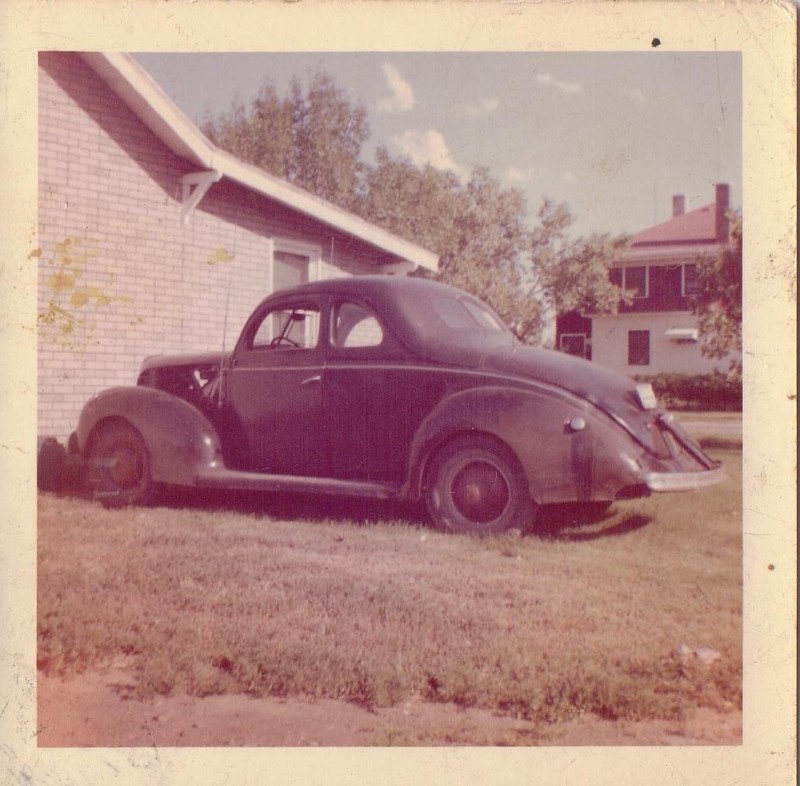
That car belonged to my brother Virg, and my Dad before I got it. Someone put a bigger, 1948 engine and column-shifted transmission in it. I left Glasgow at the end of the Summer of 1960 and picked up cousin Mike in Fort Benton. We were headed for Glacier Park when a water pump pulley broke off. We left it in the gas station attendant\’s backyard and took off hitch-hiking. By the time I got back, someone had stolen the battery. I sold it for $25.
The car had an enormous trunk, much like the Moonshiner car in Thunder Road. To get a little more speed out of it, I soon learned to push hard on the rotten floorboard. That gave it another 20 MPH.
 Outlaws, Outrages and Outright Lies