First They Came

Donald Trump hosting an LIV golf tournament.
Bedminster, New Jersey July 28, 2022.

First they came for the Yeminis,

And I did not speak out

Because I was not a Yemini

Then they came for the dissidents

And I did not speak out

Because I was not one they killed

Then they came for the journalists,

And I did not speak out

Because I was not Jamal Khashoggi

Then they came for the Twin Towers,

And I did not speak out

Because I was not in the towers

Then they came for the PGA

And there was no one left

to speak out for me

@#%&!

Note: this is a paraphrase of the famous Martin Niemöller poem

Main Menu: http://www.azrockdodger.com

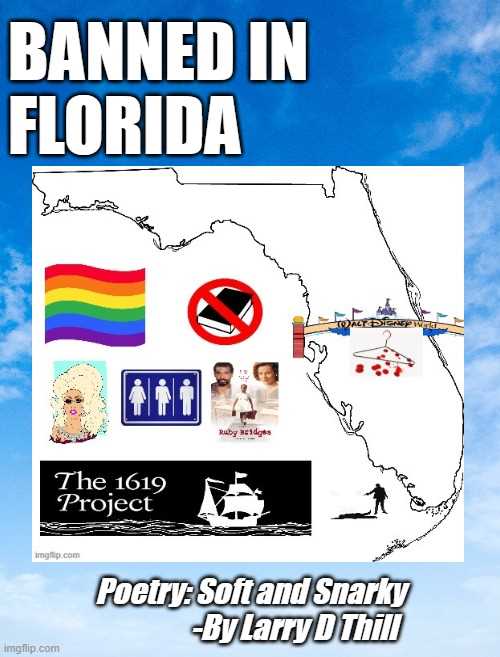
Hey Ron!

Governor DeSantis signs Florida’s Don’t Say Gay Bill

Hey Ron!

I heard you crashed on Twitter Spaces,

And wed at Disney of all places.

What about those books you banned,

That tell the story of this land?

Hey Ron!

Have you seen a Drag Queen Show?

Maybe you should hafta’ go.

Is your pronoun him or her,

Or do we have to call you Sir?

Hey Ron!

Why did you make Mickey sore,

Are you that goofy at your core?

And what about all those guns,

You keep in case someone runs?

Hey Ron!

Are you ready to declare,

Your dystopian nightmare?

And are your panties in a snit,

Or are you just full of ..it?

Hey Ron!

Who will pick your rotting fruit,

Since you told them all to scoot?

Hope your pregnancies go alright,

Cuz all your Docs have taken flight.

Hey Ron!

Why do you ban Miss Ruby’s story,

Is she a threat to White Trash glory?

And what about Don’t Say Gay,

Did not the girls let you play?

Hey Ron!

You said you fixed Sanibel Bridge,

Or did you fudge it by a smidge?

Will the next big hurricane,

Send you fleeing on a plane?

Hey Ron!

Why do you, our votes suppress,

And will you make a bigger mess?

Do you support the KKK,

Because we took your slaves away?

Hey Ron!

What have you got against our history?

We made mistakes, that’s no mystery.

Why can’t we learn, with warts and all,

Or must we hide behind the pall?

Hey Ron!

What is up with your good friend Don,

Why does he hope that you are gone?

You are just as bad as he,

Is what it seems like to me.

Hey Ron!

As your state slips into the sea,

You worry about where to pee.

Why don’t you just look around,

At real problems that abound?

Hey Ron!

Maybe you should take a hike,

And stop acting like a tyke!

LDT May 28, ‘23

Ron shows his colors

Main Menu: http://www.azrockdodger.com

Valhalla’s Call

Captain Lawrence Wicks Jordan.
Commander, HQ Co., 9th Marines, 3rd Marine Div.

He was the first we lost, but he wouldn’t be the last,

The Skipper paid the cost, beneath Valhalla’s mast.

A Mustang from the ranks, he was one of us,

Deserving of our thanks, for his awesomeness.

He didn’t have to go, but he volunteered,

To fight the VC foe, a job that he revered.

He was off to Vietnam, steady, strong and calm,

He went without a qualm, but found a real maelstrom.

Somewhere in Bình Định, the word was mighty grim,

The Skipper had cashed in, it was the end of him.

He heard Valhalla’s call, his name is on the Wall,

Too bad he had to fall, too many gave their all,

He was the first we lost, but he wouldn’t be the last.

He paid a heavy cost, his valor unsurpassed.

L/CPL LD Thill

HQ Co, Ninth Marines, (1964-65)

29 May ‘23

This poem is dedicated to the memory of Capt. Lawrence Wicks Jordan and the twenty-one other men from Headquarters Company, Ninth Marines who died in Vietnam.

Semper Fi!

Captain Jordan left a wife and small daughter. In 2012 his daughter, Deb, left this letter on her Dad’s memorial page:

Dear Dad,

When I think about you there are so many things I want to remember. I want to remember walking hand in hand with you. I want to remember you reading me a bedtime story. I want to remember you throwing me in the air and catching me or riding high up on your shoulders. I want to remember the little things. I also want to remember the big things…teaching me to ride a bike, helping me with homework, threatening a first boyfriend, seeing me graduate, walking me down the aisle. But my memory jar is empty. You left to soon. I was too young. Though I didn’t know you, you taught me the most valuable lessons in life. You taught me to be strong. You taught me to bear pain. You taught me about honor, valor and what it means to die for a cause … for God and country. Big lesson for a little girl who just misses having a daddy. But life lesson for the adult daughter of a hero. You may think that I was too young, that I would miss it all, you may think I didn’t see, that I hadn’t heard, but I got every life lesson that you taught me even though you weren’t here. I got every word, it’s written on my heart. Without you I wouldn’t be woman I am today. Even without your physical presence, I’ve grown up with your values, understanding your courage, knowing your sacrifice, with you as my foundation. You weren’t there when I skinned my knee to chase away my tears to help me when things were hard in school to guide me through my fears as I navigated life. When I was old enough to drive a car, it wasn’t you who taught me how. But you have always been my guiding star teaching me about righteousness, justice, morality and honor. So this memorial day I say a prayer and thank the Lord for the father I never knew but taught me so very much. Semper Fi, Captain Lawrence W Jordan USMC, 1932-1965.
May 27, 2012

Main Menu: http://www.azrockdodger.com

Night Patrol

The Night Patrol

BY ARTHUR GRAEME WEST

France, March 1916.

Over the top! The wire’s thin here, unbarbed

Plain rusty coils, not staked, and low enough:

Full of old tins, though—“When you’re through, all three,

Aim quarter left for fifty yards or so,

Then straight for that new piece of German wire;

See if it’s thick, and listen for a while

For sounds of working; don’t run any risks;

About an hour; now, over!”

                                                    And we placed

Our hands on the topmost sand-bags, leapt, and stood

A second with curved backs, then crept to the wire,

Wormed ourselves tinkling through, glanced back, and dropped.

The sodden ground was splashed with shallow pools,

And tufts of crackling cornstalks, two years old,

No man had reaped, and patches of spring grass.

Half-seen, as rose and sank the flares, were strewn

The wrecks of our attack: the bandoliers,

Packs, rifles, bayonets, belts, and haversacks,

Shell fragments, and the huge whole forms of shells

Shot fruitlessly—and everywhere the dead.

Only the dead were always present—present

As a vile sickly smell of rottenness;

The rustling stubble and the early grass,

The slimy pools — the dead men stank through all,

Pungent and sharp; as bodies loomed before,

And as we passed, they stank: then dulled away

To that vague fœtor, all encompassing,

Infecting earth and air. They lay, all clothed,

Each in some new and piteous attitude

That we well marked to guide us back: as he,

Outside our wire, that lay on his back and crossed

His legs Crusader-wise: I smiled at that,

And thought on Elia and his Temple Church.

From him, at quarter left, lay a small corpse,

Down in a hollow, huddled as in a bed,

That one of us put his hand on unawares.

Next was a bunch of half a dozen men

All blown to bits, an archipelago

Of corrupt fragments, vexing to us three,

Who had no light to see by, save the flares.

On such a trail, so light, for ninety yards

We crawled on belly and elbows, till we saw,

Instead of lumpish dead before our eyes,

The stakes and crosslines of the German wire.

We lay in shelter of the last dead man,

Ourselves as dead, and heard their shovels ring

Turning the earth, then talk and cough at times.

A sentry fired and a machine-gun spat;

They shot a glare above us, when it fell

And spluttered out in the pools of No Man’s Land,

We turned and crawled past the remembered dead:

Past him and him, and them and him, until,

For he lay some way apart, we caught the scent

Of the Crusader and slide past his legs,

And through the wire and home, and got our rum.

Source: The Diary of a Dead Officer (1918)

West was killed by a Sniper’s bullet in France on 3 April, 1917.

Main Menu- http://www.azrockdodger.com

Mesmerized

Ten Thousand voices chanting,

At the words he was incanting.

The banners gaily waved,

Exceptionalism saved.

The Eagle and the Flag,

So they could boast and brag.

The righteous all assembled,

As their stout hearts just trembled.

To the dais he arose,

All thoughts and reason froze.

I am the truth, the light,

And I alone am right.

I will lead this great land,

Against our foes, we will stand.

The truth is mine alone,

Deviants I won’t condone.

I will burn those evil books,

Written by those rotten crooks.

Our People are the very best,

So much better than the rest.

Just look at me, I am the State,

Empower me, don’t hesitate.

Drive the foe from our shores,

Maybe start some jingo wars.

Show the rabble where to stay,

On Heathen hordes we will prey.

In the end the fire consumes,

The places where no flower blooms.

Don’t listen to what Angels tell,

I will lead you straight to Hell.

The führer rallied their dark hearts

So evil men could play their parts.

LDT May 28, ‘23

Main Menu: http://www.azrockdodger.com

Freddy’s Diesel Racer

1952 Cummins Diesel Indy Car

One car in the storied history of the Indianapolis 500 Race stands out for its improbable powerplant. In 1952, Fred Agabashian drove an Indy race car powered by a Cummins Diesel engine. Cummins had been fielding Diesel Indy cars off-and-on since 1931 with limited success. By 1952 Cummins had refined its engines to the point where they were producing impressive horsepower numbers. They decided to go all out for the 1952 race to promote their brand. It would be the stuff that legends are made of. Fuel-injected and turbo-charged, the engine was at the cutting edge of Diesel technology. The use of aluminum castings helped keep the weight manageable. It produced over 400 horsepower at 4500 RPM.

Cummins commissioned Kurtis-Craft to build a car around their massive six-cylinder diesel engine. This was during the era that virtually all Indy cars were powered by the four-cylinder Offenhauser gasoline engine. Kurtis looked at the towering height of the diesel and concluded that it would not work in the traditional configuration of their Indy car chassis. It had too much frontal area which would increase drag. They came up with a creative solution for the problem. They would lay the engine on its side. This not only reduced drag, but it lowered the center of gravity and shifted the weight bias to improve the car’s handling in the corners.

Then Cummins hired Freddie Agabashian to drive the car. In practice, Fred discovered that the 400-horsepower behemoth performed remarkably well. So well, in fact, that he laid off the throttle a bit to keep officials and other competitors from sizing up the threat it posed.  Though they saw the car as interesting, no one thought it would be competitive on race day.

Everyone was astonished when Agabashian put the Cummins Diesel on the pole for the 1952 race with a blistering 138.010 MPH qualifying run. Was the era of Offy-powered racecars over? Time would tell.

         Unfortunately, the race did not go as well as qualifying. Agabashian started and ran well, but he found that the Diesel car didn’t accelerate as quickly as his competitors. Still, he was running in a comfortable 5th place when disaster struck on lap 71. A build-up of rubber debris from the track caused the turbo-charger to seize. The innovative car was out of the race.

         After the 1952 race the sponsoring body, USAC, tweaked the rules to make sure no Diesel-powered car would ever again grace the field at the famous “Brickyard” track. It was not until 2019 that a Cummins Diesel would spin around the Indy track. All five of the Cummins-powered cars that had raced at Indy from 1931 to 1952 appear in an impressive parade lap of vintage Indy cars before the race began.

         Though I have never seen the Cummins Diesel #28 car that raced at Indy in 1952, I have seen its driver. Freddy Agabashian retired from racing in 1958 and took a job as spokesman for the Champion Spark Plug Company. He came to my High School about 1959 for a school assembly. I think his topic was automotive safety, but I was enthralled with his racing anecdotes. I also listened to him during the many years he served as a color commentator on the radio broadcasts of “the greatest spectacle in racing.” Though Freddy “Agravatin’” Agabashian died in 1989. His famous Diesel race car lives on. Still owned by Cummins, it can be seen at various vintage racing events and is often loaned to museums.

LDY May 27, ‘23

Freddie Agabashian in the Number 28 Cummins Diesel
Indianapolis Motor Speedway, 1952

Main Menu: http://www.azrockdodger.com

The Medfield Massacre

Medfield Massachusetts, February 21, 1676.

Wampanoag attack on a village.
King Philips War 1675-76

Alerted by the sound of gunfire, Henry Adams carefully approached the door to his house. King Philip’s War had been raging since the previous year and there was reason for caution.  Other settlements, like Mendon and Lancaster, had been attacked, emptied and torched by the warring tribes of New England. Militia troops rushing to retaliate had been ambushed and massacred. Now Medfield, reinforced by troops from Boston and Cambridge, stood on the exposed frontier of the Massachusetts Bay Colony.

         To keep residents safe from attack, five sturdy garrison houses had been fortified and garrisoned. The safest of these was a formidable two-story stone house of seventy feet in length. The town had also purchased a “Greate Gunne”, or cannon, to be used in its defense. Men worked their fields with their muskets by their sides. They slept with their arms and even brought them to prayer meetings. Medfield was ready. Or so they thought.

         Henry Adams, a Lieutenant in the local militia, realized the danger of staying in his exposed house, but his home and nearby mill had to be protected. He wisely sent his wife Elizabeth and their younger children to stay in the better protected garrison house of Reverend Wilson. Two of his older children remained overnight in the Adams house.

         Sometime before dawn, several hundred native warriors crept undetected into the town. They began setting fire to buildings while training their weapons on the doors of houses waiting for the occupants to emerge. The first warning of attack came when Samuel Morse noticed an Indian hiding in his barn. Morse quietly collected his family and they fled to safety as his house and barn went up in flames. The fires caused other settlers to emerge from their houses to see what was the matter. The attackers began shooting at them. This alerted the rest of the town. Pandemonium reigned as the widely dispersed militia men tried to organize a defense.  

         Henry Adams lifted his latch and opened the door to see his mill going up in smoke. Before he could react, a shot rang out. The ball struck him in the neck. He fell dead in the doorway. His two children somehow managed to escape to the safety of one of the garrison houses as the carnage spread throughout the little community.

         More settlers fell defending their homes or running for safety. The Wood brothers, Jonathan and Eleazer, were caught and scalped. Eleazer somehow survived. Johnathan’s wife gave birth to a child during the attack. She died, but the orphaned child survived. After hiding his wife and children, Isaac Chenery returned to protect his property. Shouting, “Come on boys, there they are!” His single-handed charge at the attackers saved his home and barn. Ten-year-old Mary Thurston was captured by the Indians, never to be heard from again. At Ninety-Nine years of age Jonathan Fussell was too old to run or fight. He burned to death in his daughter’s house.

         Compounding the tragedy of the Adams family was an accident involving Henry’s wife, Elizabeth. She had taken ill during the battle and was lying in bed in the upstairs loft of Reverend Wilson’s house. Downstairs, a musket in the hands of Captain Jacobs of the Boston contingent accidentally discharged. The ball went through the floor and struck Mrs. Adams. She died the next night.

         The scattered soldiers of the garrison houses struggled to regroup and drive the attackers off. The sound of their Greate Gunne is believed to have made the crucial difference in scaring off the invaders.

In all, the massacre left seventeen Medfield residents and militia men dead and one missing. Most of the houses and barns of the town had been burned. The war would rage on until the leader of the Wampanoag confederation, King Philip, fell in battle six months later. In terms of the percentage of population killed, it is said to have been the deadliest war in American history.

Devastating as the war was, the colonists learned some valuable lessons from it. A hundred years later they would put aside religious, ethnic and regional differences to forge a new nation. Three descendants of Henry’s father would serve as Presidents of that nation.

The tribes of New England did not fare so well after the war. The colonists now needed Indian land and hunting grounds more than they needed the friendship, trade and expertise of these first Americans. Pushed off their lands and decimated by the White Man’s diseases and vices, many of the tribes, both friendly and hostile, would fade from the pages of history.

Henry and Elizabeth Adams were my ancestors on my Grandmother Pansy (Schempp) Wilson’s side.

SOURCES:

Hometown Weekly. “This Old Town: Medfield under attack” By Richard DeSorgher. February 17, 2016.

King Philip’s War. George Ellis & John Morris. The Grafton Press. New York. (1906).

Soldiers of the Massachusetts Bay Colony in King Philip’s War (Indian War of 1675-1676) George M. Bodge (abt 1870)

LDT May 16, ‘23

Main Menu: http://www.azrockdodger.com

Wisdom From A Stool

You might think that I’m a fool, a-sittin’ on this stool,

But I ain’t broke no rule, and I never have been cruel.

Hard Knocks is my school, Bud Light is my fuel, and I’m as stubborn as a mule.

I don’t know so very much, and I never had the touch,

This barstool is my crutch, and I’m a such and such.

This schooner that I clutch, ain’t helpin’ me that much, too bad the tab is Dutch.

Yesterday is gone, I’d best be movin’ on,

With the cards that I have drawn, I’ll be broke before it’s dawn.

My account is overdrawn, and somewhere near Tucson, my stuff I had to pawn.

I had a big ol’ wreck, nearly broke my neck,

I said what the heck, and wrote a phony check,

No woman can henpeck, a wandering redneck whose memory’s just a speck.

Now if I had some pluck, I mighta’ made a buck,

But it’d be just my luck, to get run over by a truck.

I’m a drunken schmuck, my life has run amok, and times can really suck.

So if you’re kinda’ wise, you just might surmise,

I ain’t such a prize, and my tales are mostly lies,

Look me in the eyes, I don’t wear no tux nor ties, but this barstool’s just my size.

LDT May 14, ‘23

Torches

Berlin 1933 Charlottesville 2017

They held their torches way up high,

  no one thought to ask them why.

They rallied for their nation’s pride,

  they sought to put their loss aside.

They disparaged those who deviate,

  but proclaimed they had no hate.

They saw the world through their own eyes,

  and thought themselves extremely wise.

They were right to bend the rules,

  to suppress the weak and the fools.

They knew the truth, or so they thought,

  and then forsook what reason brought.

They questioned not their Leader Dear,

  though he ruled with hate and fear.

In the end their hearts consumed,

  with the corpses of the doomed.

And they awoke to a shattered world,

  where the fires of Hell once had whirled.

Must their folly we repeat,

  or will we hear the Lord’s entreat?

LDT May 13, ‘23