The Upper Missouri Smallpox Epidemic of 1837

as far as the mouth of the Yellowstone
By 1837 the fur trade along the Upper Missouri had settled in to a comfortable routine. The advent of the annual steamboat had done more to enhance the trade than any other factor. Crews no longer had to endure the months-long, backbreaking journey up the river. No more using the cordelle, that laborious process of men with ropes dragging boats up the river. No more poling, no more hoping the wind would fill the sail, the steamboat had conquered the river. Most days the only members of the crew breaking a sweat were the hands that fed the ravenous furnace that generated the steam.
The steamboat had changed the very nature of the fur trade. Permanent trading posts could now be established at strategic points along the river. The once hostile tribes could be persuaded to bring their furs to the posts in order to trade. The free and company trappers could get their “possibles” at a trading post. The annual rendezvous began to disappear. The hated Hudson’s Bay Company of the North could no longer compete in fur trade of the Missouri. They had no great river for commerce , they had no steamboats.
Everyone benefitted from the trade. The fur company made huge profits. The lonely trapper had better access to vital supplies, sugar, coffee, tobacco, powder and lead. Manufactured goods, like clothing, knives and cookware were now easier to come by. One might even get one of those great Hawken rifles to defend himself with. The tribesmen of the Upper Missouri looked forward to the annual steamboat’s arrival as well. They had come to covet many of the same things the trappers did. Maybe they wouldn’t get a gun as good as the Hawken, but it would still be better than the tribe over the ridgeline had.
The St. Peters left St. Louis that spring with everything that the hardy inhabitants of the Upper Missouri wanted or needed. They might even have had a little “firewater” stashed on board. Liquor was highly valued on the frontier. It could help a lonesome trapper deal with the boredom and isolation. More importantly, the tribes would do almost anything to get it. Alcohol was worth more than anything else in the trader’s store to a native American. Not being used to it, however, they tended to overindulge. This left them at a disadvantage in trade. It also caused friction within the tribe and led to vital social and community tasks being neglected. Alarmed by the effects of alcohol on the tribes, the government sought to ban it from the Upper Missouri. Companies who violated the ban faced the possibility of having their licenses revoked. A small amount of liquor for consumption of the Whites was all that was allowed.
To get around the restrictions on alcohol, companies devised ingenious methods of hiding their cargos. Some portaged the contraband by land to get it past the inspectors at Fort Leavenworth. One boat was designed with an ingenious tram system that moved the liquor while the dark cargo hold was being inspected. One company transported a still to its post up the river. There was no limit on how many bags of sugar could be transported.
Sadly in 1837, alcohol was not the worst cargo that the St. Peters was carrying. It had something much worse on board. And it would easily slip by the government inspectors. When it got to its destination, it would decimate the tribes of the Upper Missouri. Unseen and without warning it would kill healthy people in a matter of days. The proud and fierce Native Americans would be helpless in the face of this threat. It was smallpox.
Smallpox is a disease that has a mortality rate as high as 30% amongst European populations. For Native Americans, with no natural immunities, the death rate can be as high as 90%. Forty years before the voyage of the St. Peters an effective vaccine for smallpox had been developed, but it had never reached the frontier. Some of the traders at the isolated posts on the river had previously been vaccinated. Others may have survived earlier outbreaks on their own. Smallpox had visited the Upper Missouri tribes before, once in 1781 and again in 1801. One possibility for these outbreaks not being so devastating was that the tribes were less interconnected by trade and travel in those days. Another reason might be that they were far less likely to be at war with their neighbors in 1837 than in the past. Having peaceful trade relations would suddenly become the greatest weakness of the tribes.
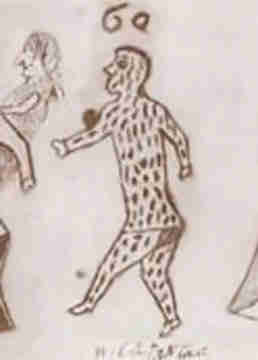
When the disease broke out amongst the tribes, it would wreak a deadly harvest of souls. In 1902 Chittenden reported that, “Deaths were almost instantaneous. The victim was seized with pains in the head and back, and in a few hours was dead. The body immediately turned black and swelled to thrice its natural size. Nearly everyone who was attacked died. “
All seemed well as the St. Peters pulled out of St. Louis in the Spring of 1837. The brand new vessel was on its maiden voyage up the Missouri for the American Fur Company. Early in the trip a crewmember fell ill with smallpox. There was no good place to put him off, so the sturdy sidewheeler just huffed its way on up the river. Soon a few more crewmembers and passengers became ill. The craft’s first major stop was at Fort Pierre in what is now South Dakota. A man named Jacob Halsey, bound for Fort Union, boarded there. Though Halsey had been vaccinated, he still came down with the disease.
The St Peters would head next for Fort Clark about 50 miles upstream from where the modern city of Bismarck, North Dakotas is located. The fort served the Mandans who had been so welcoming to Lewis and Clark back in 1804. Unlike most other plains tribes, the Mandans were a village dwelling people. They lived close together cultivating crops along the river. The wandering tribes of the Northern Plains came to them to trade. Their communal living style was a perfect incubator for contagious diseases. The Mandans were doomed.
Francis Chardon was the Bourgeois (head trader) at Fort Clark. Adding to his excitement of the coming of the St. Peters, was that his 2-year old son, Andrew Jackson Chardon, was on board. So delighted was he that he met the steamer 30 miles downstream just to see the boy. Horrified when he discovered that smallpox was on board, he retrieved child and made for the safety of Fort Clark.
To ensure the safety of the Mandans and other tribes, company officials devised a plan to keep them off of the boat when it docked. This did not work. The anxious tribesmen would not be deterred by some obstructionist crewmen with vague arguments they didn’t understand. They accused the company guards of trying to cheat them. One Mandan stole a blanket from a watchman who was infected with the disease. Chardon tried to bribe the brave to get it back but no avail. Then the Natives stormed aboard the St. Peters. This act would prove fatal for most of the tribe.
Before the disease could really take hold, the St. Peters was off to Fort Union, located at the mouth of the Yellowstone near the present Montana-North Dakota border. This would be its last stop on the trip. Makinaw boats full of goods would be muscled farther up the Missouri and the Yellowstone Rivers the old-fashioned way. Fort McKenzie, at the mouth of the Marias, and Van Buren on the Yellowstone would be their final destinations. At first it looked like the disease could be contained at Fort Union. The tribes had yet to come in to trade. The St. Peters only had one case of the smallpox on board when it docked. That was Jacob Halsey, who had gotten on at Ft. Pierre. Maybe they could just keep Halsey away from others.
Then another company clerk came down with the disease. Both he and Halsey would survive. Unfortunately, a Native woman residing at the post also caught the disease. Panicked, trader Charles Larpenteur searched his medical book for answers. He read about the vaccination process, but he lacked the needed cowpox cultures. Then he got an idea. Halsey had been vaccinated and his case wasn’t severe. Maybe he could use Halsey’s sores as a basis for a home-brewed version of the vaccine. There were thirty or so native women living at the post. He “vaccinated” all of them.
Fifteen days after the “vaccination” program began Fort Union became a scene of indescribable horror. The vaccinated women were dying. “There was such a stench that it could be smelt at the distance of 300 yards….some went crazy, and others were half eaten up by maggots….” Larpenteur put the blame on the failure of his vaccination effort on Halsey, who had a weak constitution. Larpentteur had hoped that the outbreak would be over before the Fall trade commenced in September. Regrettably, one band of natives arrived at the height of the epidemic. Though they were refused admittance to the fort, they later came down with the disease and spread it to their kin.

with a mortality rate of as much as 80% of those infected .
By September, the epidemic inside the fort was over. But beyond the wall was another matter. The sick outside of the fort were infecting more tribesmen as they arrived to trade. They died so fast that the bodies were merely hauled off and dumped in the brush. They had come for a few trinkets and manufactured goods. If they even left at all, they carried death back to their camps. The Piegans, the Blackfeet, the Assiniboine, all fell victim. The Crows, who were hunting in the Wind River Country were initially spared the outbreak. Their time would come in the fall when they headed back to the Yellowstone to trade.
The devastation on the Upper Missouri was almost unthinkable. Nowhere though was it as bad as it was at Fort Clark. Chardon kept a journal. It is chilling to read, even 180 years later.
-July 14, 1837. Less than a month after the arrival of the St. Peters, Chardon recorded the first death, a young Mandan. The disease would spread rapidly in the days that followed.
-July 20, 1837. The disease was reported to have reached the Little Missouri River country. Five days later it turned up at the meat drying camp of the Mandans.
-July 25, 1837. Four Bears, a Mandan Chief, went crazy from smallpox. Two days later 4 would die in the village.
-July 28, 1837. Alarmed by the epidemic and blaming the Whites, a young Mandan tried to kill Chardon. That night the Mandans and Rees (Arikara) held a “splendid” dance knowing they were all about to die.
-July 30, 1837. The disease had spread to the nearby Gros Ventres camp. 10 or 15 have died. Then Four Bears speaks. He blames the Whites for the plague and calls them “Black-harted Dogs” (sic). Then he says, “I do not fear death my friends….but to die with my face rotten, that even the wolves will shrink with horror at seeing me….”
-August 10, 1837. The Rees who had been camped with the Mandans flee to an island hoping to escape the pestilence. 10-15 Mandans died. The next day the Mandans moved their camp across the river. The day after that, one of Chardon’s best Mandan friends in the Little Village died.
-August 14, 1837. An old Mandan was exhorting the tribe to kill the Whites. The next day the Mandans try to get the Gros Ventres to join them in a revenge attack on the Whites.
-August 16, 1837. Very bad smell from the abandoned Mandan village. The dead and dying were left behind.
-August 17, 1837. A young Ree came to the fort looking for Chardon but instead shot Dutchman John Cliver in the back. The Ree was chased to his brother’s grave shouting that this was where he wanted to die. An employee named Garreau tackled the man and slit his body open. The Ree had smallpox.
-August 10, 1837. The suicides, previously unknown amongst the tribes, begin. A Mandan couple kill themselves. Many more suicides and murder-suicides will follow. Mandans are dying at the rate of 8-10 per day.
-August 20, 1837. A Mandan shoots his sick wife, then disembowels himself. Two young Rees stab themselves. It rained.
-August 22, 1837. Several more deaths including a Ree employed at the post. Two young Mandans shoot themselves. With the Mandans threatening to fire the fort, guards are posted in the bastions.
-August 26, 1837. A young Ree had his mother dig his grave. Chardon tried to persuade him to return to the village. The lad said no, that all his young friends were gone. He died that night. Healthy warriors left on a buffalo hunt.
-August 29, 1837. Chardon’s interpreter comes down with smallpox. Chardon frets that his services are critical to the company.
-August 31, 1837. A young Mandan widow kills her two children, then hangs herself. There are only 23 Mandans left.
-September 1, 1837. Two bodies wrapped in a buffalo robe float by on a raft. The Rees relocate to the unattended Mandan cornfields.
-September 4, 1837. A young Mandan came by the fort hunting his father who left him in the brush to die. He wants to kill him.
-September 8, 1837. Seven sick at the fort. The son of old L’etaile died.
;September 16, 1837. Two more of Bellehumeur’s children are sick. That makes his wife and five children ill.
-September 19, 1837. Only 14 left alive in the Little Village. At least 800 dead.
-September 20, 1837. Fourteen sick in the fort. Rainy and cold. No firewood. Bellehumeur’s youngest died.
-September 23, 1837. “Entered My Winter quarters, my youngest son (Andrew Jackson Chardon) died today.”
-October 16, 1837. The smallpox has broken out amongst the Sioux.
Blame for the 1837 Smallpox outbreak rests solely on the officials of the American Fur Company and the Captain of the St. Peters. The boat should have stopped at the nearest port and quarantined itself when the first case occurred. Granted, this would have led to privations at the Upper Missouri trading posts and a loss of a year’s worth of revenue. It might have even caused friction and conflict with the disappointed tribes. None of these consequences would have been as bad as what happened through the company’s negligence. Moreover, many of the company’s employees were felled by the disease. Most of their unvaccinated wives and children died.
Nobody knows how many died of the smallpox in 1837. Estimates range from 15,000 to 150,000. The Mandans and the Arikara nearly disappeared. Other tribes were greatly weakened. Eventually they would be pushed further west by the encroaching Sioux. (The Sioux, or Lakota, were probably the least impacted tribe, possibly due to their inability to get along with the whites and the neighboring tribes.) The fur trade would continue until the beaver, the buffalo and the Native Americans were all but extinct. Prince Maximillian of Prussia had visited the region a few years before the epidemic. When he heard the news of the disaster, he wrote. “The destroying angel has visited the unfortunate sons of the wilderness with terrors never before known….”
DEDICATION: This page is dedicated to Harrison Lane, Chair of the History Department at Northern Montana College (Now MSU-Northern). It was he who first told me the story of the 1837 smallpox epidemic during his “Westward Movement” course in 1968.
REFERENCES:
http://www.mman.us/stpeterssmallpox.htm Mountain Men and Life in the Rocky Mountain West. Michael Schaubs.
ndstudies.gov North Dakota People Living on the land. Section 3: Smallpox Epidemic of 1837.
The American Fur trade of the Far West. Hiram Martin Chittenden. (1902). Francis P. Harper , Publisher.
Main Menu: http://www.azrockdodger.com





















 Outlaws, Outrages and Outright Lies