She said yes! I had a date with the prettiest dark-eyed girl at Buena High School. Oh, how I had longed for this day. I had a secret crush on her since she showed up at our Freshman Orientation. It took a year to work up the nerve to talk to her. Her name was Marisa, which gave hint to her Hispanic heritage.
There were problems, however. I only had a learner’s permit. I’d have to take Mom along when I picked her up. Worse yet, I’d have to drive Dad’s old truck since she lived on a dirt road in Palominas. Luckily, I was smitten and could endure these humiliations for the sake of romance.
Mom and I arrived at her ranchette out on Clinton Lane ten minutes early.
“Should I go in?”
“You might as well. You’ve got every dog on the place barking.”
I stepped out of the truck and was greeted by a large white pit bull with blood-red eyes. I recoiled as it sniffed me and began to raise its hind leg. Fortunately, the stream only hit my right shoe. I resumed my long walk up the driveway to a double-wide trailer that had seen better days. I knocked as there was no bell.
I heard heavy footsteps coming toward me. The knob turned and the door creaked open. A bloodshot eye peeked out through the crack. The chain was lifted, and the door opened. I gasped as I saw the heavy-set man with three days worth of grey whiskers.
Marisa’s step-dad was none other than Ben Spencer, the leader of the militia group, Palominas Patriot Patrol.
“You Mike?” he asked, patting the Glock on his hip. The gun was intimidating, and I knew he wouldn’t hesitate to use it. He had gotten some recent notoriety for shooting up his neighbor’s garage when he heard a noise outside.
“Yessir.” I gulped.
“Marisa ain’t ready. Come in and sit a spell. Tell me about yerself. You on the football team?”
“No, sir. I play soccer.”
“Soccer? Hmph. You ain’t one of them furruners are ya?” “No, sir, my people came over on the Mayflower.”
“Near as bad being a damn Yankee,” he retorted.
We were interrupted as Marisa made her grand entrance. God, she was beautiful. Her long, dark hair perfectly framed her gorgeous almond face. She wore turquoise earrings and a necklace to match. Her little black dress was perfect. She flashed me a smile as big as the Lavender Pit. My heart soared.
“Who’s that in the truck?” she asked.
“That’s my Mom. She needs to use the truck while we’re at the movies.”
Mr. Spencer jabbed me in the ribs with his elbow.
“You ain’t no Mama’s boy?”
I melted into the floor at this veiled attack on my masculinity.
“No, Sir.”
“The movie ends at nine. You git her home by ten.”
“No problem, Sir.”
When Marisa, the pit bull, and I reached the truck, Mom exited and introduced herself. Although Mom sometimes berated Mexicans for coming over here and taking her welfare benefits, she was gracious toward Marisa.
“Oh, you look so nice.”
“Thank you, Ma’am,” cooed my date.
Clearly, Mom was signaling me that I needed to lay onb some compliments.
“Uh um, nice place.”
Mom let Marisa in first, so she could sit by me. I pulled the seatbelt out from where it was stuck under the seat and brushed the crumbs off. Then I helped her get it fastened. I stepped on the clutch and turned the key. Old Blue started up, letting out a puff of its namesake smoke. The dog backed off from the leaky muffler. I checked the mirrors like I was taught in Drivers Ed, slipped the shifter into Reverse, and let the clutch out. It lurched backward. The engine died.
A few minutes later, we were finally on our way. Mom did most of the talking.
“Bumpy road. Your hair looks so nice. Mike wants to be an engineer.”
I turned onto Highway 92 and headed North. In a-half-hour I could ditch mom and have this deliciously sweet thing all to myself. Should I put my arm around her? Do people do first kisses in the movies? I wish my Dad were here. He knows about women. He just ran off with one.
Suddenly, I looked in the mirror. Lights were flashing. One of Arizona’s finest was pulling me over. As I slowed to a stop, two Border Patrol vehicles came out of nowhere and hemmed me in. This was a high-enforcement area. I must have aroused their suspicions by coming from the border. What excuse would they use this time? I wondered. Too much window tint, dirty license plate, air freshener on the mirror? It didn’t take much.
Stay calm, I told myself as the trooper approached.
“License and registration.”
I fished out my permit as Mom fumbled in the glove box for the registration. A Border Patrolman reached past her and grabbed the stash Pop had left in it.
“Your name, young lady?” he asked looking at Marisa.
“Marisa Lopez.”
“Got an ID?”
“No, I’m on a date. I left it at home.”
“Hmmm. US citizen?”
“Dreamer, I’ve got papers at home.”
Marisa spoke with a bit of a Spanish accent. The agent noticed.
“Get out of the truck, all of you.”
The next thing I knew, Mom and I were handcuffed in the back of a deputy’s car. We had just been read our rights. Human smuggling? Can this be real?
I looked back to see where Marisa was. Zip-tied and crying, she was being helped into the back of a Border Patrol van. She was headed for an ICE detention center in another state. We would get to call a lawyer from the Cochise County Jail. Marisa would not be so privileged.
How would I explain this to Ben Spencer? Would I ever see Marisa again? Life can be tough on the border.
Reuben slung the bat behind him and dashed for first base. He looked up to see the direction of the ball as he ran. It was fair, but flying high. As it started on its downward trajectory, the man on third base ran towards it. His bare hands clapped on the leather-wrapped orb. Reuben was out!
It was the end of the game. The Centerville Nine had easily defeated the inept Country Boys by a score of eight to zero. For most of the Country Boys, it was their first try at baseball, the game that had recently arrived from the East. They had thrown wildly, dropped balls, struck out, run into each other, and stood by helplessly as runners stole bases. In comparison, the Centerville Nine had worked together with military precision. Each man knew his position and how to react when the action came his way. This hurt the farm boys, who considered themselves stronger and more agile than the lads from the city.
One of the losing players opined that, “This baseball game don’t mean nuthin’ anyway. It’s just a fad. It’ll never catch on.”
After the game, the captain of the Centerville team approached the Country Boys.
“We didn’t do right by your team. We’ve been practicin’ and playin’ since last year. Thus far, we’ve had trouble getting together with other teams because they are so few and far between. The game would be more fun if we had a local team to play against. We were thinking about that when we challenged you to field a team. It wasn’t fair that you had never even seen baseball played before. If you are up for another matchup, we’ll teach you the basics beforehand.”
“That’d be fine,” said one of the Country Boys. “I’m itchin’ to settle the score, but this swattin’ the ball business has me dogged.”
“Not a problem. We’ll pitch slow meatballs at first, so’s you can get your hand-eye coordination down. I noticed Ben here throws the ball straight and fast. Maybe we can turn him into a pitcher.”
“That would sorta help. Maybe you could teach us how to keep from runnin’ into each other catchin’ them fly balls.”
“Ha! That we can do. We can give you some pointers on where to throw the ball to get an out. We call that assistin.”
The men agreed to meet after church the next Sunday for a joint practice session. The Country Boys hoped they would do better in the next game.
Before Sunday rolled around, the men from both teams had other things on their minds. There was trouble in the South. As it had threatened, South Carolina had seceded from the Union shortly after Lincoln’s election. Six more states quickly followed them in leaving the United States. They had formed a new government called the Confederate States of America. The North still had military posts in the region that had left the Union. The successionist government wanted them out. In most cases, the Federal troops packed up and left. But the Federals refused to give up Fort Sumter, which guarded the entrance of Charleston harbor. Lincoln wanted them to hold out, but didn’t want to start a war over the fort. The South Carolinians were trying to force the garrison to leave by refusing to let supply ships into the harbor. They brought up cannons to further intimidate the installation. The opposing forces stared across the harbor, daring the other side to make the first move. Everyone waited anxiously for one side to blink. Thus far, neither had.
The day had started as a pleasant Sunday afternoon in April. The prairie grass was greening, and crops were sprouting. Unfortunately, the crisp Spring air was filled with apprehension over the unfolding drama in South Carolina. That morning, Pastor DeLay had spoken of the nation’s peril. His sermon drew on the eloquence of the nation’s new president, Abraham Lincoln.
“Our nation is divided, brother against brother. One holds to a peculiar institution that is abhorrent to the other. No voice of reason has yet been able to calm them. Prayer and fasting have not produced a resolution. As Mr. Lincoln once said, ‘A house divided against itself cannot stand…. I believe this government cannot endure permanently half slave and half free. I do not expect the Union to be dissolved—I do not expect the house to fall—but I do expect it will cease to be divided. It will become all one thing, or all the other.’
“For me, dear brothers and sisters, that means that the best way to end the abomination of slavery is to bind this great nation back together. If the seven southern states that have seceded are allowed to break up these United States, the institution of slavery will endure for many more years. Only if we restore our unity can we work together to end this crime against God and man. I join our president in beseeching the South to come to its senses. If they do, we, the people, can find the means to end slavery without causing economic harm to anyone, North or South. I believe in Mr. Lincoln’s call to our better angels.”
‘The mystic chords of memory, stretching from every battlefield and patriot grave to every living heart and hearthstone all over this broad land, will yet swell the chorus of the Union, when again touched, as surely they will be, by the better angels of our nature.’
Reverand DeLay then delivered a fervent closing prayer for peace and reconciliation. It wouldn’t be easy, he remarked.
The young men of Appanoose County had hoped to distract themselves from the nation’s blooming troubles by practicing the fundamentals of baseball that afternoon. It was all too clear, though, that the approaching storm was about to engulf all of them. One wrong move by either side in Charleston could plunge the country into the abyss of war. Despite their bold talk, the men of Appanoose County wondered if they would be up to the task if called. What was war really like?
They turned to Reuben for advice as they limbered up for the practice session. He alone among them had faced hostile fire in the Kansas Border War.
“What are them Southerners like?” asked one of the men.
“It’s hard to put them all in the same kettle,” answered Reuben. “There are plenty of good folks in Missouri who couldn’t care less about slavery. The ones from Little Dixie are different.”
“Little Dixie?”
“Yep, that’s the part of the state where they grow slave crops like tobacco, mostly along the Missouri River. There’s two kinds there. The rich ones have lots of slaves. The rest of them are mostly ignorant and poor. They can’t get ahead because they don’t get free labor from slaves.”
“Seems like that would make them side with the slaves, not the big planters.”
“You’d think so, but the only status they have is that they are better off than the slaves. The meaner sort of them become overseers and slave hunters.”
“How did you manage to drive those reprobates outa Kansas?”
“It wasn’t easy. There wasn’t a lot of advantage to owning slaves there. The place doesn’t favor the kind of big plantations that require slave labor. The Missourians mostly just came over on election day to stir things up. Those who settled there were not much different from us. Of course, there were exceptions, but the real troublemakers were sons of plantation owners from Little Dixie and the deep South. They managed to rile up some of the locals with high-falutin’ talk about the Southern way of life being threatened if Kansas went Free-Soil.”
“How were they in a fight?”
“They were mean buggers who liked to throw their weight around. If they couldn’t scare you off the land, they’d come ridin’ in at night and burn you out.”
“That why you left?”
“Partly. I thought we had the best of ‘em, but they wouldn’t give up as long as they could sneak up on you. We had a militia company that went after them every time they caused trouble. We gave ‘em more than they got. Sometimes we raided the wrong places, though. Mostly, we went after the right ones.”
“What happened if you had a head-to-head fight with them?”
“We had our Sharps rifles. That made them keep their distance. All they had was coon guns, mostly old muzzle loaders. Good for bushwhackin, but useless in a fair fight. We captured or ran them off every time we had a direct fight.”
“How many did you kill?” asked a teenager.
Reuben spat on the ground.
“None that I know of, but I fired a few balls in the right direction. We were mostly out to put the fear of God in them. If they left us alone, we left them alone.”
“You think there’s gwine to be a war?
Reuben thought for a minute and spat on the ground. “Boys, you are supposed to be teachin’ us how to swat that ball.”
Two years after leaving Kansas, Reuben was in the field checking the growth of his corn when a well-dressed man drove up to his Iowa farm in a buggy. He looked official. Was he trouble? Reuben peered at the stranger from the cover of the field. The man got out of the rig and knocked. Would Margaret know how to deal with him, he wondered.
Margaret opened the door. After a brief discussion, she let him in. He was indeed a government official, a census taker. She offered him some fresh buttermilk and sat him down at the table.
“This won’t take long, Ma’am. I just need a few things about your family and farm. First off, what’s the name of the head of the household?”
Rrr..Reuben, Reuben De.. ,ah,… lay.”
How do you spell that, Ma’am?”
“D-I-L-L-A-Y”
“Got it. Sounds Irish.”
“Aye begorrah!” said Margaret, mimicking her grandfather’s old country accent.
“Reuben’s age?”
“Twenty-five.”
“Nativity?”
“Ohio”
“And you are his wife, obviously.”
“Yes. I’m Margaret. I’m 20, born in Indiana.
“Children?”
“Yes, two. Rosellen is two. Born in Kansas…, I mean Kentucky. Little Clinson is one. He was born here in Iowa.”
“Any others?”
Just the hired hand, George Wentworth.
”The value of your personal estate?”
“It’s assessed at $490.”
Margaret still didn’t understand how they had bought the place for cash two years ago. They had left Kansas almost penniless. Reuben wouldn’t say where he got the money. His work done, the man thanked her and left.
Reuben came into the house after the census taker was out of sight.
“That was the census taker. Why must we keep up this charade whenever a stranger comes by?”
Reuben looked at her with unblinking eyes.
“When will you tell me what you did in Kansas?”
Reuben didn’t answer.
“If you did do something there, wouldn’t Governor Medary’s amnesty proclamation cover you?”
“I don’t think so,” Reuben said glumly.
Margaret stared into his eyes, not understanding. Governor Samuel Medary had signed the amnesty bill five months after Reuben left Kansas. It ended the prosecutions of all the Jayhawkers, Bushwhackers, and Ruffians so long as they behaved. Then it hit her.
“Missouri? Did you do something in Missouri?” she asked, raising her voice.
Reuben blinked and glanced down at the floor.
“Damn you Reuben DeLay!”
Indeed, Reuben had left the Kansas border country in a hurry. The sheriff of Bates County, Missouri, was on his trail. It all began one September day in 1858 at the Barnes General store in Mound City. He ran into Abe Sandusky, one of his old Sugar Creek Company companions.
“Heard you were fixin’ to drag up.”
“Yep, the Missus already left for Iowa. She got tired of the Bushwhackers and Ruffians,” said Reuben. “I sold off nearly everything, ‘cept a little mare I’m kinda fond of.”
“That’s too bad,” Sandusky mused. “Ever think of gittin’ even?”
“Every damn minute of every damn day.”
“I hear old John Brown is planning a big raid into Missouri. Maybe we should tag along and git us some booty.”
“I dunno, anyone who rides with Brown after what happened at Pottawattamie would have to be a little daft. He’s got no compunction about killing. If they ever catch him, they’ll hang him along with anyone who’s with him.”
“Spose so, but I’d sure like to git back some of what them Ruffians stole. You up for a private raid?”
Reuben thought long and hard. He had just found a buyer for his claim and had sold off the crop and most of the stock. After paying off his debts, his purse now contained exactly forty-four dollars. That was two dollars more than he had when he arrived in Kansas in 1856. All that hard work for a dollar a year? he asked himself. Now he’d have to start all over. Besides, he had a wife and family to support.
Abe paused a second and pulled out a handbill that read:
Horse & Mule
Auction!
West Point
September 19
-H. Masters, Auctioneer.
Hmm, Reuben thought. Missouri had a reputation for good horse prices, and he had one to sell. Besides, Daisy, his little mare, had a special quality. Other horses followed her lead. He had noticed her leading them toward water and greener grass. She was a lead mare. That could be useful.
“Are you thinking what I’m thinking?” he said, pointing to the poster.
Sandusky looked at the handbill and broke out into a grin.
“How many do you figure we’d git?”
“Twenty or thirty, if we’re lucky.”
“If they’re good horses, that’s a lot of money. How many men would it take?”
“I’ve got a lead mare. If those Missouri horses will follow her, three riders ought to do it.”
“I could ask Ned Wolcott to come. He’s been burned out by them Bushwhackers twice.”
“Ned’s a good man. Let’s see if he wants in.”
A few days later, the men met again to formulate their plan. Reuben would go to West Point the day before the auction to consign the mare. Then he’d find a place nearby to spend the night. When all got quiet, he’d be joined by Ned and Abe as they released the horses. All that was left was to point them toward Kansas. If there were any guards at the auction site, Reuben would have to find a way to distract them.
The Friday before the auction, Reuben rode into West Point alone, leading the mare. Ned and Abe camped in a hidden coulee a few miles from town. The auction arena was on the far side of town. Reuben carefully checked out the route as he passed through. He saw two taverns on the main road. That spelled trouble. He imagined being spotted by a throng of drunken Missouri Ruffians as they tried to run the horses past the saloons. He’d have to find another route.
He located the auction site on the outskirts of town. It had a small auction barn with corrals in the back. He hitched the horses to a rail and went inside. Talk like you’re from Missourah, he cautioned himself.
“Kin I help ya?” said a man who appeared to be the auctioneer.
“Yep, I’m fixin’ to consign a fine mare for tomorrow’s auction.”
“Well, let me take a look at her.”
The two men went out to look at Daisy. The auctioneer, Herk Masters, sized her up, checking her ears, teeth, and hooves.
“She’ll do jes fine. Any papers?”
“No, Sir, but I can give ya a bill of sale.”
“That will work. If’n she’s stole, me and the rightful owner will be a-huntin’ ya’ll down. C’mon back inside and fill out the paperwork.”
Reuben used his old Sugar Creek Company pseudonym, Isaac Smythe, on the documents. He gave an address near Nevada, Missouri.
“You stayin’ overnight?” asked the auctioneer as they put Daisy in a pen.
“I reckon so,” drawled Reuben. “Might just lay my blanket under yon tree.”
“Maybe ya’ll could help my man Jeb keep an eye on the corral tonight. I’d hate to see some damn Jayhawker try to steal what ain’t his’n.”
“Glad to help out.”
“Good. I’ll pay you three dollars if’n you stand guard tonight and help with the stock tomorrow.”
“Now that sounds mighty fine. I need to run back to town and git some victuals fust, but I’ll be right back.”
The two men shook hands, and Reuben rode back toward town. This time, he found an alternate route along a creek to avoid the main part of the town. He met Ned and Abe at their camp and filled them in on the setup. They listened attentively.
“I need you two there at 2 AM. Just before you get to town, take a right and follow the road along the creek so you don’t attract attention. We’ll trail the horses back that way when we come through. Hide yourselves in the stand of trees next to the entrance. I’ll signal you by waving a lit torch. No talking. There’ll be another man standing guard with me. I’ll try to make sure he ain’t awake.”
“Sounds good. I can’t wait to even up the score for all the mischief them Ruffians done,” said Ned.
His two accomplices bid Reuben goodbye and slipped back into hiding. On his way back through town, Reuben stopped at a tavern. He ate and bought a jug of fine Kentucky Bourbon. He hoped Jeb would like it.
Back at the auction house, Reuben and Jeb settled in for the night. They agreed to take two-hour shifts. Reuben twisted the cork on the jug and offered it to Ned.
“Ain’t nuthin’ finer than good ole bourbon from Kentuck,” he remarked.
Jeb took a sip, savoring the flavor.
“Well, swizzle my twizzle. Damn fine, my friend, damn fine.”
“Drink up. My Missus don’t like me a-drinkin’. It needs to be gone before I head for home.”
“I’m your huckleberry,” grinned Jeb as he took a long pull on the jug.
It’s going to be a good night, Reuben thought.
Reuben let an already mellow Jeb have the jug as the man ended his Midnight shift. Jeb was happily sipping on it each time Reuben came by on his rounds of the corral. Within an hour, Jeb’s snoring proved the alcohol had worked.
At 2 AM, Reuben bundled up a sheaf of straw and lit it to signal his comrades. The plan was working. The men quietly snuck into the pens and shooed the horses through the open gates. Reuben put a halter on Daisy and led her to the front of the herd. He’d ride point with Daisy in tow. Ned and Abe would take up the rear flanks.
In half an hour, they were beyond the sleeping town of West Point. Reaching the main road, they picked up the pace and raced for Kansas. They had nearly 40 fine Missouri horses in tow. The Bates County posse would not find their trail until late the next morning. By then, the Jayhawkers were out of their jurisdiction. Frustrated, the sheriff sent a posse member to Linn County to see if he could identify the inside man whom auctioneer Masters described. A young man named DeLay, who had just left the area, fit the description.
The horses were sold, and Reuben left Kansas a wiser and richer man. The border troubles and the issue of slavery were now behind him.
World trade and tariffs are complicated. Dirt bikes are not. Enter the diminutive Hodaka motorcycle.
Back in the ‘60s an Athena, Oregon grain exporter had a problem. The Pacific Basin Trading Company, PABATCO, was selling lots of grain to Japan. The were accumulating piles of Japanese Yen in return. A way was needed to convert this currency into dollars while making a profit.
As the story goes, a PABATCO executive who happened to be a dirt bike rider had an idea. He had been observing a revolution in the off-road motorcycle industry. The big four-stroke British machines that had once dominated off-road racing were giving way to lighter, faster, more agile two-stroke bikes from European marques like Husqvarna, Maico and Bultaco. Though the Japanese made great motorcycles, they had yet to come up with a competitive dirt bike.
He sketched out an idea for a small dirt bike on a napkin. Its main feature was a sturdy, double loop cradle frame that protected the engine. He checked with his contacts in Japan. Could they build it? The answer was yes.
HodaKA, A Japanese machine tool maker already had a successful engine. It was very compact, with an innovative ball bearing and spring shifter mechanism. The engine was light and powerful. The PABATCO-designed frame provided excellent balance and handling. The little bike that resulted from this collaboration was a terror in the dirt. It’s first dedicated racing model was called the Super rat. It could outrun much larger machines. It was a win/win for PABATCO and Hodaka.
The folks who are screaming the loudest about tariffs and trade deficits could learn a lot from the PABATCO/Hodaka success story. The goal in world trade should be to establish long-term relationships that benefit both parties. Ideally, the value of a nation’s exports should equal the cost of its imports. If it doesn’t, there are other mechanisms to balance out the differences. The country with the surplus balance could simply buy more for the other country. It could also invest its surplus in the other country. America’s trading partners buy real estate, build factories, and invest in our securities. That makes some Americans nervous.
Tariffs are often proposed as the solution to trade imbalances and as a way of increasing government revenues. This is a slippery slope to follow. George III famously tried to impose a tea tax (tariff) on his colonial subjects. The colonists rejected the tariff along with George’s rule over them. Napoleon’s “Continental System” was another failure of tariffs. He wanted to lock England out of trade with the European continent. Smuggling became rampant. Napoleon’s protectionism failed to make France wealthy and self-sufficient. It caused wars in the Iberian Peninsula and with Russia. Rather than benefitting France, the system impoverished it. Meanwhile, England increased its trade with Spain, Portugal, and their colonies. America, exasperated by the seizure of its sailors and cargoes by the belligerents, enacted and embargo on trade with the warring parties. The embargo was one of the underlying causes of the War of 1812.
It is true that much of America’s early revenue resulted from tariffs. We did not enact our first income tax until the Civil War. After the war, tariffs continued to be a major source of revenue. Working-class Americans saw these tariffs as placing too much of the burden of taxation on them. As a result, the 16th Amendment which authorized the current income tax was ratified in 1913. America continued to rely on tariffs, but gradually shifted the burden of taxation toward the progressive income tax. In 1930, Congress reversed that trend by passing the Smoot-Hawley Tariff Act. Economists no say the tariffs exacerbated and prolonged the Great Depression.
Today, tariff advocates are once again claiming that tariffs will solve all of America’s problems. They claim if we impose new tariffs, factories building the cheap products we now buy overseas will spring up all over the land! Really? How long does it take to plan and build an iPhone factory? Can we find skilled workers to build them for $7.25 an hour? Who among us is willing to pay $3000 for the phones they produce? Granted, some industries are so vital that they need some protection. This may be better accomplished by subsidizing them. The bi-partisan CHIPS Act was a step in the right direction. Unfortunately, it appears to be in jeopardy for largely political reasons.
Not everyone understands that tariffs are a tax on ordinary American consumers. Tariffs are not paid by the country of a product’s origination. They are paid by the US importer when the products arrive. Most, if not all, of this charge is passed on to the consumer. The tax is regressive, meaning that the lower your income, the higher percentage of it goes toward paying the tax on the things you need. The wealthier you are, the less percentage of your income goes to paying tariffs.
Tariffs also raise production costs for nearly all domestic products. Does your new Ford have tires with rubber from Malaysia? Will the new home you are building use lumber from Canada, light fixtures from India, or tile from Mexico? Can you even get those items in today’s market? How many factories will have to shut down due to unavailability of key materials from abroad?
The flip side of imposing tariffs is the inevitable imposition of punitive tariffs by other trading nations. This hurts American producers. One sector which suffers the most is agriculture. When tariffs are imposed on farm exports, our trading partners often look elsewhere to fulfil their needs. With no market for their crops farmers go bust. The last time we got in a trade war with China, they quit buying soy beans and pork from us. We had to bail out farmers with subsidies. It was a self-inflicted wound.
Perhaps the biggest hope of those advocating increased tariffs is that they can be used to pay off the national debt. Good luck with that. First, such an idea would shift more of the burden of taxation from those with high incomes to ordinary working-class Americans. That would have consequences in terms of their purchasing habits. The higher prices would inevitably lead them to buy less. This could, and likely will, result in a recession. Tariff revenue might just have to be used for relief of those whose livelihoods are disrupted by them.
In summary, tariffs are a tool that can be used to help or hurt our nation. Used unskillfully by a self-interested leader, they could cause much more harm than good. I am pretty sure that Donald Trump’s fat ass has never been on a Hodaka Super Rat. This innovative little machine once helped the farmers of the Pacific Basin find a sustainable market for their products. Trump would destroy the mutual benefits of world trade with his incompetent, ham-handed approach to tariffs.
OK, enough of my rant. I need to check to see how much I lost in my 401K today.
Reuben sat on the bench reflecting on the War, his marriage, his family, his sorrow, and his guilt. Beside him sat his revolver, cold, hard, loaded. Next to the gun was a crock of rye whiskey. He twisted the cork off, cradled it in the crook of his arm, and took a long swig. It was not his first drink of the day. It burned as it passed down his throat. A few more gulps might numb the pain. Nothing would make it go away. The darkness in his soul was crushing. It came like waves, pounding him into formless nothingness. The anguish was unrelenting.
He had come back to his Iowa farm one last time to collect his things. The place still held some of his clothes, his military documents, and some warm memories. Gone was his estranged wife and the three kids he held so dear. Knowing he was coming, Margaret had taken the children to her parents’ house. For all he knew, it might be years before he saw them again. He barely knew the two youngest. Thankfully that damn hired hand, Cochran, was nowhere around either. He couldn’t tell for sure, but Cochran’s relationship with Margaret seemed too cozy. Who am I to talk? Reuben chided himself. It was he who had first strayed from the marriage.
He reached down for the jug and took another gulp of the liquid fire. The world would still not go away. Setting the jug down, his hand fell on the gun. Was this the end? Could he do it? Should he put it to his temple or mouth? Either way, it would be quick. Would anyone care?
He had survived where others had perished. He was home, but somehow lost in the unrelenting trauma of war. Familiar faces and things no longer held the same meaning. He slept fitfully. Sometimes he woke up screaming. Other times he wept. His health hadn’t recovered. He often had a fever followed by the shaking chills. His belly churned at the thought of food he once found savory. His flesh hung loosely from his frame. The faith that once comforted him was also gone. Along with it went hope, security, and purpose.
His failed marriage wasn’t his only problem. His last act as a Union officer continued to haunt him. He had been in command. It was he who offered up his saber in defeat. His hopes of sparing his men from harm had not worked out. They had suffered. Some were dead. It was on him. As their commander, he was responsible.
The Holbrook brothers, John and Charles, were dead. Good boys, young, dedicated to the Union cause. Their abolitionist parents had gone out of their way to assure Reuben that they did not hold him responsible for the loss of their sons.
A prisoner at Andersonville, Dorence Atwater, had secretly documented the deaths at the camp. Reuben’s friend, Fred Buckmaster, was on the list. He had died of his wounds shortly after Reuben left for Camp Oglethorpe. Two more of Reuben’s men, Daniel Himes and Ephriam Cobb, were on Atwater’s death list. The Confederate prison pen at Florence, South Carolina, became the final resting place for I Company troopers Jacob Graft, Nehemiah Solon, and James Swift.
Only two of the men had made it home before Reuben. Oden’s Galvanized Rebel ruse to get released from Andersonville had left questions about his loyalty. James Mason from Company K had escaped and somehow made it to Union lines. In the process, his health had been destroyed. The end of the War brought more news on the fate of the others. The O’Connor brothers had made it through. They were in Atlanta. William Patrick, Joe Ramsey, Bill McNulty, Mike Gallahar, and Jeremiah Cronin were with them. All were put back on duty. The last time Reuben saw them, they could barely stand. Now the Army expected them to march? They were scheduled to come home when the rest of the Third Iowa was discharged in August. Ben Tulk, John Frush, Joe Fletcher, Sam Eddy, and John Davis were luckier. They were already being repatriated upriver for discharge at Davenport.
Reuben knew his men would not be coming home as the vigorous, healthy young men they once were. They’d require months, maybe years, to recover from the ravages of the Confederate prison system. Maltreatment, disease, and malnourishment had emaciated their bodies. Like most prisoners, their spirits suffered as well. Fortunately for them, they would not feel the guilt and shame of their commanding officer.
It was unusual that all his men had been accounted for. God only knew how many other Union prisoners lay in unmarked mass graves all over the South. The Rebs hadn’t been very good at keeping records.
Though there was joy upon his return to Centerville, Reuben was racked with sorrow and guilt. He had taken to drinking. His fling with the nurse at Keokuk was now common knowledge. Margaret was suing him for divorce, alleging adultery. She wanted the farm and the kids. His time away at war had hardened his feelings, but he longed desperately to reconnect with his children. Now they had been taken from him along with his spirit, dignity, and honor.
Honor. That was the final blow. He had been unfaithful. He had fallen for the kindness of the widow who had nursed him. He had taken her to dinner, to her home, and to bed. It was wrong, but he couldn’t change it.
He’d served for such noble causes. Preserve the Union, make men free, protect home and family. Had it all been for naught? Everything he loved was gone. All taken by the War and his personal failings. He could never forgive himself. The damage was irreversible. He picked up the gun. It had the power to kill. It could be used for good or for evil. It didn’t care who pulled the trigger or why. It clicked as his thumb pulled the hammer back.
His thoughts were interrupted by his dog, Cassie. She came around the corner looking for something. She was a hunter. Maybe she sensed a rabbit nearby as she sniffed the ground. Reuben put the gun down when she spied him. She forgot about the rabbit. He had everything she needed. She approached the bench and gazed up with her soft brown eyes. Reuben reached down reflexively to gently stroke her head. He could feel her warmth as she nudged the palm of his hand and gave a soft moan. Then she laid her head on his lap. Tears ran down Reuben’s grizzled face.
There was still good in the world. Perhaps there was hope.
Index: Unbowed: The Saga of a Civil War Cavalryman-
Reuben was surprised to see his friend James Mongomery brushing past the crowd gathered in front of the Barnes General Store, which served as the Post Office and Polling Place for the brand-new hamlet of Sugar Mound. Had Mongomery changed his mind about boycotting the vote on the Lecompton Constitution, he wondered.
Election day was a time for people to gather. It was both a social and political event. Old and new friends exchanged information and shared their views. Much of the crowd fell into the category of new friends. There had been a surge in immigration to Kansas the year before. Most of the new settlers were, like Reuben, men from the Midwest with Free-State sympathies. Kansas had changed, or had it?
As the men mingled a commotion erupted inside the building. Presently, Montgomery emerged, carrying the wooden ballot box in his arms. He held it aloft for all to see.
“Freemen of Linn! I have defended your rights in the past time, and I am here to defend your rights today!”
Some of the men nodded in approval. Others were confused. What was Montgomery up to?
Then he smashed the box on the ground and shouted, “Freemen of Linn, I right you!”
The astonished crowd of voters reacted in horror as Montgomery began stomping the ballots into the mud.
“Stop!”
“What are you doing?”
Reuben couldn’t believe what he was seeing. He and most of the men in the crowd had just voted against the Lecompton Constitution. With the pro-slavery Kansans boycotting the election, the Lecompton Constitution was bound to be rejected. That would allow the Free-State faction to write their own constitution banning slavery. They were now the clear majority and could pick their own leaders. They controlled the legislature and most local offices. Knowing this, Reuben began to wonder if Montgomery had gone mad.
A half dozen men stepped forward to restrain the angry abolitionist. He continued kicking furiously as they dragged him off. Most of the ballots were ruined. It was too late to re-run the election. Many of the early voters had left.
Luckily, for history, the rest of Kansas had just voted overwhelmingly to reject the Lecompton Constitution. Despite these definitive results, that rejected document would ultimately be submitted to President Buchanan and Congress for consideration. There it would find plenty of opposition. Even Stephen Douglas, author of the Kansas-Nebraska Act, would oppose it.
Meanwhile, it was evident that James Montgomery had crossed the line. He had blatantly disrupted one of the first free and fair elections in the territory of Kansas. And there were witnesses. Lots of witnesses. Montgomery would soon be indicted for his crime. It was ironic that this was the only indictment he ever faced. None of his raids and thefts ever resulted in criminal charges. He could literally get away with murder. Meanwhile, life went on in Kansas.
That spring, the DeLays improved their property. Reuben broke more of the rich virgin soil. New calves and piglets were born. The chicken flock continued to grow. Under Margaret’s talented hand, the cabin became a home. All of Kansas seemed to be prospering. For now, the Border War was over.
By April, Margaret’s time for birthing their first child had come. Reuben had arranged for a near neighbor, Mrs. Wilson, to help care for her when the time came. She was there when Margaret’s labor began.
“Do I need to fetch Doc Smythe?”
“You better,” said Mrs. Wilson as she ran a damp cloth over Margaret’s forehead.
Reuben kissed Margaret and squeezed her hand. “I’ll be back shortly.”
When he returned to the cabin with the Doctor, Mrs. Wilson met him at the door.
“Come meet your daughter,” she beamed.
Inside, an exhausted Margaret was cradling their newborn in her arms.
“She’s perfect,” she said, looking down at the baby.
Doc Smythe stepped forward and checked the patient and baby. His examination complete, he handed the little red cherubin to Reuben.
“She is beautiful! What shall we name her?” Reuben asked, holding the baby close.
“How about naming her Harriet after your mother?”
“Mother would like that, but we need another name to call her. I’ve always liked Rosellen.”
“So, Harriet Rosellen DeLay?”
“I like that.”
The birth of their first child brought great joy into their tiny Kansas cabin. Unfortunately, events far from the young couple’s control continued to shape their lives and the destiny of Kansas. Before long Montgomery was planning another raid.
“I’ll be damned if I’ll let you go galivanting off on another raid with that James Montgomery!” Margaret fumed. “He’ll bring us nothing but trouble. The war is over. Why stir things up?”
“Those Bushwhackers from Bourbon County tried to invade us last year. Montgomery wants to teach them a lesson.”
“That was last year dammit! We now control the legislature, the courts, and the law. Why not let them handle those scalawags?”
“I suppose that’s true,” Rueben conceded. “There has been a lot of an eye for an eye. Besides, the Army is back in force at Fort Scott.”
“I implore you, don’t go!”
“Don’t worry. I’m gonna’ sit this one out.”
It was good that Reuben skipped the raid on Fort Scott. The day after the raid, one of the men from Montgomery’s Sugar Creek Company stopped by the DeLay cabin.
“You OK?” asked Reuben.
“Nope. We made a big mistake trying to raid Bourbon County yesterday.”
“How so?”
“Well, we were advising some Bourbon County men up on the Marmaton River to leave the area when word got back to Fort Scott. The Deputy US Marshal met us with twenty dragoons. We retreated to a stand of timber where we figured we could hold them off with our Sharps. We turned and fired a volley when they got in range. I saw a few horses and one man fall. This morning, the word came that the wounded soldier had up and died.”
“You killed a US Dragoon?”
“’fraid so. If they find out who did it, we’ll all hang.”
Margaret broke in, “Good Lord! They might grab anyone from the Sugar Creek Company. I’m the only one who can swear Reuben was here with me yesterday. What if they don’t believe me?”
“Don’t worry, dear. They’d have to have a witness to say they saw me on the raid.”
“Witness? You know how those damn Bushwhackers lie!”
“Well,“ Reuben interjected. “I have to say I’m disappointed. I never regarded Montgomery as a killer. I’ve told plenty of folks he wasn’t the one that killed that slave-hunter, even though lots of people accused him of it.”
“I don’t know if he killed that slave-hunter or not,” said the visitor. “I do know he wrote the man’s death off with a quote from Exodus. “And he that steeleth a man, and selleth him, or if he be found in his hand, he shall surely be put to death.”[1]
Reuben gulped. Killing in the name of the Lord was still killing.
After the man left, Margaret was furious. “Montgomery is nothing but trouble! I forbid you to have anything to do with that vindictive, self-righteous man! He will get you hung!”
Reuben nodded sullenly and said, “I won’t.” It was a promise that would be hard to keep.
The event that spurred Reuben to return to the warpath came on May 19, 1857. Margaret was doing her household chores when she heard horse hooves rapidly approaching the cabin. She stepped out of the door to see a man reining his mount to a stop.
“Where’s your husband?” he asked excitedly.
“Over there,” said Margaret, pointing to the field where Reuben was planting corn. “What is going on?”
“There’s trouble near Trading Post. Gather up some emergency supplies and head for Mound City!”
That wasn’t what she wanted to hear. She was still recovering from her daughter’s birth and was not eager to travel with the new baby. She held her breath for a second as the man wheeled his horse around and raced off toward the field. Then she went back into the house and hurriedlygathered a few clothes and personal items for the trip. She had no idea how long they would be gone.
Reuben entered the cabin a few minutes later and grabbed his weapons.
“Are you going to tell me what is happening?”
There is trouble on the border by Chouteau’s Trading Post. Men have been shot. Everyone is evacuating to Mound City. After the women and children are safe, we’ll figure out what to do.”
“You’re going after them, aren’t you?”
“Probably. The only way we stay safe is to stop those damn Bushwhackers.”
An hour later, they were in Mound City, where people were pouring in from all directions. Those coming from the border area were particularly excited. Women were sobbing. Children wailed. Grim men swore. It took a while to sort out the story as more witnesses arrived.
“It was Charles Hamilton and about 30 Missouri Ruffians.”
That name sounded familiar to Reuben. He was one of the more rabid pro-slavery men that Montgomery had expelled from the county.
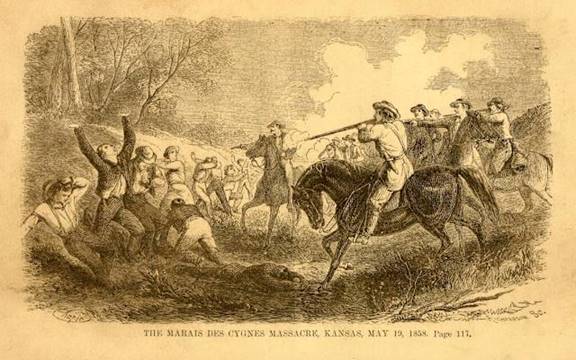
“They went from farm to farm gathering up those they thought were free-state men. Took about a dozen of them to a ravine and shot them down in cold blood. Some of them survived.”
“The place is called Marais des Cygnes.[2] They killed Bill Stilwell.”
People groaned. William Stilwell was a local farmer, known and respected by all around Sugar Mound.
Then an eyewitness, Asa Hall, arrived. The attackers had missed him with their first volley. He purposely dropped with the wounded and dying men and played possum. When two of the assassins came down into the ravine to administer the coup de gras, they assumed he was dead as they searched him for valuables.
“Tell us what happened.”
“They caught us off guard and rounded us up one by one. After a while, they let the old men and boys go. They let one feller go because he was wearing a Masonic ring. Then they herded us into a cut and made us stand in line. It was Hamilton hisself that gave the order to make ready and take aim. The rest of them seemed a bit skittish. One of them turned his horse away and said he wanted nothing to do with such a God-damned piece of business. As he waited to be shot, Hairgrove said, ‘Gentlemen, if you are going to shoot us, take good aim.’ Then Hamilton pulled out his revolver and started firing. The others all joined in. Afterward, a couple of them dismounted and shot the wounded. I don’t know how I kept from shakin’ while I was trying to look dead.”
“So, which way did they go?” asked Sheriff McDaniel.
“Not sure. Before they shot us, I heard them say they had a list. That probably means they were after more free-soilers.”
The Sheriff and Colonel Mitchell began organizing a posse. Montgomery, who had been away, soon joined them. After making sure Margaret was taken care of by the rear guard and the good women of Linn County, Reuben accompanied the posse. By dusk, they were headed east toward the massacre site. Arriving, they found the area deserted by friend and foe. Hamilton and his murdering posse must have fled to Missouri.
They rode all night to West Point, where Hamilton was known to hang out. Halting the men at dawn, Sheriff McDaniel sent a small group of men into town to confer with the townspeople.
“That’s a mistake!” insisted Montgomery. “They’ll be warned and slip out of town.”
McDaniel refused to change his plan but ordered a few men to cover the other road leading out of town. As the advance group was conferring with the townsmen, several men were seen leaving town. Montgomery gave chase, catching but one straggler. After interrogating the man, nothing incriminating was found. They turned him loose. Later, they learned Hamilton was on his way back to his home state of Georgia. It would be five years before a lone member of the raiding party was caught, tried, and hanged.
The news of the Marais des Cygne Massacre spread like wildfire throughout the nation. Even Southern papers condemned it. Whittier wrote a poem which included these lines:
The foul human vultures Have feasted and fled; The wolves of the Border Have crept from the dead.[3]
Kansas was once again in crisis. Strong leadership was needed to right its course and restore peace. That leadership came with James W. Denver, the fifth territorial governor in the four-year existence of the territory. Denver assumed his duties as governor with some reluctance. On January 4, 1858, he wrote his wife, “If they will only let me turn over the government to some of them in four or five weeks I will give them a pledge never to put my foot inside of their Territory again. Confound the place it seems to have been cursed of God and man.”
Despite his reservations, he became an able administrator who could keep the disparate factions in Kansas politics from waging open war on each other. One day in June, Margaret was reading the Lawrence Herald of Freedom while the baby slept.
“This article is about Governor Denver’s Fort Scott truce. Will it hold?” she asked her husband.
“I hate to see Hamilton and Clarke get away with their murdering an pillaging, but I guess I can live with it if the trouble ends. Montgomery sees it as offering all of us an amnesty.”
“Well, here’s what the Governor said, he’ll withdraw the troops from Fort Scott and put them on the border with Missouri. Elections for new officers will be held in Bourbon County. Old arrest warrants will be cancelled unless they can be properly authenticated. The militias of both sides will be disbanded.”
“That is what we wanted. Now that we have a majority of voters, the elections will give us better men in office. Montgomery has promised to lay down his arms and disband our little Sugar Creek Company. If the Ruffians don’t hold to their end of the bargain, we can always take to the field again.”
“God, I want peace. A war zone is no place for little Rosellen to grow up in. I am ready to pack us up and leave if there is any more trouble.”
“If the other side keeps the agreement, we will have peace.”
The peace did hold through the summer of 1858. Everyone was too busy with the abundant crops in their fields to care about fighting. With everyone tending, not burning, the crops, Kansas became a land of plenty. Confidence in the future was buoyed. More Free-State settlers poured in. Land prices soared. In August, Kansas was finally rid of the hated George Washington Clarke. Instead of firing the Bushwhacker who masqueraded as the government land agent, President Buchanan appointed him Purser of the Navy. US Army troops escorted him safely to the Missouri border. Kansas was a safer, better place without him.
The main threat to peace in Linn County in Linn County was the arrival of the notorious abolitionist, John Brown. He came riding in on a tall, strong chestnut horse, gazing warily about for any sign of his enemies. He settled on Sugar Creek under the pseudonym Sibel Morgan. He planned to punish the pro-slavery faction by robbing them and taking their slaves. He was no stranger to violence. He had murdered five men at Pottawatomie in 1856. At first, Brown was made welcome by James Montgomery. Later, they would clash over Brown’s tendencies toward reckless violence. Montgomery told the Sugar Creek men that Brown kept his own counsel and he would not be responsible for any trouble Brown brought down on Linn County. Fortunately for the maintenance of the peace, Brown took ill and was unable to pursue his violent intentions. The fragile peace held into the fall. Then all hell broke loose again.
For the DeLay family, the peace ended one dark September night. Margaret was up late with their colicky baby. Hearing a noise, she peeked out of one of the gun slits in the wall.
“Reuben! Someone with a torch is out by the corral!”
Reuben rolled out of bed, grabbed his revolver, and made for the door in his drawers. Outside, he saw a couple of men shooing the horses out of the open gate. He immediately began firing. There were three measured shots to scare off the intruders and summon help. It worked. The men abandoned their task and raced for their horses. They were gone in seconds.
Then Reuben noticed the fire. They had torched his little barn. The hay inside was burning fiercely. There was no saving it. He went inside, threw on some clothes, and went after the horses. By the time help arrived, he had them back in the corral, and the barn was a smoldering ruin.
“Did you see them?” queried his neighbor, Saul Barnes.
“Nope. It was too dark. Couldn’t tell if it was Border Ruffians or those robbers from Bourbon County.”
“I hear them buggers from Fort Scott have been itching to start pilfering again. After Denver negotiated the truce, they lost their means to get money for drinking and gambling.”
“That is the last straw!” shouted Margaret. “Tomorrow, the baby and I are off to Iowa. Papa says we can come home any time. This is no place to raise a child, let alone two!”
That was news to Reuben. It was the first he had known they were expecting again.
“But dear, the place is just starting to pay off. Another year and we’ll be in the black.”
“I don’t care. I can’t stand another day in this wretched place. If the bandits don’t ruin you, the grasshoppers will.”
Reuben knew there was no changing her mind. He’d have to send her home while he sold the place and closed out his affairs. His sojourn in Kansas had been a failure.
“This court is now in session. Would the defendants please rise?”
The three men looked around as if seeking allies in the crowd. Two of them slowly began to stand.
“Git yer sorry ass up!” demanded the farmer serving as both guard and bailiff. He nudged the reluctant man with the butt of his Sharps rifle. The Squatters Court of Linn County was in session. The judge was another free-soil farmer, Ben Searles.
“State your name and residence,” ordered “Judge” Searles pointing toward the first man.
”Isaac Jones, Linn County,” said the first man.
“You are charged with stealing and butchering three hogs from the Silas McKay farm on or about March 25, 1857. How do you plead?”
“I am innocent and I don’t recognize the legitimacy of this court. Try me at Fort Scott before Judge Williams if you must.”
“The good citizens of Linn County do not recognize the authority of slave courts. I will record your plea as not guilty.”
The remaining defendants also plead not guilty.
“Is there anyone here that will speak for the defense?” Searles asked.
“I will.”
“And you are?”
James Snider of Clinton County, Missouri.”
“How do you know the defendants?”
“Two of them were my neighbors back in Missouri. I was partners in business with the other, Mr. Jones.”
“Place your hand upon this here Bible. Do you swear to tell the truth and nothing but the truth, so help you God?”
“I do.”
“Would you please tell the court why you think these men are innocent?”
“These men are good, God-fearing citizens. I have never known them to steal, lie, or cheat. They cannot possibly be guilty of this crime.”
“Where were you during the last week of March of this year?”
“Home in Clinton County.”
“Did you see any of these men on or about March 25, 1857?”
“No Sir.”
“Sit down. Are there any other witnesses for the defense?”
The crowd looked around, but no one stepped forward.
“Alright. Does the prosecution have any witnesses?”
“We do, Your Honor,” said a man acting as the prosecuter.
“Where is he!”
“Here, Your Honor,” said a man in the crowd.
“State your name and residence.”
“Mel Wagner, Linn County, Kansas.”
“Put your hand on the Bible and swear to tell the truth”
“I, Mel Wagner, do solemnly swear to tell the truth.”
“How do you know the defendants?
“I’m a neighbor of Isaac Jones. I’ve seen the others around Sugar Mound. I’m the owner of the hogs they stole.”
“Describe the theft.”
“On the night of March 25th, I was awakened by my dogs barking. I checked my place and found the gate open to the hog pen. Three hogs were missing. The next day I confronted Jones, who had given me some trouble before. He sneered at me and acted pretty damn guilty. Then I checked his barn and found the other two rascals there busy butchering three hogs.”
“Did anyone see them take the hogs?”
“Yessir. Ab Jenkens came along on the road as they were herding them into the Jones place.”
“Is Jenkins here?”
“Here I am Your Honor.”
“Come up here and get sworn in. Do you swear to tell the truth on this here Bible?”
“Yep.”
“Tell the court what you saw.”
I come up the road early that mornin’ and saw three men herding three hogs onto the Jones place.”
“Are those three men here now?”
“Yep. Them thar’s the ones,” Jenkins said pointing to the defendants.
Someone in the crowd slapped his leg and shouted, “Guilty! A few protested with “No!
Searles banged the butt of his revolver on the table and hollered, “Order! We will decide the guilt or innocence of these men by secret ballot after we’ve heard all the evidence. Every man here is empaneled as a juror. Are there any more witnesses?”
There was no answer.
Searles banged his pistol on the table again. He looked sternly at the assembly. “Each of you will come forward one at a time and mark your ballot. We’ll use my hat.”
Reuben took his place in the line to vote. It was the first time he had voted on anything. When his turn came, he wrote guilty on the paper, folded it in half, and dropped it into the hat. The final vote was sixteen to five. The five were relieved that Davis had let them vote by secret ballot. Maybe their farms wouldn’t be visited by the Sugar Creek Company that night.
“You men are guilty of the theft of the hogs as charged. I sentence you to pay fair restitution to Mr. Wagner. I also assess ten dollars in court costs, payable immediately.”
There were cheers from the free-state men in the group. They knew that “court costs” meant they would soon enjoy a jug of Searles’ whiskey. Reuben stayed for the party but didn’t imbibe.
His civic duties finished, Reuben left for Westport a few days later to pick up his bride. He was there as the steamer Paul Revere was docking. He studied the passengers anxiously. The slaves who served as deck hands tossed a rope to men on the shore. Soon it was tied up fast and the ramp lowered. Margaret was one of the first to disembark. She dropped her satchel as Reuben ran through the crowd.
“Reuben, I missed you so much!”
There was a long embrace and warm kisses. “Did you have a good trip?”
“The boat stopped at a few places in Missouri where I didn’t feel welcome. They even searched my cabin looking for guns and abolitionist newspapers. Telling them I was from Polk County, Missouri helped.”
“I’ve got a lot to show you when we get to our place. I think you are going to like it.”
“Oh, I can’t wait. I’ll have so much to do turning our cabin into a home.”
Reuben gulped and said, “Well it’s still pretty rough. The walls are up and the roof is near done.”
“It will do just fine. Did the stock make it through the winter?”
“It was a bad one, but the grazing association got them all through. We’re getting some calves now.”
“I can’t wait to see the place.”
Soon Reuben had the luggage loaded in the wagon. There was so much he wondered what the fare had been but didn’t ask.
The trip back to Linn County helped them catch up on the news. All was well back in Iowa. Reuben had plowed another ten acres. The neighbors were nice. The wagon rolled on.
“Oh my, it’s beautiful!” exclaimed Margaret as she got her first glimpse of the farm. The cabin was set near the sugar maples that lined Sugar Creek. There was a lush green carpet of new grass in the pasture. The freshly plowed fields were neat and orderly. Margaret could see the small front window she had insisted upon. She frowned a bit knowing she’d have to shorten the curtains she had brought with her. Reuben had made the window just the right height to place his Sharps on the sill if he had to defend the cabin from bushwhackers. There were small rifle slits in the other walls. He had started a wall of rocks around it to provide further protection. The daffodils he had gotten from Clarinda Montgomery were now in bloom.
“I love it!”
Reuben picked her up playfully and carried her across the threshold. They were home. The next few weeks would be a buzz of activity as they improved upon the place. Margaret learned to cook on the hearth of the stone fireplace. The neighbors came to meet her and finished the roof.
By summer the couple had the cabin livable. The furniture was crude but functional. The crops were doing well and livestock were thriving. It was all thanks to their hard work. The threats from the pro-slavery faction continued to diminish as more and more free-state settlers poured into Kansas. Southeastern Kansas, including Linn and Bourbon Counties, remained contested ground.
Twenty miles to the south of Linn County was the town of Fort Scott. It had become the center of pro-slavery agitation. It was full of drunks, gamblers, and other hangers-on who were quick to use the pro-slavery cause as an excuse to abuse and rob the free-soil settlers. The federal judge at Fort Scott, Joseph Williams, demonstrated his pro-slavery sentiments in his rulings. He protected the men who raided Linn County when they returned to their sanctuary. The Sugar Creek Company was constantly on alert for raiders whether they came from Fort Scott or Missouri. They had to be ready to counter any threat.
“I have information that our ‘friend’ George Washington Clarke is planning another raid,” Montgomery told his assembled company. They’ll be coming from Bourbon County on Monday afternoon. They plan to catch us off guard in the night. I’m going to stop them. Who is with me?” Montgomery calmly asked his men.
Reuben joined a chorus of “I am!” responses. It was time to stand up to Clarke. A spot on the Leavenworth to Fort Scott Road was selected for the confrontation. The men went home to gather and clean their guns. They would reassemble on Monday morning and await the raiders.
The site for the company to make its stand was a narrow passage through a grove of trees. Montgomery issued strict instructions to the men before they took their places behind rocks and bushes.
“Remember men, we are not here to commit murder. No one shoots unless we are fired on. Once Clarke’s men fall into our trap, I will go out on the road and explain their peril. If they agree to lay down their arms, I want two men, you, Schmidt, and you, DeLay, to come out and help me disarm them. We’ll take their horses and guns. They can walk back to Fort Scott. Any questions?”
“I’d sure like to settle a few scores,” said one of the men.
“We are not here to start further trouble. If we teach them a lesson, that will be enough. We don’t want another Pottawattamie Massacre. If we start shooting with the advantage of our position and arms, we’ll kill or maim most of them. That will bring the Federal Army down on us and alienate our friends and the papers. We win by showing restraint and voting in larger numbers than they do. Kansas will never be a free state if we overreact.”
Montgomery’s men took their hiding places. With their Sharps rifles at the ready, each man had a commanding view of the road. In-spite-of Montgomery’s admonition, a massacre remained a possibility. All eyes were focused on the road coming from Fort Scott.
“Let them pass that dead tree over there. Then show yourselves, but don’t shoot,” commanded their leader.
Reuben stared down the sights of his rifle, practicing aiming at rocks and b ranches along the road. If he had to shoot, he was ready. He understood why Montgomery urged caution though. He hoped for a peaceful outcome. Then he saw the column of riders approaching. It looked like about twenty-five mounted men. Some carried rifles and shotguns across their saddles.
The invaders had almost reached the dead tree when one of the defenders’ horses reared and whinnied. Clarke raised his hand to stop the column. He motioned his men to fan out and envelop the ambush site from the sides. The element of surprise had been lost.
Ka pow! One of Montgomery’s men fired a warning shot. Clarke’s horsemen began to retreat. A few tried to get off a shot before they left. Montgomery’s men fired a few shots after them.
“Hold your fire!” roared Montgomery.
Fortunately for Kansas history, the frightened riders had skedaddled out of range. None had fallen from their saddles. It was good, however, that they had been driven off. Perhaps they were now forewarned of the dangers of raiding into Linn County. The Sugar Creek Company had faced down the bushwhackers from Fort Scott. No blood had been shed. Perhaps, they wouldn’t come back.
The best hope of the settlers of Linn County was that a legislative solution might resolve the slavery issue once and for all and ease the tensions. That would be a long and convoluted process. That Fall, some Kansas delegates were toiling away in Lecompton. They were working on a constitution that would see Kansas enter the Union as a slave state. In typical Kansas fashion, the Free-Soilers had boycotted the election for the convention delegates. This gave the opposition a free hand to draft a pro-slavery constitution. In the middle of their deliberations, a new state legislature was elected. This time, the Free-State side won both houses. The Lecompton Convention began to realize public sentiment was no longer on their side.
“I’m confused,” Margaret said quizzically. “Why are there two votes on Lecompton?”
“That’s an easy one,” answered Reuben. “Kansas has two governments, one slave and one free. We don’t vote in their elections, and they don’t vote in ours. If we all voted together, we’d probably have to shoot each other. The exception was the vote for the legislature. We knew they’d cheat, but we won anyway. Shucks, they turned in a whole bunch of votes from people on the Cincinnati, Ohio City Register. Then, wonder of wonders, Governor Walker threw out those votes. That pulled the rug out from under the Lecompton cabal. They know they are outnumbered, but they’re holding a rigged election on their slave constitution anyway.”
“Rigged? How so?
Reuben frowned, “The way it is worded we lose either way we vote. It should be a straight yes or no vote, but it isn’t. We’re boycotting it and we’ve scheduled our referendum for January 4th.”
“Let me see if I understand. The December vote is for the Lecompton Constitution with or without slavery. What’s wrong with voting for the Constitution without the slavery clause?”
“The way the proposition is written, a vote for the Constitution with the no slavery clause doesn’t prohibit slavery.”
“Doesn’t prohibit slavery? It says Constitution with no Slavery. How does that mean Kansas keeps slavery?”
“It’s a trick. The clause only prohibits the importation of slaves. It lets the enslavers keep the slaves they have and there is nothing to keep them from sneaking more in. The vote we scheduled in January has three options; No on Lecompton, Lecompton with Slavery, and Lecompton without Slavery. If we turn out the vote, the Constitution will be defeated. We won’t get to become a state, but at least we can go back and write a better Constitution.”
“Politics,” fumed Margaret. “So exasperating. If women could vote we’d fix this nonsense in a heartbeat.”
Reuben chuckled but didn’t take the bait. Women’s suffrage wasn’t going to happen anytime soon.
The first vote on the Lecompton Constitution was held on December 21, 1857. As expected, the Free-Soil Kansans boycotted the vote. The Constitution with the Slavery Clause passed overwhelmingly. The Free-State side remained confident that their vote scheduled for January 4th would be far more decisive. The three options seemed fair to both sides. Perhaps Popular Sovereignty would work after all.
Before the vote, Reuben and Margaret would have Christmas to celebrate. They made little things for each other; a knitted scarf to keep out the cold; a pair of carved wooden candleholders. Life would get even better for them in the new year. It had to. They were expecting their first child!





 Outlaws, Outrages and Outright Lies