I am in the process of converting my research on the life of my ancestor, Reuben DeLay, into a work of historical fiction. As each draft chapter is completed, I will post it here. Readers are invited to follow my blog to stay up-to-date on the book’s progress at:
I would appreciate any input you might have on what I have written. your thoughts, criticisms, suggestions and encouragement keep me on track and motivated.
If you are willing to becomie a Beta reader or Editor, let me know in the comments.
The man had jumped into the road from behind a bush. The first shot from his pistol was a warning, aimed over Reuben’s head. Now the gun was leveled at him. Before he could even think about grabbing the musket by his side, two more men emerged from the bushes on each side.
“Don’t even think about it!” one of them growled swatting the gun out of Reuben’s reach. “Who are you and where are you from?”
Reuben cursed himself for not following Montgomery’s advice. These men were probably the posse members he had been warned about. He would have to think fast.
“I’m Reuben DeLay from up in Putnam County.”
“Putnam County, Missourah?” queried his interrogator.
“Yep,” Rueben answered nodding.
“You know Sheriff Martin up theah?”
Reuben sensed a trap. He had no idea who the sheriff of Putnam County was and he suspected the posse man didn’t know either.
“Martin? You must be mistaken, Sir. The sheriff there is old Zach Brown. He’s been sheriff since I was a kid,” Reuben lied. “Man has a damn fine reputation for catching runaways. He has all but shut down that damn Underground through Iowa.”
“I spose I could be mistaken,” grumbled the man. “You kinda sound like one of them Yankees though.”
“We do talk a bit different in Putnam County than y’all do down on the river, Reuben conceded. We’re still sons of the great state of Missourah though,” Reuben said with pride in his newfound accent.
“What business you got in these parts?”
“Like everyone else, I’m looking for some land. All the good tracts hereabouts seem to be taken though. Looks like I’m gonna have to look farther west.”
“That feller there is fixin’ to quit his claim,” the man said pointing to the third posse member who had yet to speak. “If’n yer not one of them damn abolitionists, he might make ya a deal”
Reuben set the brake and climbed down from the seat. He stuck out his hand as he approached the man with the land.
“Good to meet you Sir. I’m Reuben DeLay,” he said. “Maybe we can do business.”
“Tom Bayliss,” said the man extending his hand. “Pleased to meetcha.”
“So where’s this land??
“Right over theah,” was the response as the man pointed over his shoulder. “It’s a good place, but I don’t want to move my family here because of all the trouble that damn Montgomery and his cutthroats are causin;”
“Who is Montgomery?”
“That would be James Montgomery. He’s one of them Campbellite preachers who turned his back on the South. We burnt him out once. Instead of leavin’ he built a fort and organized a bunch of raiders. They hit my place the other night.”
“Well, that’s too bad. I hope they didn’t do you much harm.”
“They burnt mah cabin and ran off some of mah stock. I got off a couple of shots. I mighta’ hit one of them S.O.B.s.”
“I sure would hate to take advantage of your troubles, but if you’re gonna sell, I’m interested. How many acres?”
“Bout two hunnert. Good fer grazin’ an’ plowin’
“Can I take a look?”
“Sho nuff. These here fellers can stay and guard the entrance.”
“Hop in,” Reuben said as he launched himself back into the wagon. “Can’t wait to see it. Mr. Bayliss.”
Bayless pointed out the key features of his place as the team plodded along.
“Got access to Sugar Creek over thar. Turned the sod to plant some corn on yon meadow. Corral is still in good shape,” he said as the wagon approached the smoking ruins of his cabin.”
“I like what I see.”
“If’n yer strong enough to hold it, it’ll be a good place fer ya. Just don’t let no more of them damn Yankees come into the valley.”
“Are there any neighbors I can count on for help?”
“Not many. The fellers helpin’ me guard the place are from Bourbon County. There’s still some good Missourah folks over by Trading Post. The county officials are all Southerners. Sometimes we get help from across the line. They come to vote on election day and help us keep the free-staters away from the polls. You didn’t hear it from me, but they’re plannin’ another raid against Montgomery and his abolitionist friends.”
“Now, that sounds interesting. I will be careful who I hang with. It’s a damn shame you have to leave, but I understand. Is the land paid for?”
“Nah, I filed the papers and figured I’d pay up when I got a few crops in.|
“By my calculations, you owe the government about $250 for the land. So, what is it you want for your claim?”
“Forty Dollars oughta do it.”
Reuben looked about thoughtfully. The improvements Bayliss had made didn’t amount to much. His cabin was gone and the wagon sitting by it was a wreck. There was little to justify the man’s demand for forty dollars.
“Can we make a trade?”
Bayliss scratched his chin and thought for a moment. His eyes wandered as he visually inspected Reuben’s wagon.
“I need to be able to haul my belongins back to Arkansas. I’ll take you wagon and the two dray horses.”
Reuben countered with, “I need one of the horses for plowing. You can have the one on the left and I’ll swap my wagon for your broken one.”
Bayless grimaced and pretended to think a minute. “You drive a hard bargain, DeLay, but I’m gonna take it.”
Reuben dug into a trunk in the wagon and brought out his writing materials to make out the quit claim. Not being lawyers, the two men struggled over the wording.
“I, Tom Bayliss, do hereby transfer the below-described claim on Sugar Creek to Reuben R. DeLay…..”
Once satisfied with the document, they returned to the main road where the two posse men witnessed their signatures. They spent the rest of the afternoon loading Bayliss’ possessions on the wagon.
Bayliss harnessed his saddle horse and the old plug Reuben had traded him to the wagon and headed down the trail. Neither man knew they would one day take opposite sides in a cataclysmic civil war.
As soon as Bayliss disappeared down the road, Reuben saddled his horse and made a detailed inspection tour of the land. He was pleased with what he saw. The grass was already tall and green. Sugar Creek was easily accessible to his animals. There was abundant timber along its banks. The field Bayliss had plowed showed promise of fertility.
He had brought a wagon load of basic farming tools from Iowa. He made a mental list of the other things he needed; seed, canned goods, coffee, and a few chickens. He had to find a wheelwright and some boards to fix his new wagon. Most of all, he needed a good revolver.
That evening he cut some poles and pitched his canvas shelter. Then he built a fire. It was time to write a letter home.
Dearest Margaret, he began.
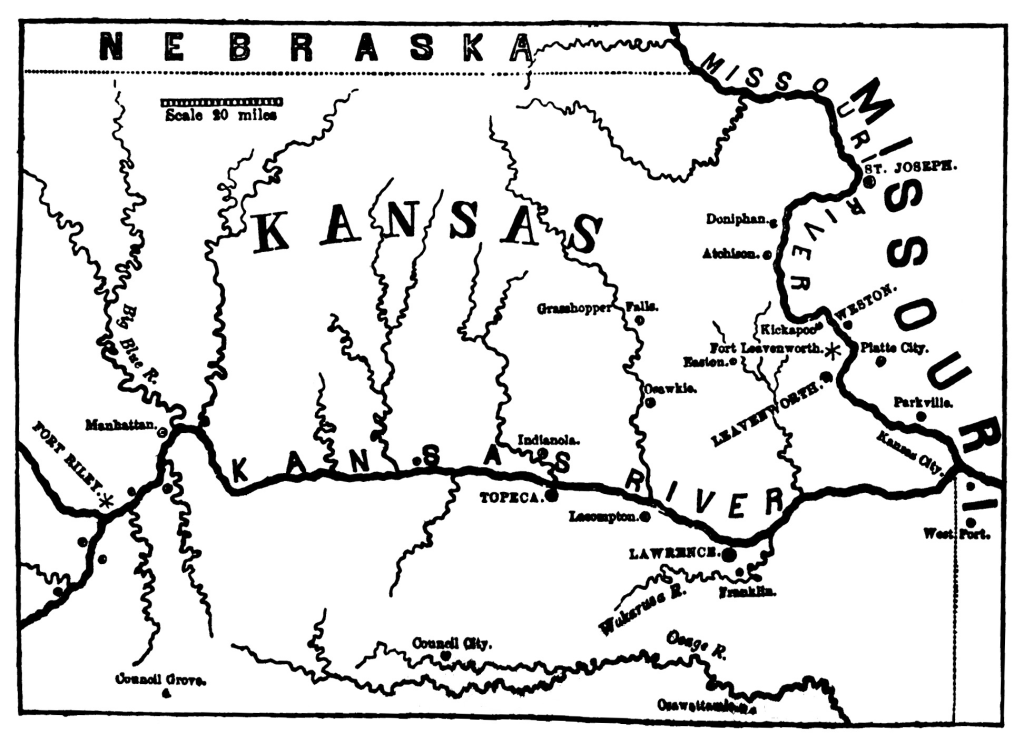
We have a fine place now. It is in Linn County, about 80 miles south of Kansas City. The grass is lush and the creek flows freely. The soil is dark and fertile. We have plenty of wood to build our cabin. You will love the open air and the freshness of a Kansas morning. It will be the perfect place to start our family.
I made a good trade for the land. I got a man from Arkansas to quit his claim for one old horse and the wagon. The first two good years will pay off the $250 we still owe the government land office. I’ll build a cabin before you come next year.
The troubles in Kansas are not as bad as I had expected. I have met men on both sides and no one has shot me yet. The squatter I bought the claim from got run off by my free-state neighbors. They have banded together to support each other. If there’s any trouble, they have a signal to bring help. I expect the free-staters to prevail. This country isn’t suited to slavery and plantations.
I do miss you terribly. I remember the comfort of your sweet caress in my dreams. I can’t wait to make you mine and bring you to this good land. Do continue to keep me posted on the wedding plans. I hope Uncle Jacob can do the ceremony.
Give my love to your folks and mine. I’m sure I’ll have a few adventure stories to tell when I return this winter. (Some of them might even be true!)
You loving man,
Reuben
p.s. Could you check and tell me who the sheriff of Putnam County, Missouri is? I’ll explain later.
These are perilous times. In less than two weeks our new president has broken every norm, made a mockery of our democratic values, destroyed the Rule of Law, disrupted the economy with tariffs and freezes, jeopardized our health, and demoralized millions of Americans.
He is trying to create chaos to anger the American people, including his own supporters. (Sorry, it was never about you.) There is a reason for this madness. He expects We the People will take to the streets in protest.
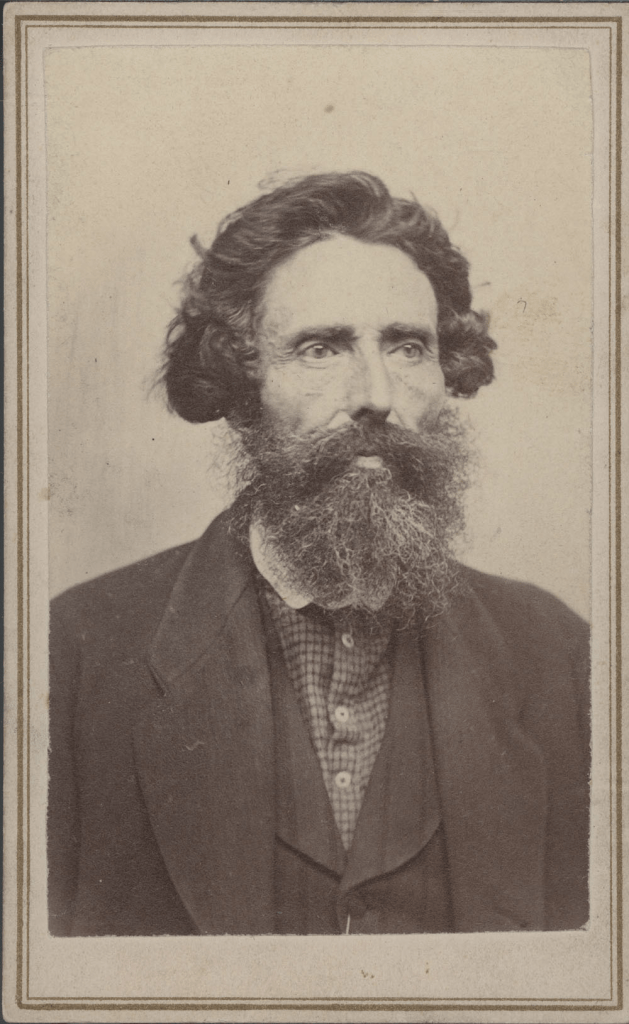
“Hold up there!” called someone from behind. Startled out of the monotony of the trail, Reuben looked back. A rider was approaching. He looked like a rough, crude frontiersman; shaggy beard and all. Reuben brought the wagon to a halt and waited.
“Hello friend,” said the man as he approached Reuben’s perch on the wagon seat. “I’m James Montgomery,” he said putting out his hand.
“Reuben DeLay,” he responded extending his hand for a firm, friendly handshake.
“What brings you to Linn County young man?”
“Fixin’ to settle if I can find the right place..”
“Where do you hail from?”
Reuben paused. He now understood that being from the wrong place could cause problems in Kansas. “Why do you ask?”
“Well normally it would be none of my business, but if you happen to come from somewhere up north, you might want to be on the lookout for the Bourbon County Posse.”
“Posse? What are they looking for?”
“They’re patrolling this road to see that no Free-Staters try to settle here.”
“Now that doesn’t sound very neighborly. Aren’t they a little bit out of their jurisdiction?”
“Bourbon County is full of squatters from Missouri. They mean to make Kansas a slave state.”
“Looks like some of your local folks feel the same way. I ran into a man named Morgan a few miles back. He didn’t seem to like that I was from Iowa.”
“Morgan’s a hard case. He came over here from Missouri to stir up trouble. He’s been telling the Missouri Ruffians and the posse who to drive off. You’re lucky he didn’t shoot you in the back.”
“He had a colored slave who seemed a whole lot friendlier.”
“That would be Sam. There are maybe a hundred slaves like him in the whole territory. Their owners figure it’s too easy to escape here, so they leave them home. Yet they want the whole of Kansas to become slave country. I’d help Sam, but he’s got family back in Missouri. He can’t leave them behind and it’s hard to get all of them to the Underground.”
“That’s kinda low, using a man’s family like that..”
“I’m working with some folks to get his family freed so I can spring him at the same time. We’ll probably send them all through Iowa. Do you have any contacts with the Underground?”
“I might, “Reuben responded cautiously. “I’m not sure I should be takin sides though.”
“You need to choose. This is no place for folks who are afraid to fight for what’s right. Two years ago, we had a lot of Quakers come here from Pennsylvania. They figured they were doing the Lord’s work by plowing a few acres and voting to make Kansas free. None of them were willing to fight though. Most were gone before their first harvest was done.”
“Driven off? asked Reuben.
“That’s right. This is no place for folks who can’t stand their ground. It appears you have a lot to learn about Kansas. Mind if I ride along for a spell?”
Reuben made room on the wagon seat and said, “Hitch your horse in the back next to mine and we’ll talk a spell, Mr. Montgomery.”
Montgomery dismounted, tied his horse’s reins to the wagon, and pulled his rifle from its scabbard. Reuben noted that it was the very latest in modern rifles; a breech-loading Sharps.
“You need that?” queried Reuben as Montgomery climbed aboard with the riffle.
“I get shot at regularly. Last year they burned me out. If you want to settle here, you need to defend yourself and fight for what’s yours.”
“I was hoping not to get involved with your troubles. All I want is a piece of land.”
“Maybe you should be looking for a place in Nebraska. In Kansas, we fight.”
By now, Reuben realized Montgomery was far from the rough-cut frontiersman he first supposed him to be. The conversation revealed him as a thoughtful, educated man. His zeal for the free state cause was also obvious.
“I had hoped I wouldn’t have to take a side.”
“This is Kansas. No one is neutral here.”
“So, tell me how am I supposed to make a go of it here.”
“Now we’re getting somewhere. First, you need to be more alert. I was well within pistol range before I hollered at you back there. You could have been dead, bushwhacked by a posse. Keep your weapons close and look for safe places to hole up. If the posse catches up with you, don’t tell them you’re from Iowa. Are you familiar with any places in Missouri?”
“Yes, Appanoose County is right on the border. We did business in Putnam County.”
“OK. Any time you deal with territorial officials, the Land Office, or anyone who talks, looks, or acts like a Southerner, you are from Putnam County, Missouri. Don’t be afraid to drop a few names. Make them up if you must.”
“I guess I can do that. I learned from my encounter with Morgan that it’s Missour-AH, not Missour-EE.”
“GooD! Now, why is it that you don’t have strong feelings about human bondage?”
“Well,” stammered Reuben, “I know it’s wrong, but I never figured I could do much about it.”
“You need to make up your mind right now!” barked Montgomery. “If you don’t have the gumption to take a side, you don’t belong in Kansas. You might as well turn this wagon around and head back to Iowa with your tail tucked between your legs.
“Are you a man of faith?” Montgomery continued.
“Yes Sir.”
“And what does the Lord, your God, tell you about slavery?”
“My Uncle Jacob is a man of the cloth and calls it an abomination.”
“Well son, you should have listened to your uncle. Slavery is an abomination. It is practiced by the meanest of men for the worst of reasons. It is a stain upon the soul of this great nation. Now its proprietors are trying to expand it onto this untainted soil. Slavery doesn’t belong anywhere, least of all in Kansas.”
Reuben nodded respectfully as Montgomery continued.
“See that tall grass around us? It was put there by the Almighty for our use. We can till it, use it for grazing, or harvest the honey, nuts, and berries that abound here. There’s plenty of wild game for the table here too. Deer, turkey, waterfowl, you name it. We’ve got everything except buffalo and you can find them a day’s ride to the west.
“All the Lord expects of us is to be good stewards. That means we take care of the land and work it in His name. If he wanted the land worked by slaves, he would have made you and me slaves. We can make this a promised land of milk and honey if we follow God’s will. So long as we are good custodians, it will sustain us for generations.
“Before I got here this was Indian country. They took care of it and left not a mark on it. Thanks to greedy Southerners, they have been forced to move on. The slavers from Missouri want to take their place and use up this land for personal gain while exploiting their fellow man. They care nothing about this land. They are here to extend the power of the slave-holding class. If Kansas comes in as a slave state, Colorado and New Mexico will become slave states too. This will give the South more seats in Congress and perpetuate their evil aims for all time. If the good Lord allows our side to prevail, the whole country will be free. You should understand that no man can be free until all men are free. I believe the Lord wants you to be on his side.”
James Montgomery was sounding a lot like Uncle Jacob. Their main difference was their domain. Uncle Jacob ministered in the safe environs of the free state of Iowa. The locals understood his aims and protected him. Taking such a stand in Kansas could get you burned out and run off the land. It might even get you killed. Men like Montgomery would put their liberty and lives on the line for a just cause.
“I didn’t come to Kansas to pick a fight. I’m here to find a place to settle on. I sold everything I had back in Iowa to get this outfit,” Reuben said pointing to the back of the wagon. “I’ve come too far now to turn back. I don’t want a fight, but I’m here and I’ll take a stand if need be.”
“Good. We need folks like you to fill Kansas up. That means fighting for your land and the end of slavery. It’s a good fight. I hope you don’t waver.”
“I can stand my ground if I have to. I hope I wont be standing alone though.”
“You won’t be alone. I’ve organized the free-state men along Sugar Creek for mutual defense. When one calls, we all respond. Three shots in quick succession bring a dozen armed men. Sometimes we organize retaliatory posses to get back at the bushwhackers. Thanks to our efforts Sugar Creek is mostly settled by free-soilers.
“We are having a meeting at my place next Thursday evening. That would be a good time for you to meet the men. You will, of course, need to convince them that you are with them to be accepted.”
“Are you saying there’s room for me on Sugar Creek?” asked Reuben.
“Funny you should ask. There’s one pro-slavery holdout from Arkansas that is about to leave. Some good folks visited him the other night and used a little persuasion. I hear he’s scared of his own shadow now. He still hasn’t paid the government for the land and you could buy out his claim with pocket money. The land is good; fertile and well-watered. His improvements aren’t much though. His cabin burned down the other night. Must have been an accident.”
Reuben winced at the idea of taking advantage of someone who had just been intimidated into leaving. He was starting to realize, however, that this was the way things got done in Kansas. The meek would not inherit this land.
“I suppose I ought to go see him then.”
“Good. Just remember when you talk to him that you’re from Putnam County, Missour-AH.”
Reuben didn’t like lying, but a white lie to accomplish the Lord’s work and get him set up in Kansas wouldn’t hurt much.
“I’m interested,” he said. “Just point me in the right direction.”
“Ok. We need to separate before we get to his place. It wouldn’t do for him to see us together. Just turn west up Sugar Creek from Sugar Mound. His place is two miles up on the left. His name is Bayliss, Tom Bayliss.”
“Well, I look forward to doing business with Mr. Bayliss.”
“Meanwhile you need to be more alert when you travel through these parts. Got any arms?”
“Musket back there,” Ruben said nodding toward the wagon box.
“Better get it out. Remember, three quick shots to summon help.”
“It’s a muzzle-loader. It may not fire all that fast.”
“Three shots,” responded Montgomery, holding up three fingers. “You might want to get a revolver. I’ll be taking my leave now. See you on Thursday.”
“Git offa mah property you damn Yankee som beech!” commanded the little man with the tobacco-stained teeth. “And stay away from mah Niggah, you heah?”
Reuben’s first encounter with the residents of Linn County had rapidly gone south. He could tell the little man meant business because his hand had moved to the grip of a very big Colt Navy Revolver.
“Didn’t mean no harm, Sir. I’m fixin’ to find me a place hereabouts. This here colored man is makin’ you some pretty good furrows with that John Deere plow. I needed to watch.”
“You best be a-gittin along.” barked the little man. “Maybe head on back to Ioway.”
Reuben released the wagon brake, shook the reins, and hollered, “Giddy up!”
The conversation was over, but Reuben had learned a few things about his new surroundings. The Black man plowing the field knew more about busting Kansas sod than his master. They had had a productive conversation.
“You a free man?” Reuben had asked as the man brought his plow to a stop near Reuben’s wagon.
“Nah Suh, I belongs to Massah Morgan”
“Where did you come from?”
“The Morgans have a tobacky farm in Missourah. They sent me and Massah heah to stake out a clain for plantin’. Massah’s gonna help Kansas become slave.”
“How does that sit with you?”
“Tain’t nuthin I kin do bout it. I’s born a slave and I recon I’ll die a slave. You white folks can talk all youse want, but nuthin ever changes.”
“Got family?”
“Wife and three chillen back in Missourah. Massah say he’ll bring ‘em heah soon as we make good. I ain’t sure how long that’ll be cuz Massah tain’t much fer farmin.”
“What happens if you don’t make good?”
“Don’t wanna think bout that. Massah might sell muh wife ‘n chillen down the river. They’s worth more in N’Orleans than they is in Missourah.”
“Well I hope that don’t happen then. If I had my say, Kansas will be a free state.”
“Well Suh, I hopes youse right. What brings you way out here?”
“I’m gonna get a place, raise some good horses and cows, and marry the purdiest gal in Iowa. This land looks like it might work for both farmin’ and grazin’. What’s the market for beef and grain?”
“Massah takes care of the sellin’ and we ain’t growed much. Mostly corn and wheat. Massah don’t know nuthin’ bout cattle, so all we’s got is mules for plowin’.”
“Is this the right trail to Sugar Mound?”
The Black man nodded.
“How far?”
“Bout three hours with a rig like your’n. Jes look fer a big ol’ hill wid a passel of Sugar Maples. Cain’t miss it.”
Both men looked up as a rider approached.
“Here comes Massah, I better be gittin me back wid dem lines. He don’t cotton much to sluffin’ off.” He grabbed the reins and prodded the mules to resume his task. The steel plow lurched forward and ripped into the virgin sod.
Reuben’s thoughts wandered as he waited for Mister Morgan to approach. It was always good to talk with a fellow farmer, even if he happened to be a slaveholder. The Black man plowing the field had been helpful. His well-cared-for mules were harnessed to a John Deere plow, just like the one Reuben had in the wagon. Reuben noted that the man’s furrows in the virgin Kansas sod were perfectly aligned. Each new cut lifted the sod and deposited it on its side in the previous furrow. The man plowing the field was good at his craft. Lucky is the farmer who can find someone to plow like that, Reuben thought. And it didn’t matter if that man was Black or White.
He first noticed that the man was Black when he turned the rig around. His well-muscled ebony arms held the plow steady as he began his return. His black face gleamed with sweat underneath his course straw hat.
Reuben knew that few slaves had been brought to the Kansas territory. There were even fewer free men of color there. Kansas was no place for growing cotton and tobacco, the two labor-intensive crops that fueled the slave trade. Moreover, many midwestern farmers coming to Kansas didn’t appreciate competition from Black labor, free or not.
Reuben knew a little about slavery. He had grown up in Appanoose County, Iowa, just a stone’s throw from the slave state of Missouri. The “Little Dixie” part of Missouri where slave-holding was economically feasible was only about a hundred miles to the south. He’d seen slaves on his occasional trips into Missouri. The slaves he had seen worked hard, often singing to relieve the boredom. It was not lost on Reuben that slavery had its darker side. He knew about the cruelties inflicted upon them by hired overseers. He knew that families could be separated and sold off at the whim of their owners.
Years ago, he had seen runaway slaves seeking aid at the DeLay farmhouse. His father, Joseph, provided them with food, and directions. Sometimes the DeLays sheltered them in the barn. All that ended with the passage of the Fugitive Slave Act of 1850. Slave hunters now had free rein to pursue runaways into Iowa. Local people and law enforcement officers were required to aid them or at least stay out of their way. It was a federal crime to harbor or help a fugitive slave in any way. A few of his neighbors were eager to collect the rewards for recovering the escapees. For Fifteen Dollars they would condemn a human being to eternal bondage. The captured runaways were often held in the county jail until their owners came to claim them.
After the 1850 law went into effect, some brave Iowans decided to resist. They became conductors and station masters on the Underground Railroad. They would hide fugitives from the “men stealers” and arrange for them to escape to the North. Chicago was the preferred destination for the runaways. There, they could book passage on a steamer to Canada. Only in Canada could they be free from the fear of capture and return to slavery.
Rumor had it that Reuben’s Uncle Jacob was involved with the Underground Railroad. As he got older Reuben found that the rumor was true. Jacob was a Methodist preacher interested in more than just saving souls. His faith told him to save men from the cruelties of slavery. For Uncle Jacob, slavery was wrong; a sin against God. He was also a man of action who lived his faith. Being a circuit-riding preacher he had the perfect cover for his nocturnal trips to the next station on the line.
Reverand Jacob DeLay had built a hidden cellar under his house for his charges. It was a risky business. Sometimes the slave-hunters would persuade the Sheriff to help them search Jacob’s place. Somehow Jacob always knew about the Sheriff’s intentions and moved his human cargo to safer locations. Though Uncle Jacob had been careful not to involve Reuben in any illegal activity, he was occasionally asked to mount a fast horse to carry a message or warning to some remote station on the line. It was exciting work for an adventurous young man.
Reuben well-remembered his Uncle’s passionate sermons on the evils of slavery.
“Man is imperfect and greedy. He easily falls under the Devil’s sway. Then he begins to sin to satisfy his wicked desires. Abominations abound in the mind of a sinner. The greatest of these abominations is SLAVERY!
“Slavery is the most base and ignoble practice ever undertaken by man. It is based solely upon AVARICE! Such avarice hardens the heart and makes men callous to the feelings of humanity. Ought we not be ashamed for not speaking against this evil institution that makes men chattel?
“The commerce in human beings causes our God to weep. The barbaric treatment of the enslaved rests on the consciences of all men, not just slave-holders. What have we done to end this abominable practice? Not enough, I think.
“Would you consent to the enslavement of your brother, your sister, or your neighbor? Then why do you countenance this abomination in these United States? Do you support the ripping of families apart for the sole purpose of profit? What profit a man if he loses his soul? Have you seen the lash marks of the overseer and looked away? Have you bought the produce of enslaved hands because it was cheaper? Do you greet the oppressed stranger as you would your neighbor? Were you not once strangers in a strange land? When your God asks you what you did about the chains and scars of slavery, what will you say?”
Uncle Jacob’s sermons got mixed reactions from congregations. Some folks, upon realizing the subject was slavery got up and walked out. They had their reasons. It was common for Northerners to fear the competition from freed slaves in the labor market. Others worried that liberated Blacks might corrupt the blood of the White race. Some just felt that Blacks were lazy, stupid, and inferior. Most Iowans of the day, however, showed at least some sympathy toward the plight of the enslaved. Though Reuben wasn’t a fire-breathing abolitionist, he believed that slavery was inherently wrong. When Uncle Jacob took up a special offering at the end of an anti-slavery sermon, Reuben would dig into his pocket. He understood well that the money went to support the illegal activities of the Underground Railroad. His Uncle was flaunting a bad law to achieve what he felt was God’s will. Perhaps Reuben would have to make that same choice someday. His move to Kansas was making it harder to ignore the issue. Much harder.
Helping Reuben make his choice was the little man with the big gun. The man wore a broad-brimmed planter’s hat with a tan linen coat. His face had the paleness of one who spent most of his time in the shade. Reuben suspected that a look at his hands would reveal he hadn’t spent much time doing real work. Besides the big Colt revolver, Morgan had a coiled whip over his shoulder. Though Reuben always gave strangers the benefit of the doubt, Morgan’s countenance seemed foreboding.
Could free and slave labor coexist in the same place he wondered? That was the issue the Kansas-Nebraska Act was supposed to solve. The decision on whether to become a free or slave state was up to the people who settled there. Senator Stephen Douglas, the bill’s author, called it “Popular Sovereignty.” Unfortunately, the bill had caused a race between settlers from the North and South to see who could fill up Kansas first. The majority would then decide the issue. This was already causing friction as Reuben drove his wagon into Kansas in the Spring of 1856. Early efforts to establish a constitution under which Kansas would become a state had caused considerable animosity. There were two competing constitutions, one free and one slave. In the case of the Lecompton Constitution, thousands of Missourians had been persuaded by free booze and transportation to spend a day voting as pro-slavery Kansans. The delegates sent to write the free-soil Topeka constitution were selected from the anti-slavery contingent. Neither side recognized the other and Congress was reluctant to approve statehood under either constitution.
Reuben sympathized with the free-soil faction but had not joined their cause. Men like Morgan were pushing him in that direction.
At first, Reuben and Morgan had discussed what crops grew well in this part of Kansas. The tone changed when he casually mentioned that the country looked like Iowa when his family settled there in the 1840s. As it turned out, Iowa was a land full of hostile abolitionists to slave-owning Southerners like the man he was speaking with.
Reuben should have known better. Ever since he crossed over into Kansas at Leavenworth, he found himself amongst dueling groups hell-bent on making sure Kansas would become either a free or a slave state. The Leavenworth crowd was decidedly pro-slavery. The territorial lawmen and the commander from the fort there were quick to intervene on behalf of the pro-slavery faction. Those with Free State sentiments were made to feel unwelcome, often by a nighttime raiding party. The Fugitive Slave Act was vigorously enforced. People who aided runaways faced prosecution.
It was a different proposition when he arrived in Lawrence. The area had been settled by rabid abolitionists from New England. They were there to do the Lord’s work of making Kansas free. Their tactics resembled those of the pro-slavery faction. If they couldn’t persuade those who didn’t share their opinions on slavery to leave, they burned them out. No wonder everyone in Kansas went about their business armed like they were going to war. Reuben had seen a man in Lecompton who had two pistols and a Bowie knife stashed in his red sash. He had a rifle slung over his shoulder and what looked like the hilt of a dagger sticking out of his boot. All he needed to complement his baggy costume was a Derringer in his front pocket. Reuben wondered if it was passed time to pull his old muzzle-loader from its protective blanket and oilskin cover. The locals were making him nervous.
Reuben still wanted to put the slavery issue to the back of his young mind. All he needed was a piece of land to call his own. There was a certain raven-haired beauty back in Iowa who seemed eager to share it with him. Like his father and grandfather had done, he intended to make a new life on the frontier. He wasn’t looking for trouble.
As the wagon jolted over the rough trail, he heard the sharp crack of a whip. Morgan was intimidating his slave with a near miss. Reuben felt a flush of anger.
HISTORICAL NOTES:
Reuben DeLay’s obituary says he first came to Kansas in 1856, settling in Linn County. Located on the Missouri-Kansas border, Linn County soon became a hotbed of activity in the contest to make Kansas either a free or slave state. This led to violence and intimidation on both sides of the border.
The fictionalized sermon by Jacob DeLay is based loosely on a 1774 sermon by Elhanan Winchester.
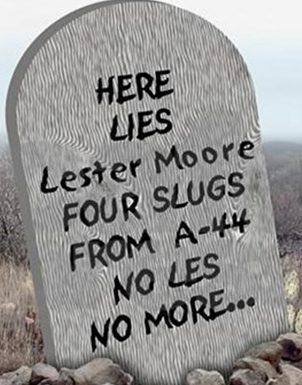
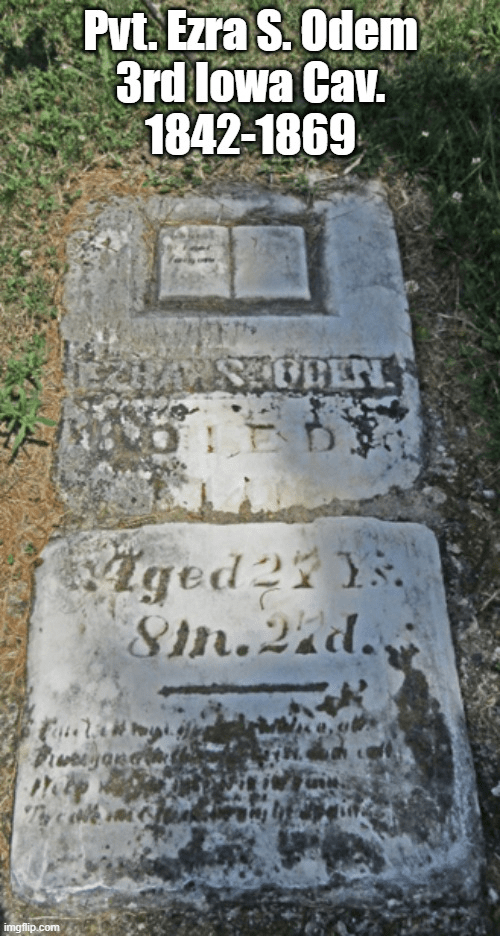
Grave Marker placed by the Grand Army of the Republic.
After a few days of recuperating at home, Reuben rode into Centerville. He had some letters to mail and was anxious to get fresh news from the front. The post office was in the back of the Square Deal General Store. As he strode up the steps a man leaving the store hunched over as if to avoid contact.
“Odem?” he queried. “That you Ezra?”
The man paused and looked up sheepishly. He was indeed Private Ezra S. Oden of I Company, Third Iowa Cavalry.
“Uh, good to see you, Lieutenant.” The man responded as if seeing a ghost.
“You made it?” Reuben asked incredulously.
“Yep. Though I ain’t findin’ much of a welcome hereabouts.”
Reuben thought he knew what Odem was talking about. The circumstances of his early departure from Andersonville were bound to put him under suspicion. Lots of suspicion.
They had been through a lot together. Long, dreary marches, moments of sheer terror under Rebel guns, losing comrades to disease, accidents, and enemy fire. Odem was one of the men Reuben had commanded to lay down their arms when the Tennessee Cavalry had them surrounded and outgunned. Odem was still Reuben’s responsibility as they went into the prison at Camp Cahaba and later at Andersonville. He was a good trooper who had served loyally and valiantly for three years. His choice was not a good one, but it was understandable. Collaborate or die.
Rebel officers had often come to Andersonville to recruit men for the Confederate war effort. The South needed men skilled in trades like blacksmithing, carpentry, shoemaking, railroading, and masonry to replace those lost to Confederate conscription. Skilled tradesmen were offered parole if they would serve the Rebel cause. Even more insidious were the efforts to recruit prisoners into the Rebel army. The Rebs had promised such men the moon; decent rations, good uniforms, enlistment bonuses, and free land at the end of the War. They were told the South would establish its independence upon winning the conflict. This would make all their sacrifices seem in vain. Men whose enlistments had already expired were prime targets of the recruitment effort.
There were few takers. Most of the prisoners would rather die than face the disgrace of serving the South. Those who did sign up were often professional bounty jumpers. These men had enlisted in the Union Army to collect the bonuses paid to enlistees. At the first opportunity, they would desert. Then they would travel to a different location to repeat the process under an assumed name. Many of the Raiders who had terrorized the prisoners at Andersonville were bounty jumpers. Some of these men had ended up joining the same Confederate artillery unit that had its guns pointed at the prisoners.
Odem had come to Reuben after one of the pitches by the Confederate recruiters.
“Sir, I don’t think I can last much longer in this hellhole,” he said. “My bowels are rejectin’ what little bit of food they give us and my teeth are getting loose from the scurvy. I need to get out of here.”
Reuben was keenly aware that his once-healthy men were beginning to waste away on the camp’s poor rations and contaminated water. Odem was probably in the worst condition of all of them. Even the wounded Solon was getting on better than Odem. The men in the camp were dying at a rate of 100 per day. Soon the I Company troopers would become part of that gruesome number.
“There are tunnels underway. Have you thought about escaping?”
Odem raised his downcast eyes. “I’m too weak to last long in them woods,” he said gesturing toward the pine forest surrounding the camp. “I’m not even sure I could climb a tree if’n the dogs ketch me.”
He paused for a moment. “I’m thinkin’ ‘bout enlistin’”
“You want to join the damn Confederate Army!” Reuben exploded. “What the hell do you expect to get from that?”
“My plan is to join up, get healthy, and desert Sir”
“You sound like one of those New York bounty jumpers. Plenty of ‘em have switched sides and become galvanized. What makes you think you can pull that off?”
“I’m fadin’ fast. It’s my only hope. It’s either stay here and die slowly or join ‘em and maybe die quick.”
“You know it’s long odds. If the Rebs find out, they’ll hang ya. If’n you make a break for our lines, you’ll be shot at by both sides. If’n you do make it to our lines, you’ll likely be shot as a deserter. I don’t see nuthin; good a-comin’ from it.”
“Hell, you know me. I kin talk my way outa anything. If I make it, I’ll let all the folks back in Appanoose County know yer alive. Maybe I can carry out some letters.”
“I cain’t tell you that it’s gonna be OK. At best, it’s desertion. People are gonna call you a traitor. I cain’t stop you, but if’n yer mind’s set, I wish you the best.”
The next day at Roll Call, Odem’s name wasn’t called. The men of I Company never mentioned their galvanized Rebel again. That is until Rueben met him on the steps of the general store.
“So how did you get away?” Reuben queried.
“That part was easy,” responded Odem. “After they assigned me to a unit, I jumped off the train near Atlanta. I walked toward the guns until I found the lines. Pretended to be a Reb returnin’ from furlough. Snuck through their lines when no one was a-lookin’.”
“And then?”
“Well, things got a bit complicated. I was in a Rebel uniform carrying an Enfield rifle when I crawled up to one of our pickets. He got a little twitchy on the trigger when I didn’t know the password. Made me drop the gun and stand up in full view of the Rebel works. Had to do me some fast talking to get him to take me prisoner. He didn’t believe I was an escaped Yankee. Neither did his Sergeant. A Captain interrogated me for an hour, then told a Colonel I was a Rebel spy. The Colonel, at first wanted me shot on the spot. He finally relented and sent me to Sherman’s staff where I was grilled about Rebel positions and strength. I figure I gave ‘em a good account as they passed it on to Sherman hisself. Then I was sent to the Memphis for Court Martial.”
“How’d that go?”
“Well, they decided I was a deserter, but under the circumstances, they gived me a dishonorable discharge. I had to walk most of the way back to Iowa beggin’ for food from farmers. Some of them folks in Tennessee and Kentucky don’t cotton much to Yankees, deserters or not.”
“So, how’s it been since you got back?”
“Folks don’t understand. There’s been words. Kids call me names and throw rocks at me. I don’t git out much. My Pappy keeps me busy on the farm. I’m headin’ west as soon as I kin.
Reuben knew he was the only person in Appanoose County who understood what Odem had gone through. The war was nearly over and it was time for the healing to begin. He decided he had to help Odem if he could.
“I need you in church with me on Sunday. Can you come?”
Odem looked back quizzically. Being in church with a bunch of his critics and tormentors was about the last place he wanted to be.
“Church?”
“Yeah, church. I got some things I wanna say to people. It may or may not go over well. I feel like I owe it to you. I may not have approved but you did what you had to do.”
The two men shook hands and Odem departed wondering what Reuben might have to say. He wasn’t looking forward to what was bound to be an inquisition.
When Sunday came, Odem held back on the street until he saw Reuben and the DeLay family enter the church. The Pastor shook Odem’s hand limply and mumbled a welcome. At least he hadn’t been ordered to leave.
Inside the sanctuary, he saw Reuben had saved him a seat. He walked the lonely aisle trying not to make eye contact with anyone. Then he sidestepped into the DeLay pew. Reuben had stood on his approach. He shook his hand warmly and introduced him to Margaret and the kids. They sat down as the organ began to play the call to the service. No one else acknowledged Odem’s presence.
The service began with an opening prayer. The safety of the troops in the field was prayed for. No one wanted their loved one to be the last man killed in the War. Then the Preacher asked for the sharing of joys and concerns. Reuben stood and faced the congregation.
“Friends,” he began. “This war has been a test for all of us. We’ve lost some fine young men from hereabouts. On June 11, 1864, I was captured along with seventeen other Appanoose County men at Ripley, Mississippi. I was separated from those men a few months later and regret I’ve no new news on them. I only know that one of them has made it home safely. He sits next to me.”
“Private Ezra S. Oden is a veteran of the Third Iowa Cavalry. When the War came, he answered the call for volunteers. He served beside me in a dozen battles in Missouri, Arkansas, and Mississippi. He never wavered, he never flinched. He did his duty as he was called. He cheerfully obeyed all orders and went the extra mile to ensure his comrades were safe. As a loyal cavalryman, he rode deep into enemy territory to disrupt Rebel railroads, interdict supplies, and keep the Rebel rear in fear. Like me, he reenlisted when his time was up.
“As you all know, our last foray into Mississippi didn’t go so well. We hit a wall of Confederates at a place called Brice’s Crossroads. Like the rest of the Third Iowa, Private Odem did his best to hold the line against Nathan Bedford Forrest’s troops who had a far better position for the attack. Running out of ammunition, exhausted from the long march in the mud and two hours of intense fighting, we were ordered to fall back. We retreated in good order, bringing out all our dead, wounded, horses, and equipment. We were replaced by infantry who were even more exhausted than we were from the long, hot race through Hatchie Bottom. If it had not been for the incompetence of General Sturgis, we might still have won the day.
The next day, June 11, I was second in command of the rear guard outside Ripley. We had expended much of our ammunition keeping the pursuing Rebs at bay. Suddenly, the 16th Tennessee Cavalry came rushing out of the adjacent woods. Fighting on foot, we were quickly surrounded by a far superior force. Only Captain Stanton, who was mounted, and a couple of the horse-holders managed to escape.
“It pains me that I was by then the senior officer on the field. It was my call to surrender your sons, brothers, and husbands. There was no choice. We no longer had the means to carry on the fight. Private Odem was among the last to obey my command to put down his saber. There is no shame in an honorable surrender with no means left to carry on the fight.
“Odem stayed strong during our march into captivity. He helped the other prisoners and shared their privations. When interrogated, he gave nothing up to the enemy. We kept our honor and held our heads up high as we entered the cars that would take us to hog pens the Rebs call prisons. Odem was always there to help the sick and the weak.
“Escaping from Andersonville was an impossibility. Anyone crossing the deadline was shot. The stockade walls were unscalable. Those who tunneled out were quickly hunted down with mean dogs. The food was deficient. The water was befouled. Medical care was almost nonexistent. Men were wasting away from starvation and disease. By August, we were sending 100 corpses a day to the Dead House. You all heard about those conditions in Prescott Tracy’s Report to Congress. It was even worse than what Tracy described. Believe me, I was there.
“It was under these conditions that Private Odem came to me with a bold plan. He would escape by pretending to show allegiance to the Confederate cause. I thought I was crazy, but we were all probably going to die anyway. If he was willing to take the risk, I had no objection.
“It took incredible courage and stamina for Odem to thwart his Confederate companions and find his way back to Sherman’s Army. He could have been killed in a dozen different ways. Now he sits among us, a testimony to his courage, stamina, and ingenuity.
“How many of you would not know that your sons, brothers, and husbands had survived the battle had it not been for Ezra Odem? How many wives drew on your husband’s pay because Odem proved they were still alive? How many of you got letters he smuggled out? How many of you got better prices for your grain when Vicksburg fell, opening the New Orleans trade? It was troopers like Odem that kept Johnston from rescuing Pemberton’s garrison at Vicksburg. How many of you cheered when Sherman telegraphed, ‘Atlanta is ours and fairly won?’ Private Odem briefed his staff on how the Rebels were deployed in one sector of the line. He saved lives and shortened the War.
Then Reuben, is browdamp with sweat, turned and looked at Ezra.
“Private Odem, you have stood by my side through many trials and troubles. Would you now stand by my side, again, as a loyal brother in arms?”
Odem looked up at Reuben, slowly rising from his seat. His body quivered with anxiety. The preacher looked down from the pulpit and slowly raised his hand as if seeking the intervention of the Almighty. The church was silent as everyone held their breath. People shifted uncomfortably in their pews as they contemplated what Reuben had said.
Then from the back of the sanctuary, someone began clapping lightly. Then another joined in. And another. A wave of enthusiasm moved toward the front of the church as more people stood and clapped. The organist began to play “When Johnnie Comes Marching Home.” There were loud Hurrahs. Reuben stood proudly as a flush of relief flashed across Odem’s face.
Private Ezra S. Oden was home.
NOTE ON HISTORY: This story is based on the Roster and Records of Iowa Soldiers, War of the Rebellion. It reads:
Oden, Ezra S. (Veteran.) Age 20. Residence Caldwell, nativity Ohio. Enlisted Aug. 20, 1861. Mustered Sept. 6, 1861. Re-enlisted and re-mustered Feb. 2, 1864. Taken prisoner June 11, 1864, Ripley, Miss. Dishonorably discharged Aug. 31, 1864, Memphis, Tenn.
I have found no record of what Oden did to earn a Dishonorable Discharge after being a prisoner at Andersonville. Whatever he did, it was not considered serious enough to prevent him from returning to Appanoose County. There he got married, had a child, and died in 1869. He was given a GAR (Grand Army of the Republic) grave marker to commemorate his service. Today the marker is broken in half. In 1887, his former company commander, Cornelius Stanton, recognized Oden’s service as being with “fidelity and courage” in an article about I Company troopers in the local paper.
The Confederate prison, Camp Asylum,, the former South Carolina Lunatic Asylum. Reuben DeLay was confined there from December 1864 until it was evacuated before Sherman’s advancing army on February 17. 1865.
A fictionalized account of Reuben DeLay’s time in Confederate prisons
Reuben gently pushed the blanket he shared with Dawes over the form of his softly snoring bedmate. The air was cold and his joints ached from sleeping on the hard ground. He needed to stretch and get his blood circulating. He crawled out of the makeshift shebang and stood surveying the chaos of the camp in the damp, grey South Carolina morning. He noted that the water in the only pail his mess owned was not frozen. That was a relief. The weather at Camp Asylum had been miserable, but at least the men were better protected than at the open Camp Sorghum.
The Johnnies upgraded us from an open field to a lunatic asylum, He thought. What’s next, the Astor House?
The former South Carolina Lunatic Asylum was an improvement over some of the prisons he had been confined in. The sick could recover in the hospital building. His mess had constructed their shebang near the outer wall to gain some shelter from the wind. They had stitched together some tent scraps and hung them over an arbor of willows driven into the ground. It leaked; badly.
Reuben shared the sheebang with Dawes and four other Lieutenants. They slept together, messed together, and generally looked after each other. They shared what little they had; a griddle fashioned from some sheet iron, the rusty pail, a worn-out deck of cards, a tattered Bible, two pocket knives, and not much else. They had three blankets for six men. Dawes and Anderson had no shoes. Blaine had had no hat to protect his balding head.
A handful of men were already up and awake. Reuben moved toward a man who was tending a small fire. He looked gaunt with stooped shoulders, sunken eyes, and the blackness of pitch pine smoke residue covering his face. Like everyone, his beard and hair were long and shaggy.
“Greetings my friend, and a Happy New Year to you!” said the man.
“Happy New Year!” Reuben responded automatically.
It was now 1865. A year ago, he had been on his way home to Iowa. The furlough had been surreal. People celebrated the return of the Third Iowa with dinners and speeches. For the moment, the war was forgotten. Now he was a prisoner of the Confederacy. Would he ever know the warmth of an Iowa fireplace again? Would he live to see Margaret and the kids? He barely knew the two youngest. Six-year-old Rosellen was now old enough to print “I love you Papa,” at the end of her mother’s letters. He received their last letter in Memphis two weeks before his capture. He still carried what was left of it in his pocket. Reading it was one of his few comforts in prison.
Gradually, more men began to assemble around the little fire. They huddled together like cattle in a storm to keep warm. Greetings were terse. Some simply nodded in recognition.
“Hell of a way to spend New Year’s,” one grumbled as he pulled his blanket tighter around his shoulders.
“Well, here we are,” said the philosopher of the group. “Lincoln is probably holding a reception at the White House today. Jeff Davis is eating crow ‘cuz Uncle Billy just marched across Georgia and took Savannah. If he heads north this Spring, we’ll be between him and Grant.”
“Unfortunately, Lee and Johnson’s armies are in the middle with us,” someone pointed out. “Johnson might be retreating all over the South, but Grant cain’t seem to make any headway against Lee.”
The others, some from Grant’s army, nodded in agreement. The Butcher’s Bill in Virginia was a hell of a price to pay for victory. Still, they could hope.
“The South is runnin’ out of everything; men, material, food,” remarked the philosopher. ‘Their money is worthless and they can’t get anything past the blockade. Just look at those miserable wretches guarding us. They’re defeated and they know it. I heard two of them deserted last week.”
“When I made it to the Blue Ridge, the mountains full of shirkers from the Confederate draft and deserters from their army,” said Meigs. “They ain’t got nuthin’ invested in the Rebel cause and they know the jig is up.”
The others grunted in agreement. Someone asked, “Anyone made one of those New Year’s resolutions?”
“Yep,” said one. “I’m gonna lose me some weight.”
This brought a hearty laugh from those present. Most had lost a third of their weight on the miserable rations provided by their captors. After seven months of captivity, Reuben was a shadow of his former self. It was hard to tell how much of him was left under his loose-fitting uniform.
“I think I’ll escape two or three more times,” said Meigs. The men laughed. He had escaped from their last camp twice. He almost made it to Tennessee and freedom the second time. The Home Guard had captured him stealing a chicken from a farmer.
“I’m gonna study the Bible. All of it. Maybe I’ll take up preachin’ if’n I survive,” said another.
“You mend your ways?” chimed in his companion. “That’ll be the day!”
“I’m gonna take all my back pay and move to Montana,’” said a man with a New York accent. “I hear the gold in Bannack is lying on the ground, ready for the taking.”
“You couldn’t even dig out a privy, let alone bust up hard rock and quartz city feller!” chided a grizzled Captain from Sherman’s Army of the West. “The Sioux or the Cheyenne would be skinnin’ you alive before you got half there.”
“And what about you, Lieutenant?” asked Major Bowers. “Got any notions for 1865?
Reuben thought long and hard. Then he said, “Some of my New Year’s resolutions didn’t pan out.”
“How so?”
“Well, in 1856 I resolved to become a success as a Kansas sod-buster.”
“Kansas? You were in all the troubles at Lawrence then?”
“No, I bypassed Lawrance to settle farther south in Linn County. Big mistake.”
Those Border Ruffians from Missouri give you a hard time?”
You might say so. I got shot at a few times and they burned me out once.”
“Burned you out/. How long did you stay?”
“Two years. I stuck it out as long as I could. By the time I left, I was married with one kid and another on the way.”
“Lucky you made it that long. What kept you alive?”
I joined up with Montgomery’s Self-Protective Company. We got even with some of those buggers from Missouri.”
“You were a Jayhawker?” asked Major Bowers incredulously.
“I suppose you could say that. Montgomery didn’t cotton much to thievin’ except when we needed something for the cause. I left Kansas for the last time with some fine Missouri horses though. Sold them for enough to get a good place back in Iowa. I had to live under an alias until the war started. Those Missouri sheriffs have long memories and sometimes they stray into Iowa.”
“Was that Colonel Montgomery of the colored South Carolina regiment??
“That would be him, ‘cept when I knew him, he was a preacher and a dirt-poor farmer. He got in a little deep but managed to stick it out. He volunteered when the War started and they dropped all the warrants.”
“Any of your other resolutions work out?”
“In ’57 I resolved to marry the purdiest gal in Iowa. We’ve got four kids now. My wartime resolutions weren’t so hot though.”
“Don’t I know that one. Last year mine was Win the War in Sixty-Four!” chuckled Bowers. He was followed by a chorus of wartime slogans from the men.
“Victory in ninety days!”
“Save the Union!”
“Home by Christmas!”
The men all laughed at their naïve objectives for the war.
Then Reuben spoke, “I suppose we all need resolutions to keep us going. A man without a goal in this place is a dead man.”
The men nodded soberly as Reuben pondered what to say next. It had been a long, tough war. He had risked his life in battle and suffered the privations of prison. Heavy on his conscience was the fate of the twenty men under his command when he was forced to surrender at Ripley the previous summer. At first, he had been able to look after them and keep up their morale. Then he had been sent to the officers’ prison at Macon. He now had no idea what had become of his men. Most were from Appanoose County. If he ever made it home he would have to face their families.
All eyes were on Reuben when he finally spoke.
“I am going to survive this damn place. And when I get back to God’s Country, I am going to make sure that nothing like this ever happens to anyone else.”


 Outlaws, Outrages and Outright Lies