
Homecoming

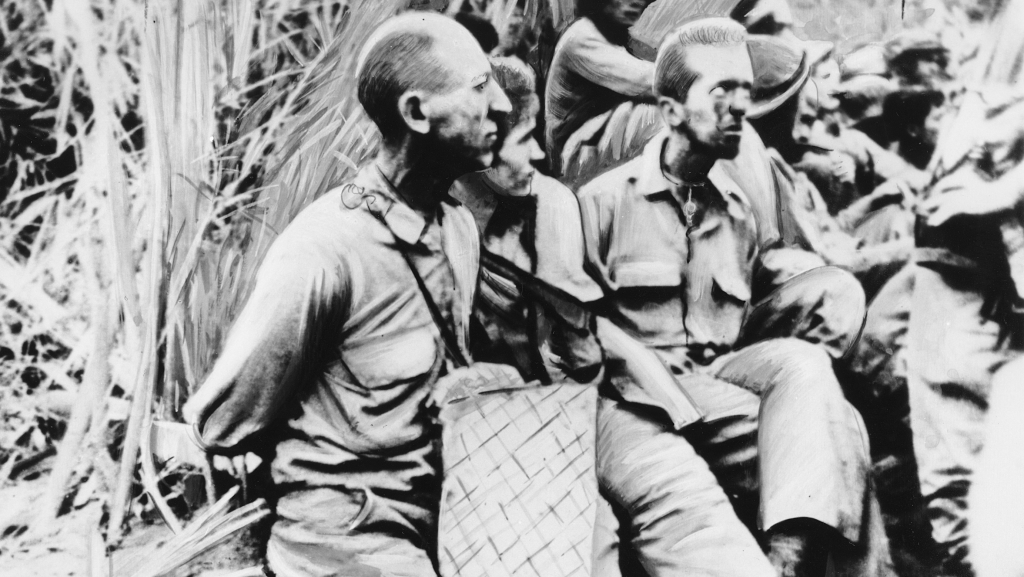
9th Marines regimental CP at ther Old French Fort near Danang.

The Ribbons on his chest

The thousand-yard stare

A DD-214

They told him DiDi Mau!*

            *Get the @#%$ out of here!

An airplane, a ship, a bus, and a thumb

Crossing 8 time zones

The World.

No men in black pajamas

with AK’s

No thuds walking closer

No C-Rations with bad cheese

Resuming his cheap civilian ways

Among men with bone spurs

Mothers with answered prayers

Mothers with Gold Stars in the window

Pretty young round-eyed girls

Just like before

Waiting to write their Dear Johns

Riots in the streets

Protests at the gates

Of dead Camelot

Bad habits

Lucky Strikes, beer, a little dope

Fitting in

Job applications

Skills?

Rifleman, KW-7* repairman, potato peeler

            *Sorry, it’s classified.

Desired position?

Something without mud, blood, or the creeping crud

GI Bill, college, home loans

Old men at the Legion

Talking glory, duty, country

Not his war

A bed

With clean sheets and a pillow

Then the demons come….

LDT October,12, ‘24

Main Menu- http://www.azrockdodger.com
May i Take Your Hand?

May I take your hand and open every door?

May I lift you up and tell you that there’s more?

Can I hold a candle to alight our way?

Can we stop a while and our thoughts convey?

Could I be the comfort that you sometimes need?

Could I find a way to help your dreams succeed?

Is there anything that I can do for you?

Is there any way to drive away the blue?

May I take your hand, each and every day?

May I win your heart so you want to stay?

LDT October 5, ‘24

Main Menu- http://www.azrockdodger.com

Laura

Sometimes a song is just too raw to listen to. Laura from 1967 is such a song,

“Laura hold these hands and count my fingers,

               Laura, touch these lips you once desired

               Lay your head upon my chest and hear my heartbeat

               Gently run your fingers through my hair….”

               It was the best breakup song ever. A little harsh at the end, but the tune kept pulsing through my brain. I knew a bit about breakups. Sadness, anger, jealousy, even revenge. Every time the song came on the radio, I sang along. It came from the bottom of a shattered soul and It was gut-wrenching. It crushed me as it hit home. God, I loved that song.

               I first heard it in the winter of 1967. I lived alone in a widow lady’s basement near the college. I spent my days studying History, Economics, and British Lit. Nights were spent in the honky-tonks of Havre. For money, I got by on $100 a month from the VA. It wasn’t much of a life.

            “Laura touch these ears that listened to your wishes

               Most of them, fulfilled and that’s a lot

               Let your soft, gentle hands caress my body….”

            By that time I knew a thing or two about love. Casual infatuation, fleeting ecstasy, eyes that melted anxious hearts. It always ended badly for me. That’s why I loved breakup songs. I cranked the volume up every time Leon Ashley sang, 
“ Laura, see these walls that I built for you

               Laura, see this carpet that I laid

               Laura, count the dresses in your closet

               Note the name upon the checkbook in your bag….”

               Well maybe I hadn’t been that far into any of my failed romances, but they still hurt a bit. There are lots of ways to breakup and there’s a good breakup song to cover every one of them. “Breaking up is hard to do,” but “I hope that the train from Caribou, Maine runs over your new love affair.” You get the picture.

               That winter I had an acquaintance living in the room next to mine. We shared a refrigerator and a bathroom. The rent was cheap. Jim was just out of the Navy. I had a hell of a lot more in common with him than the fresh-faced kids in my Econ 102 class. We had been places. We had done stuff. We told stories. Some of his were true.

               There was one thing different about us. Jim was in love. No, not that casual fling stuff I knew about. He was hopelessly devoted to a young lady named Sarah. I knew who Sarah was. Unlike the women from my side of the tracks, she was an angel from a good family. A damn good looker too.

               Jim had asked Sarah to marry him. After consulting her family, she put him off. He was a lowly meatcutter at the local slaughter house. He had working man hands. Worse yet, they were covered with mercurochrome from all the cuts he got at work. He’d have to show a bit more promise before he won this fancy lady’s hand. Jim doubled down. He worked long hours and saved every penny. He rarely joined me at the local gin joints. He was a serious young man. I had to respect that.

               The one pleasure Jim allowed himself was playing his guitar. Through the thin wall I could hear him well into the night as he crooned the latest country songs. His strumming soothed me as I studied economic curves. His singing wasn’t bad either.

               One night I met Jim coming down the stairs. He looked shaken, stunned, sad.

               “What’s up man?”

               “Sarah broke up with me. Took up with some rancher from down in the Breaks.”

               “It happens,” I consoled him, not having a clue as to how bad he was hurting. His eyes looked a little red. “Maybe sailors do cry,” I thought.

               “It’ll be all right, there’s lots of fish in the sea,” I said still not understanding the depths of his despair. How could I know his pain, never having lost someone whose soul had mingled with mine.

               Jim just shook his head glumly. I hadn’t been much help. We parted and went to our rooms.

               A few minutes later, I heard him strumming his guitar. Then he began to sing.

             “Tell me what he's got that I can't give you

               Must be something I was born without

               You took an awful chance to be with another man….”

               “O.K. He’s working it out,” I thought. “It can’t be any worse than my last breakup. He’ll get over it. Damn fine song though.”

               He strummed along without singing for a while. Then his plaintive voice came through the wall.

            “So tell me what he's got that I ain't got

               Tell me what he’s got that I ain’t got

               Laura, what’s he got that I ain’t got?….”

               “That’s it!” I thought. “The guy is jealous. That’s why he’s singing such a whiny breakup tune.” Then the chorus hit me.

“Laura, see those fancy curtains on the windows

               Touch those satin pillows on your bed

               And if there’s time before I pull this trigger

               Then tell me what he’s got that I ain’t got…”

               “Crap!” I knew he had a gun. Would he use it? Nah. He’s just a dumb-ass country boy like me. No way.  Then he began again, his voice quaking.

            “Sarah, hold these hands and count my fingers

               Sarah, touch these lips you once desired

               Lay your head upon my chest and hear my heartbeat

               Gently run your fingers through my hair….”

               Sarah? That was different. I closed my Econ text and listened.

               “Let your soft gentle hands caress my body

               And then tell me what he’s got that I ain’t got….

            I jumped to my feet and barged through his door before he got to the part about 
“And if there's time before I pull this trigger…”
He was sitting forlornly on his bed with his guitar on his lap. The gun was beside him; cold, heavy, unloved.

               “Get your sorry ass off that rack!” I commanded. “We’re gonna go get drunk!”

               The juke box played a lot of sad old country songs that night. I used every quarter I had to make sure none of them were called Laura.

               EPILOGUE:  Jim and Sarah are real people whose actual names I have long since forgotten. I remember that night every time I hear the song. “Jim” healed faster than I expected. A few weeks after the breakup, he bought a brand-new ’67 Pontiac Firebird. A red one.

LDT October 9, ‘24

               Leon Ashley topped the Billboard Country Chart with Laura in 1967. The song has been covered by many other artists, including Tom Jones, Marty Robbins, and Kenny Rogers. I prefer Ashley’s version. My breakup song was “Thank God and Greyhound You’re Gone.” What song got you through your breakup?

Laura- Leon Ashley- https://youtu.be/DnGQ_2JA1LQ

Empty Campsite

Somewhere in the Dragoons there lies an empty camp,

Up on Soren Pass, it’s a long, long tramp.

Where a miner found some glitter in a vein of quartz,

Digging through the rock, he had a mine of sorts.

We don’t know what he found, nor why he’s not around,

The wind’s the only sound, on this lonesome ground.

The mystery is but how, his camp sits empty now,

He weren’t no big highbrow, is all we can avow.

Did he wander down below, with only candle glow,

A poor lost sourdough, who met his final woe?

Is he buried in a stope, or somewhere down the slope?

There ain’t no use to mope, for him there is no hope.

The ashes have gone cold, lost in days of old,

The story must be told, for those who lust for gold.

So maybe shed a tear, ‘cuz he isn’t here,

The cost of gold was dear. back in yesteryear.

LDT September 25, ‘24

2050

            Coltrane stopped and pivoted as he reached the steel door. The digital timer next to the little observation window ticked down. Eight seconds. He had plenty of time before the shock collar began buzzing. He held his wrist up to the scanner. He didn’t like the chip, but what could he do? He had once spent 30 days in the hole for prying it out with a broken piece of circuit board. The reimplantation had put it behind the tendons of his wrist.

            The door opened automatically. He had 3 seconds to get inside. No shocks tonight. He stepped in as the door swing shut. It closed with a clunk, then the lock motors whirred as the bolts engaged. Home sweet home.

            It had been a long, tedious day at his workstation. A creative man, Coltrane had found ways to make his job more interesting. His assignment was to monitor the state media consumption of a block of citizens. They were required to read the daily official bulletins. Each article had a minimum reading time. Missing an article, or spending too little time reading it caused an alert. Too many alerts could result in re-education.

            The system was old and Coltrane had found ways to thwart it. No matter what his clients did, they never got more than a warning. Meanwhile, his alternate persona was busy hacking the system. He made sure his tormentors in the guard force got scheduled for re-education. Sometimes he planted damaging information in their personal communications. He didn’t worry that getting caught meant certain death. Lisa would be fine. She had access to millions in untraceable digital currency. Where did it come from? Don’t ask. The Directors had stolen it from people like him anyway.

            His tiny cell included a combination stainless-steel commode and washstand. His bunk was a metal rack suspended by chains. The top bunk was empty now. He’d had cellmates over the years. Some collaborated with the regime and got released. Three of them had been called out at Six AM. Later, the guards came and collected their meager belongings. They would suffer no more. The worst roommate had been Frank. He was a snitch. He only stayed 3 nights. Coltrane had warned the other inmates about him.

            He was now in the 20th year of his 20-year-to-life sentence. No parole hearing was scheduled. In 2029, he had been a minor bureaucrat in the Economic Statistics Analysis Division. He had prided himself in his accurate reports. They helped the government spot and fix problems. All that had changed when the new regime came to power.

            Early in 2030, Coltrane noticed a dip in some leading economic indicators. He gathered the data and submitted his reports and charts to his boss, Dr Benbow. Soon he was summoned to Benbow’s office.

            “Your report is flawed;” Benbow snarled. “Take it back and double-check your sources.”

            Crestfallen, Coltrane retreated to his office. His reports had been checked and double-checked. They showed the regime’s policies weren’t working. Abruptly his computer monitor lit up. A message from an outlying prefecture. Subject: Revised Report. The numbers were better. Then another message, and another. He looked at each one carefully. Eight thousand housing starts in Madison Township in February. Interesting. A few keyboard clicks told him that there were only 6,853 households there. What was going on?

            Alarmed, he brought the revised figures to Dr. Benbow. “The numbers are different Sir, but something is off.”

            Benbow grabbed the new report. His face brightened as he scanned the figures and charts. “Well done my boy. Now take the afternoon off. I’ll forward these new numbers to the Bureau of Information.”

            “Sir! The damn numbers are wrong. Someone is cooking the books!”

            “You have been working too hard. Take a little siesta. We’ll talk tomorrow.”

            Coltrane never saw Benbow again. At 9 AM the next day, he was escorted out of the building by security. He barely had time to grab Lisa’s picture from his desk. Things would get worse, much worse.

            Coltrane soon learned he was not likely to get a new job. Too old, under-qualified, over-qualified. Or was it his mixed race, his immigrant parents, or his failure to convert to the State religion?  He couldn’t know. Then the hammer dropped.

            He was summoned to the headquarters of the Citizen Police. This new group of officers were former militia members. They earned their jobs by helping the regime gain power. They didn’t play nice.

            He was escorted to a dimly lit room furnished with only one chair.

            “What do you think of your new government?” he was asked by the interrogator.

            “It’s OK. Some teething problems, but they will get it together,” he responded hopefully.

            “Are you now or have you ever been a member of the Resistance?”

            That was a shocker, but his answer was a firm, “No!”

            “You wrote this check to the opposition!” the man yelled flashing the blue paper in front of his face.

            “Oh God!” Coltrane thought. “That damned check!” Lisa had told him not to write it. Now the authorities had it. At least it hadn’t been written on their joint account. He was going to prison, but maybe Lisa would be spared.

            “Do you admit that this is your check with your signature?”

            “Yes.” There was no use in denying it.

            “In the name of the Supreme Leader, I am placing you under arrest for sedition!”

            Coltrane’s trial was a joke. The judge was an appointee of the regime. His friends were so cowed that none would testify. A frightened co-worker offered hearsay evidence. The prosecution held all the cards. He was guilty.

            Coltrane washed up and sat on the bunk. Lights out was sounded on the intercom. He took one last look at the camera that watched his every move. He remained poker-faced. Too much of a facial expression could put him in the hole. He stripped to his pink underwear and laid on the hard bunk. He dreamed of 2029.

            Orwell had been right. He just got the year wrong.

LDT September 11, ‘24

Main Menu- http://www.azrockdodger.com
Desert Race

THE MASS START OF A DESERT RACE IS A CACHOPHONY OF CHAOS.

TeThe line of bikes stretches for hundreds of yards. How many? Hundreds, maybe thousands. One of the greatest spectacles in racing is about to begin. Men, kids, even women are astride a kaleidoscope of colorful machines. Bright jerseys and worn leathers topped by every variety of crash helmet ever produced. They wait, silent, tense, their anxious breath fogging the lenses of their goggles.

            Each rider has a foot poised at the kick-starter. An open hand covers the clutch lever. Fingers flex at the throttle. The engines have gone silent. All talk has ceased. The riders scan the horizon. They have already picked their lines for the first 50 yards. After that they will read the terrain on the fly.

            Off in the distance the smoke bomb is lit. Riders suck in their breath as a tiny wisp of black smoke appears. It gets bigger. The bomb is five miles off. It tells them where they will pick up the marked trail. Officials scan the line as the starter raises his pistol. Nerves make stomachs churn. Riders look left and right. Will the novice on the right try to take their line?

            Boom! The gun goes off.

            Riders stomp furiously at their kick starters. Engines fire. Throttles are twisted, gears engaged, clutches released. They are off, handlebars clashing. A few are left in the dust, their loaded-up machines wont start. They must control their excitement to clear the excess fuel. No one wins a desert race at the start.

            Riders dodge rocks and pucker bushes while seeking better lines. A rock sends someone flying. The faster riders on the bigger bikes have shot out front. A few riders are down. A bike has died. Already. Each bike spews a rooster tail of dust behind it. Those who follow too closely get pelted by tiny bits of sand and rock. The noise and the dust are horrendous. The race becomes a cacophony of chaos. The assembledge has turned into a jumbled mass of motorcycles, each trying to avoid other riders and the hazards of the trail. The dicing begins. Passes are made. The field begins to string out.

            The riders pass by the bomb. It is a pile of old tires. They make a smoky fire. There the riders pick up the trail. They know Las Vegas is out there somewhere. It’s just 120 miles away. The trail is marked by red arrows on white cardboard squares. Straight, right, left. The arrow that points down means danger. The rider must figure out what kind. A drop-off, a bed of rocks, a canyon. Rider beware!

            An ancient Triumph desert sled wallows in a sand wash while a kid on a Hodaka skims by on top of the sand. More crashes, more broken bikes. The sight of spectators spells danger. They only congregate where riders crash. The guy pointing the fancy camera at the riders wants to sell them a picture. A Jesus Freak holds up a sign. John 3:16. Something to think about. Later, of course. There’s a race to run.

            There is a steady climb up the face of some mountains. The trail gets narrower. There are fewer riders to pass. The pack has sorted itself out. You won’t catch the hot shoes in front and the slow-pokes won’t catch you. You pass only broken bikes and downed riders. The injuries aren’t serious, so you keep going. The sweep crew will be by soon.

            There are checkpoints at various spots along the course. Each one has its own unique mark for the tank cards. Riders who miss the checkpoints are lost. No one cuts the course. The alternative routes are all dozens of miles longer.

            Bikes quit for a variety of reasons. A flat front tire will get the rider to the next pit stop. Without a spare tube and tire irons a flat on the rear ends the race. Broken chains are fixed with spare links. A pair of vice grips serves as a shifter. The steep hills can fry a clutch. Parts fall off. Engines expire due to seized bearings and pistons. Ignitions fail. Plugs foul. The fuel filter gets blocked. A rock holes a crankcase. Sometimes it gets fixed with duct tape. Too many broken spokes cause a bike to hop breaking more spokes. Broken frames and suspensions are rare. Dirt bikes are tough. Some of their riders aren’t.

            Beyond the crest of the mountains the trail enters a narrow boulder strewn canyon. Riders pick their way carefully. A broken toe can end their day. The canyon goes on forever. The guys on big heavy bikes struggle. The zippy little trail bikes gain some positions.

            The mouth of the canyon reveals a grand vista. That’s Vegas 50 miles away. The speed increases. For a while the trail follows the interstate. People gawk from their cars. The riders cross under the freeway, then back again. More passes are made. More bikes die. The riders who are left in the race all know their stuff.

            A pit stop comes up. Riders scan the crowd looking for familiar faces or their numbered gas cans. They skid to a stop. Those with pit crews guzzle Gatorade while their friends and wives refuel them. Others search for gas cans. All are off in a flash.

            The next challenge isn’t an obstacle at all. At the state line there is a dry lakebed. It is 5 miles long. It is more suited to a Bonneville streamliner than a dirt bike. The larger machines regain their advantage flashing by the smaller, bikes that passed them in the canyon. No one has a speedometer, but it is flat out across the lake. The big bore bikes top 80. The little bikes have their throttles pegged. Some bikes are jetted too lean. Their white hot pistons seize, ending their run. The smarter riders feather their throttles as bigger bikes flash by. They are in a different class, so it really doesn’t matter.

            The finish line is at the outskirts of Vegas. The bikes are funneled into a narrow corridor so there are no final passes. A course worker takes each scorecard. They are stacked on a metal pole. The first card is the overall winner. The class winers may not know they won until they read next week’s “Cycle News.” Trophies will be mailed. Those who finished have conquered the desert. Regardless of position, they are winners.

            Their eyes and nostrils burning from the dust, the exhausted riders wait for word on their companions. The race isn’t over until all are accounted for. It’s nearly dark as the last rider comes in. He has a big, grimy smile on his face. The chase crew works into the night to get everyone out safely. A helicopter picks up an injured rider who had to be carried out of the canyon. There’s another race next weekend at Lompoc.

LDT September 8, ’24

            EPILOGUE

            The Days of mass starts in the desert are long over. The last running of the Barstow to Vegas race was in 1974. There were 3200 competitors in 2 waves. The race was not held again due to environmental considerations. The remaining desert races are mostly held in Nevada, Arizona, and Mexico. These races use staggered starts, no more than 4 riders at a time. Finishing order is determined by time on the course. These races are not nearly as exciting as the mass starts of the old days.

            I was fortunate to run in the 1973 Baker to Vegas race which used 2/3 of the previous year’s Barstow to Vegas course. Pictured is the Hodaka Super Rat I rode that day. The large trophy in the center is from that race.xt.

I rode this Hodaka Super Rat in the 1973 Baker to Vegas Race. The large trophy in the center is from my class win.

Main Menuhttp://www.azrockdodger.com

Skeleton Canyon Treasure

  I studied the legend, the facts and the lore,

I did my research, there had to be more.

I bought a map from an old miner’s daughter,

  She said, “Look here.” Thought maybe I oughter.

Combed the records at the Tombstone Courthouse,

  Found a claim that was gnawed by a mouse.

That Skeleton Canyon was an old treasure route,

  Where bandit gold was hidden no doubt.

Where the mule trains plodded to prosperous mines,

  With dry goods, and tools, and Castillion wines.

Where the ambushers waited to prey upon them,

  ‘cuz there weren’t no law to catch or condemn.

For one hundred years it was always the same,

  After the Spanish, the Mexicans came.

Then greedy Gringos began to arrive,

  Up in the canyon, they couldn’t survive.

Some say the treasure was taken away,

  Some say it’s there to this very day.

I thought I knew where it might be,

  Stashed in a cave waitin’ for me.

I had to try and I wanted to go,

  Got me a burro named Mexican Joe.

Asked a banker for a grubstake,

  He told me to jump in a lake.

Hocked my watch and my old wedding band,

  That woman was gone from this barren land.

Packed what I had on my burro’s back,

  Couldn’t think of what I might lack.

Headed on out one bright summer day,

  Nothin’ but sand could get in my way.

The Peloncillo Mountains loomed up ahead,

   Many who passed through them are now dead.

I searched in the washes and up on the hills,

  Enough treasure awaited to pay all my bills.

I poked with my pick and started to shovel,

  Put up a shack that was more of a hovel.

Dawn found me workin’ with never a rest,

  Assuring myself that I’d find my quest.

Thirty-three years of toil and of sweat,

  I doubled down on my get-rich bet.

If only I’d found it, I’d really be set.

  If I weren’t so old I’d be out there yet,

Then I concluded that I was deluded,

  I sat and I brooded over riches eluded.

Those who hanker to head for them hills,

  Better work on their bequeaths and wills.

Most of the gold is already found,

  There ain’t nuthin’ left a-lyin’ around.

LDT September 7, ‘24

            Skeleton Canyon (also called Guadalupe Canyon) is in the southeastern corner of Arizona. It is a pass through the Piloncillo Mountains that long served as a trade rout between Mexico and Arizona. Both legal and illicit goods moved both ways through the canyon from the Spanish Colonial Era to the days of the Arizona frontier. It was also a frequent place for ambushes by the Apache, Mexican bandits, and American outlaws. The Tombstone Cowboy Gang of OK Corral notoriety preyed upon Mexican smugglers there. Old Man Clanton was killed after he camped too close to the border with stolen Mexican cattle. Geronimo surrendered at Skeleton Canyon in 1886, ending the Indian Wars.

Skeleton Canyon, Arizona

Main Menu- http://www.azrockdodger.com
Old Truck Waltz

Virgil Thill with Dad’s 1950 Chevy

An old truck will get you where you wanna go,

 The gears might grind and the ride might be slow.

A stove bolt six or a flathead eight,

 Are all you need when the road ain’t so great.

Though the fenders flap and the bed is rotten,

 They’ll take you back to a time forgotten.

Feedin’ the herd at twenty below,

 Pushin’ along through two-foot of snow.

Haulin’ a load of whatever you’ve got,

 Stakin’ out the best huntin’ spot.

It’s all that you need when you go to town,

 It’ll pull your Caddy when it breaks down.

Parked in front of the Oasis Bar,

 What the hell, who needs a car?

Everyone wants a rusty old truck,

 And If you have one you are in luck.

LDT August 31, ‘24

Main Menuhttp://www.azrockdodger.com

Flight

Frontier Airlines DC-3

There she was and she was a beauty. Polished aluminum gleaming in the sun. And I had eight silver dollars in my pocket. I was gonna fly!

            The airshow was always a big deal. Barnstorming acts from all over came to perform. There were military displays. One year they had a helicopter. Another time an airplane landed on a speeding car. The wing walker had been a disappointment. They just strapped him to a pole on top of a biplane and he spread his arms as it flew by. Hardly death-defying.

            This year was different. The Air National Guard brought in five Mustangs. They were lined up on the tarmac. Their pilots chatted with spectators. They were my heroes. I knew all about the P-51, even though they now called it the F-51. It had dominated the skies over Europe and drove the Messerschmitt and Focke Wolfe fighters away from the bombers. They practically won the War.  

Aviation was my passion. When the teacher wasn’t looking, I sent exotic paper airplanes flying around the classroom. Mine had tails on them and flew farther than anyone else’s. The money I earned from cutting grass went toward model airplane kits. Rubber-powered. I could never afford one with a real engine. I read all the books; 30 Seconds over Tokyo, Reach for the Sky, Yank in the RAF. I knew what a joystick was and ached to press the trigger as a MiG 15 slipped into my crosshairs. It is good for a boy to dream.

In truth, I had never even been in an airplane, except for that wrecked trainer inside the burned-out hanger on the other side of the field. Gordon Watson and I had snuck into the airport on a slow day and climbed into the cockpit. It had a joystick and rudder pedals, but the wings and tail were burnt off. The airport manager chased us off.

Today, however, I was going to fly in a real airplane. Frontier Airlines offered rides in one of their airliners for a mere eight bucks. I had just enough money for the ticket. With no money to spare, I snuck into the airshow by the old road leaving my bike by a hole in the fence. I was now a spectator at the 1955 Glasgow Airshow.

I walked right by the Mustangs. I could check them out later. The DC-3 airliner was just beyond the hangers. People were already clustered around buying tickets at a little booth. “I hope they don’t sell out.” I thought as I tapped my pocket to feel the eight silver dollars. I got in line behind an old cowboy with tobacco juice dripping from the corners of his mouth. He looked more nervous than I was. The plane only seated about 2 dozen passengers. I counted the number of folks in front of me. I would get on the first flight.

I admired the DC-3 as I waited. Twin engines. Big nine-cylinder radials. A side window on the cockpit was open. I could see what looked like the pilot checking the controls. “Must be a pre-flight check.” I thought. “Safety is good. DC-3s sometimes fly into mountains. Good thing there aren’t any mountains around here.”

The top half of the fuselage was painted white with a scalloped green stripe along the middle. The word “Frontier” was painted in red letters above the stripe. The lower half of the fuselage and the wings were bright aluminum. The cabin door opened downward to reveal a set of steps. I was close enough to see some scorching from the exhausts on an engine cowling. There were a couple of streaks of oil running across the wing. “Oh well, these things were tough enough for smokejumpers.” I thought.

Finally, it was my turn to buy my ticket. My eight dollars clinked as I placed them one at a time on the counter. The stewardess looked at me gently and said, “Are your parents with you?”

“Parents? What the hell, I’m almost 12 years old. What do I need parents for?” I thought.

“No.” I squeaked.

“Sorry, unaccompanied minors need parental permission.”

“What the hell?”  She was talking like a damn lawyer. Stewardesses are supposed to be kind and caring. This one wasn’t helpful.

“Can you get one of your parents to sign a permission slip?” She asked.

“Yes!” I exclaimed grabbing the paper she handed me. I thanked her and dashed off to my bike. I had a 2-mile ride each way and I needed to hurry.

Our town was in a valley just below the airport. My route would take me down Milk River Hill. Steep and fast. Down I went. I worked up the nerve to jump the dirt berm blocking the old road. The jump was exhilarating and I landed smoothly. I was hitting a pretty good clip when I reached the first paved street. I had two blocks of downhill before the street leveled out at the high school. I must have been doing over thirty as I sailed past it. The Highway Two intersection came up fast. I could ignore the stop sign but I’d have to slow down and turn there.

No cars. Everyone must be at the airshow. I turned onto the highway and headed for Underpass. Our town’s only traffic light was blinking red. No cars. I peddled on through. I had no time to waste.

Luckily, Mom was home when I pulled into the yard. “I thought so,” she said as I explained my problem. “Let me look at it.” She grabbed a fountain pen as she read it over. “Looks OK.” She printed my name on the form and signed it.

The easy part was over. I now had to race back to the airport. And it was all uphill. Puffing hard when I reached the dirt berm, I threw down the bike and ran to the airport. My heart sank as I saw the DC-3 taking off. “Had I missed the last flight? “

People were waiting near the ticket stand, but the Stewardess was gone. “Am I too late?” I asked someone.

“Nope. But the next flight is the last one. There might be a few tickets left.”

I waited anxiously at the counter. The Mustangs took off and dipped their wings as they buzzed the field. God, those Merlin engines were loud. After they were gone, the airliner returned and circled to land.

This time the Stewardess greeted me with a smile. “I see you have it.” she said reaching for the paper. She looked it over and took my money. “Enjoy your flight.” She purred as I got in line to board.

I was lucky to get a window seat just ahead of the wing. I fastened the seatbelt like a pro. Then the stewardess came by and tugged on the end to make it tight. The captain welcomed us aboard on the intercom. I looked out the window as the propeller on my side began to whir and turn. Then it stopped. “Why hadn’t the engine fired?” I wondered.

Then it began spinning again. There was a pop and a puff of smoke from the exhaust. The prop moved in jerks. The engine roared to life. All nine cylinders were firing evenly. Engine number two went through the same procedure. The whole plane vibrated as it came to life.

After the engines had warmed a bit, we taxied to the end of the runway. The powerful engines throbbed as the plane strained against the brakes.

Shush! We were off in a rush. The acceleration pressed me back into the seat. The clumps of withered bunch grass by the runway flashed by in a blur. The tires hammered over the cracks in the runway. The plane was doing about 60 MPH when the tail lifted. “Were we flying?” No, the wheels were still bumping over the cracks in the runway. Suddenly the bumping stopped. The ground was flashing by at about 100 MPH. Then the nose pointed toward the sky. The ground fell off. I looked at the wing. The end was gently flapping up and down. “Was this normal?” Then there was a clunk, followed quickly by another. “Was something wrong?” Nope, the landing gear had come up. We were now higher in the sky. The plane banked to the right, flew over some wheat fields, and passed directly over town. I could see our house. It was a little dot at the edge of town by the river. We banked and turned downstream. The river twisted and wound as it made its way through the valley. The massive cottonwoods lining the river bank seemed smaller and smaller. We climbed more and turned toward Fort Peck. Puffy white clouds floated by.

My boyhood dream had come true. Like the poet pilot, John Magee, I had “slipped the surly bonds of Earth”. Maybe someday I could “touch the face of God”[1]

LDT August 28, ‘24


[1] High Flight. Pilot Officer John Gillespie Magee, Jr. Royal Canadian Air Force. 1941.

Main Menu- http://www.azrockdodger.com
Joy

Kids saying The Pledge just before being interned in WWII

Let’s go out and spread some joy,

 to make each other’s spirits buoy.

Do some favors if you will,

 help someone their dream fulfil.

Smile at all with whom you meet,

 make their path a happy street.

Dig deeper when the hat is passed,

 know that hard times cannot last.

Compliment the smallest things,

 and see the joy that it brings.

Lift up those who fall behind,

 help the poor, the sick, the blind.

Do not fear another’s view,

 take care with the words you spew.

Teach the young to make their way,

  always have good words to say.

There’s prob’ly stuff I have missed.

 but I hope you’ll get my gist.

There’s simple tools you can employ,  to bring the world some needed joy.

LDT August 26, ’24

Main Menu: http://www.azrockdodger.com