Contents:
–Civil War Forgiveness– https://azrockdodger.com/2025/09/18/civil-war-forgiveness/
-Wendigo- (Halloween story)- https://azrockdodger.com/2024/10/31/wendigo/
-Empty Campsite- https://azrockdodger.com/2024/09/25/empty-campsite/
-Skeleton Canyon Treasure (Poem)- https://azrockdodger.com/2024/09/07/skeleton-canyon-treasure/
-Thornhill (Poem)- https://azrockdodger.com/2024/05/18/thornhill/
-The Empty Cabin- https://azrockdodger.com/2024/04/06/the-empty-cabin/
-Buffalo Chips- https://azrockdodger.com/2024/02/03/buffalo-chips-2/
-High Desert Blues– https://azrockdodger.com/2024/01/20/high-desert-blues/
-Buffalo Nickel- https://azrockdodger.com/2023/11/03/buffalo-nickel/
-Homestead- (Poem)- https://azrockdodger.com/2023/07/12/homestead/
-Ringo- (poem)- https://azrockdodger.com/2023/03/17/ringo/
-Massai- (Poem) https://azrockdodger.com/2023/02/18/massai/
-Terrenate- (Poem) https://azrockdodger.com/2023/01/22/terrenate/
-Rex- (Poem) https://azrockdodger.com/2022/12/25/rex/
-Aces ‘n Eights- (a poem) https://azrockdodger.com/2022/10/08/aces-n-eights-2/
-John Heath (A poem about The Bisbee Massacre): https://azrockdodger.com/2022/05/08/john-heath/
-The Bisbee Massacre (Newspaper Archive)- https://azrockdodger.com/2022/05/01/the-bisbee-massacre/
-Free Trapper (a poem) –
-Bombs Away Naco! ( ¡Bombas lejos Naco!) a corrido https://azrockdodger.com/2021/12/06/bombas-lejos-naco/
–The Bones of Cochise (A poem) https://azrockdodger.com/2021/11/27/the-bones-of-cochise/
-Pete Kitchen– (A poem) https://azrockdodger.com/2021/10/23/pete-kitchen/
-John D. Lee Must Die (a poem) John D. Lee Must Die – Outlaws, Outrages and Outright Lies (azrockdodger.com)
-The Whoop-Up Trail (a poem) https://azrockdodger.com/2021/07/24/the-whoop-up-trail/
-Métis (a Poem) https://azrockdodger.com/2021/07/07/metis/
-Joe Cosley: The Snowshoe Panther (a poem) https://azrockdodger.com/2022/04/02/joe-cosley/
-A.A. Allen, Miracle Valley’s Healer
-Council Rocks– https://azrockdodger.com/2023/02/11/council-rock/
-The Invasion of Arizona
-Blue Bird-A Cold Case Mystery
-Montana History Bibliography https://azrockdodger.com/2021/11/21/montana-history-biography/
-Mountain Men and the Fur Trade Bibliography- https://azrockdodger.com/2022/11/27/mountain-men-fur-trade-bibliography/
-Arizona History Bibliography
-Mormon History Bibliography-
Free Trapper
He’s just a lonesome trapper, he’s wild and he’s free,
Makes his way on his own, don’t work for the company.
He traveled up the mighty Mo, a rifle by his side,
All he carried with him were hopes and fears and pride.
Once he had a partner, they never talked so much,
It’s French or Anglais, no common tongue to touch.
The Crow they got his horse, Blackfoot took his pelts,
Gotta’ start all over, he ain’t got nuthin’ else.
Back in old Saint Louie, there ain’t no gal for him,
But with that Shoshone maiden he’d like to take a spin.
The bridal price is just too high, horse, rifle and some shot,
Damned if ain’t more than this ol’ boy has got.
Maybe at the rendezvous he’ll freshen up his poke,
Spend it all on whiskey, end up sick and broke.
He checks his traps at daybreak, no beaver does he find,
He curses at his bad luck, the powers ain’t been kind.
He pulls out his bag of scent and baits the trap again,
Needs to find a better spot where no one’s ever been.
He wades into the stream, it’s clear and it’s cold,
He drives the stake, this time maybe he’ll strike gold.
He’ll spend the day in the brush, hidin’ from the Crow,
Maybe they won’t find him, you just don’t never know.
Could be in the morrow, he’ll dine on beaver tail,
But if his luck don’t change, he’ll have to hit the trail.
Perhaps he’ll wind up crossin’ beyond the Great Divide,
After all his travels he’s had a damned good ride.
Sleeps beneath the stars, his blanket ain’t enough,
All in all, it ain’t so bad, a’ livin’ in the rough.
Waitin’ for the dawnin’, then he hears a snap,
Maybe there’s a beaver in his final trap.
Wadin’ in he finds it, a beaver paw he’s caught,
All his work and travail have added up to naught.
And somewhere there’s a beaver knawin’ on a tree,
Only three paws left, but he’s wild and he’s free.
LDT Nov ‘20
A.A. Allen, Miracle Valley’s Healer
Physician, heal thyself- Luke 4:23

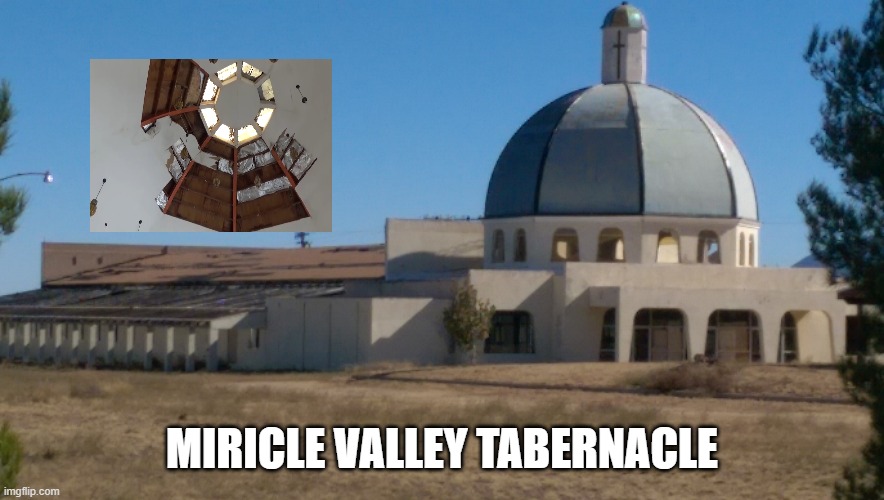
It sits mostly vacant now. A blue Moorish-style dome capping one end of a long Spanish Colonial building. Once it had a smaller orb on top with bright circus-colored stripes. It blew off in one of our violent summer storms and was last seen rolling with the tumbleweeds next to the highway. Smaller, pale yellow structures with a late Fifties vibe stand silently beside and behind the forgotten tabernacle. Across Highway 92, is a small residential community of older homes and mostly dirt streets. The streets have names invoking the faith of those who once lived there. Faith Avenue, Deliverance, Olive and Joy. The road fronting the highway, somehow got renamed Ghost Rider Lane. Perhaps that’s appropriate, because the homes behind it are now often inhabited by people escaping from convention or even the law.
If you had passed by Miracle Valley in the 1960’s, you would have seen a much more vibrant sight. Powerful preaching reverberated off the walls. The music was joyful and uplifting. Tune in your radio and you would hear a booming voice admonish you to, “Go and sin no more!” Folks came from all over the nation to hear their favorite evangelist, A.A. Allen, at Miracle Valley. Most came to be uplifted and inspired in their faith. The Word of God was spoken there, loudly and enthusiastically. Others came to Miracle Valley because they were ill, crippled or diseased. They needed the healing powers of A.A. Allen’s touch. The Lord worked through his servant.
Miracle Valley, Arizona lies near where the San Pedro River makes its way from Mexico into Arizona. The valley has been peopled for well over 10,000 years. The Clovis people hunted the wooly mammoth here. The Sobaipuri dug pit houses and tended their gardens in the valley only to be displaced by the warlike Apaches. Each culture had their own religion with its rituals and shamans to perform their sacred rites. Often, they were called upon to heal the sick.
The first Christian healer to pass through the region might well have been Cabeza de Vaca. De Vaca was one of only 4 survivors of the ill-fated Naravez Expedition. In 1528, they found themselves shipwrecked, stranded and enslaved by natives near Galveston, Texas. De Vaca gained the confidence of his captors with his healing powers, which he attributed to his superior Christian faith. Capitalizing on the good will his healings achieved, the party slowly made their way from tribe to tribe toward the Spanish settlements in Mexico. It is difficult to track their journey from the account de Vaca wrote later, but they might have passed close to Miracle Valley. It was from the survivors of de Vaca’s party that the Spanish first learned of the Seven Cities of Gold at a place called Cibola. The Spanish would mount two expeditions to find the fabled wealth of these golden cities. In 1539, the first expedition was launched under Friar Marcos de Niza. His guide was one of the four survivors of de Vaca’s epic journey, a Moorish slave named Esteban. Estaban is said to have wielded great influence with the natives he encountered. Perhaps his magic ran a little thin when he reached the Zuni villages where the tribe killed him. Encouraged by de Niza’s report of sighting the glittering cities of gold in the distance, Francisco Vasquez de Coronado launched his much larger expedition the next year. Both expeditions passed through or near the San Pedro Valley where Miracle Valley now stands. Both expeditions carried their crosses before them as they made their way into an unknown land. Perhaps there was something sacred, something special about the quiet place near the river that they had passed through. If there was, A.A. Allen would claim he found it four hundred years later.
Asa Alonzo Allen was born in Sulphur Rock, Arkansas in 1911. In 1936, he was ordained as a pastor by the Assemblies of God Church. While pastoring a church in Corpus Christi, Texas in 1949, he attended a tent service conducted by faith healer Oral Roberts. Inspired by Roberts’ example, he decided to pursue his own healing ministry. He took his crusade to radio and television preaching the “prosperity gospel” and healing the sick along the way. Eventually, he bought a tent from a dead evangelist and hit the road.
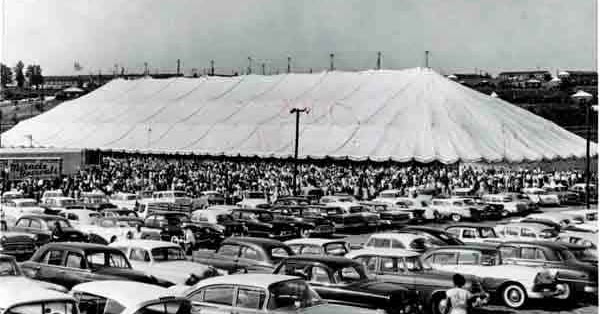
In 1955, Allen conducted a series of revival meetings in Knoxville, Tennessee. Carson Brewer, a reporter from the local paper, went to receive his “healing.” It didn’t go well. Brewer had to attend two services just to obtain a place in the healing line. While waiting to be healed, Allen’s associates tried to sell Allen’s books, magazines and souvenir songbooks for the service. Then Allen suggested they each buy 20 magazines to give to friends. Collections were taken at both services. Allen implied that the monies he collected were going to such worthy causes as a “widow woman with 15 kids.” The reporter got a slap on the forehead from Allen when he finally reached the head of the line. Earlier, the sick and the lame had been told not to waste Allen’s time by explaining their problems. They had already filled out prayer cards. The reporter failed to witness any miraculous healings for himself or anyone else.[1]

A few weeks after Brewer’s article, Allen had an embarrassing drunk driving arrest in Knoxville. He had run a red light after nearly hitting and scattering a group of children. His blood alcohol content tested at .20 percent.[2] Allen was driving a fancy new Buick. He had a ton of cash in his wallet and the day’s receipts in the trunk. A stand-in preacher had to be called to lead the evening service. At Highway Patrol Headquarters he told reporters that if they said he was drunk it would be a lie. He rebuked a photographer in the name of the Lord and told the Patrolmen his arrest was the work of the Devil. Told he was “under the influence”, Allen jumped up and shouted, “Halleluiah! ….I’m under the influence of religion.”[3]
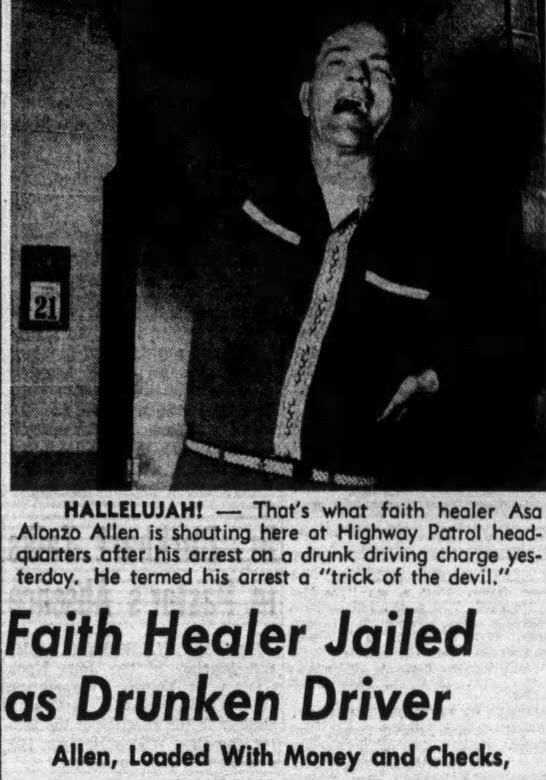
Allen was released on bond and ordered to appear in court on November 29, 1955. Two hundred spectators showed up to watch. Allen was nowhere in sight. Someone said he was in California. On January 9, 1956, his $1,000 bond was forfeited.[4] His drunk driving charge would haunt him for the next few years. California authorities wondered if his driver’s license was still legal.[5] Others wondered if his ministerial credentials were valid.
After his arrest, Allen resigned (or was expelled) from the Assemblies of God denomination. He then re-ordained himself under his Miracle Revival Fellowship brand. Later he would preach against the evils of dead denominational religion and write a book about it.
In 1954 Allen had an apocalyptic vision of the Destruction of America. Feeding off Cold War paranoia, he said God was going to destroy America with poison gas coming from Russia followed by a rocket missile attack. With frightened Americans already digging fallout shelters in their back yards, Allen incorporated the vision into his tent crusades.
“Behold, the LORD maketh the earth empty and maketh it waste and turneth it upside-down and scattereth abroad the inhabitants thereof,” bellowed Allen. The Earth will be “defiled” because its inhabitants have “transgressed the laws, changed the ordinance, broken the everlasting covenant.” Clearly, only the faithful would survive, “their only true means of defense faith and dependence upon the true and living God.” Allen had received this revelation while peering through a celestial telescope from atop the Empire State Building. It cost him a dime.[6]
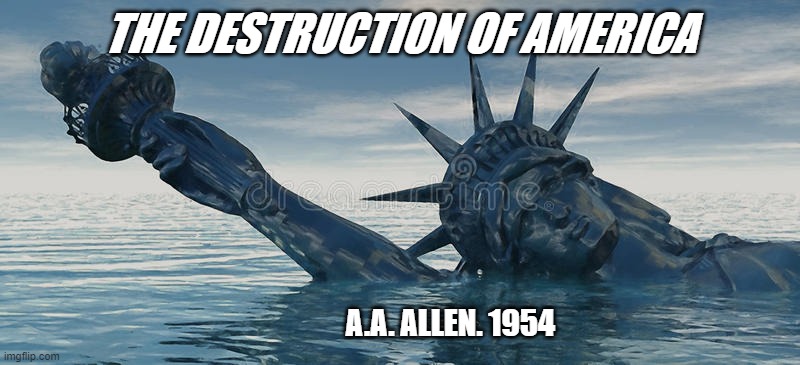
drowned in the Gulf of Mexico after being overcome by poison gas.
In 1958 local Palominas, Arizona rancher, Urbane Leiendecker, donated 1200 acres to Allen. This would become his Miracle Valley headquarters. Over time it grew to include a tabernacle, a Bible college, an airstrip and numerous supporting structures for the masses of worshippers and supplicants gathering to receive healing and the Word of God.[7]
Even Miracle Valley’s well was sacred. A prophet had told Allen that he would dig 600 feet and lose a bit before finding water. Sure enough, the “prophecy” was fulfilled. People then began claiming miraculous healings just from drinking from the churches’ water cooler. (As a side note, I drank the water from a nearby well for 21 years. It didn’t heal me, but I once got a notice from my water company that they had violated state rules on testing.) There are several videos on the internet showing Allen healing the afflicted. Typically, they arrived in a wheelchair or on a gurney with someone wearing a nurse’s outfit attending to them.[8] A few words, the laying on of hands and a request for God’s healing power was all it took. The lame would walk.[9] No one bothered to follow up to see if they really had been healed. Allen is said to have discouraged the press from attending his rallies and documenting his “healings”.[10] A few days after his Knoxville arrest a reporter was spotted taking notes at the revival. He was escorted out of the tent, “slugged” and told, “Don’t ever come back.’[11]
If you tuned in to some of the many radio stations carrying A.A. Allen’s program on June 11, 1970, you might have heard, “This is Brother Allen in person. Numbers of friends of mine have been inquiring about reports they have heard concerning me that are not true. People as well as some preachers from pulpits are announcing that I am dead.
“Do I sound like a dead man? My friends, I am not even sick. Only a, moment ago I made reservations to fly into our current campaign where I’ll see you there and make the devil a liar.”[12]
It seems that the reports of A.A. Allen’s death were not exaggerated. The message on the radio was pre-recorded. Asa Alonzo Allen had been found dead that night in a room at the Jack Tar Hotel in San Francisco. Though he had “cured” many from the same infliction, Allen was in town to get medical treatment for arthritis.
The news of Allen’s death soon hit all the papers, big and small, throughout the land. Some who had heard his voice on the radio that day couldn’t believe it. For days, people were still getting letters from him.[13] Others just couldn’t divine that one who healed so many could have been stricken in his prime. Back at his headquarters, his staff worked hard to ensure that the faithful knew the truth. Allen was gone. He would be laid to rest in Miracle Valley on June 15, 1970.[14]
Early reports said A.A. Allen had died of an apparent heart attack. After a 12-day investigation, the San Francisco Coroner ruled that Allen had died of acute alcoholism. His liver was suffering from “fatty infiltration”.[15] This news came as a shock to all but his closest associates. The 1955 Knoxville arrest had not been a fluke. The son of alcoholic parents, Allen had been known to indulge.
With the death of its charismatic leader, the fabric holding Miracle Valley together slowly began to unravel. The electronic ministry fizzled. The Miracle Magazine and pamphlets went out of print. People stopped coming to the valley. The money dried up. Some of the faithful sold their homes and drifted away. Only the Bible College lingered on. Eventually most parishioners remaining in the area found other spiritual homes. The Palominas Assembly of God Church was the logical choice for many.
Over the years, several attempts to revive Miracle Valley as a religious center were made. In the 1980’s, a group called the Christ Miracle Healing Center moved from Chicago to Miracle Valley. Their leader, “Ma” Francis Thomas, had been a disciple of A.A. Allen. Like Allen, she proclaimed herself a healer. Her cult-like leadership style soon alienated most everyone else left in the valley. There were several unfortunate confrontations with other residents, the media and the Cochise County Sheriff’s Office. Church members blockaded roads, threatened neighbors, disrupted the schools and ignored legal proceedings. One member was killed when a bomb he was carrying, reportedly to blow up the jail, exploded. Eventually, a massive confrontation with authorities took place and two church members were killed in the melee. Peace was only achieved when the group returned to Chicago.[16] Miracle Valley fell back into its lethargy.

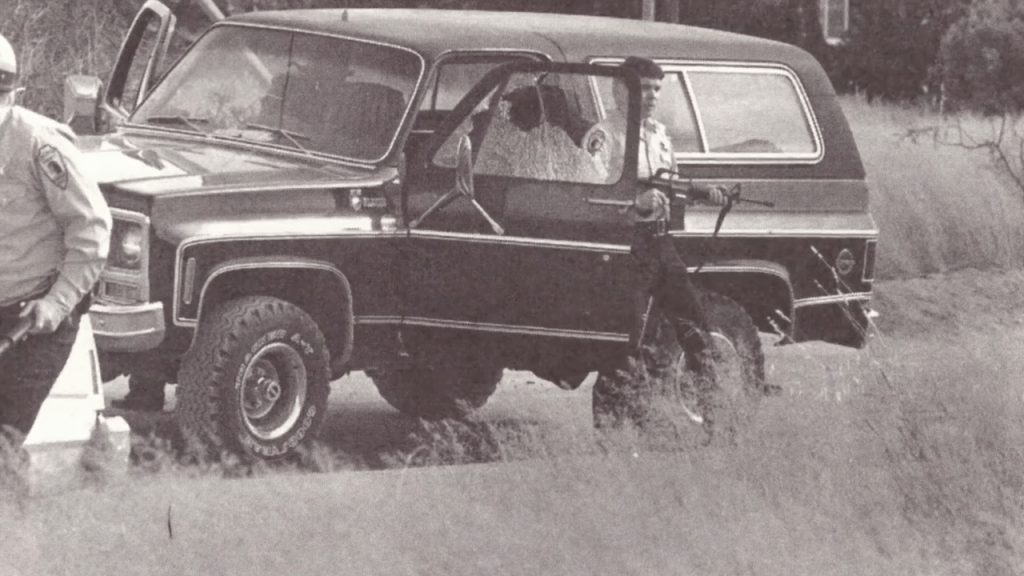
window shot out. Miracle Valley, Arizona. Oct 23, 1982
Lethargic was how I found the place when I moved there in 1995. It took me 15 years before I learned that I was passing the site of the Miracle Valley shootout on my daily walks. I watched and wondered as the tabernacle across the highway slowly deteriorated. As I walked by, Bible college students played volleyball, the girls in long skirts. Newcomers knew little of the valley’s past. Oldtimers had opinions and memories they didn’t share much. When they did talk it was with some reserve and a certain reverence for the man who would forever be associated with Miracle Valley.
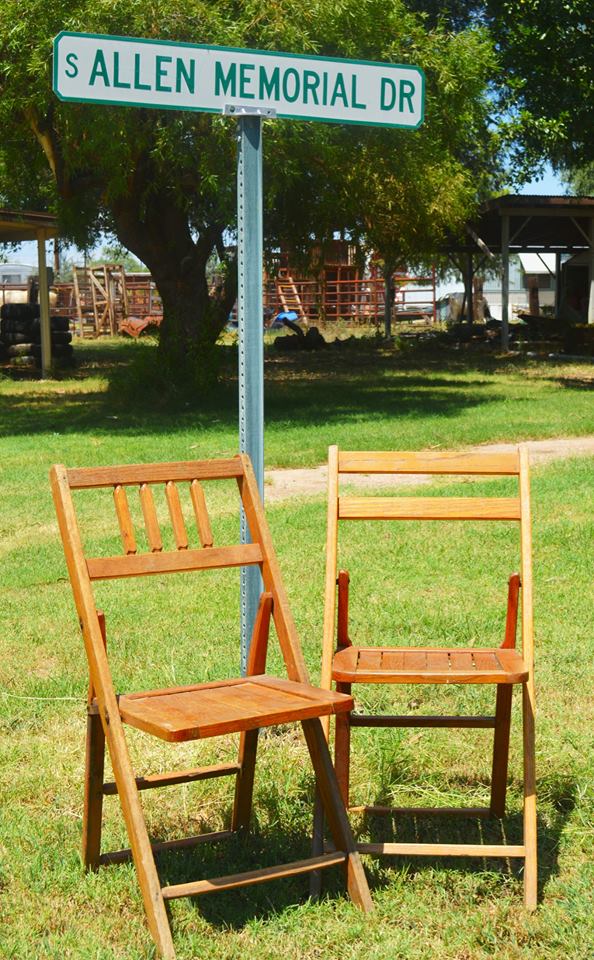
A.A. Allen’s son, Paul, keeps A.A. Allen Ministries alive in Tucson. If you want one, he will sell you an original folding wooden chair used in his father’s tent revivals.[17] I met Paul once at the Palominos Church. He seemed like an ordinary man of faith to me. Others looked at him like he was the second coming of his fire and brimstone preaching father.
Though people still speak in tongues in Miracle Valley, there is little talk of healing. Outside the tabernacle, a mournful wind blows the tumbleweeds across the eerie stillness of Allen’s complex. Five miles away, a huge cross now watches over the valley. Its quiet simplicity stands in stark contrast to the bombastic preaching of years gone by.
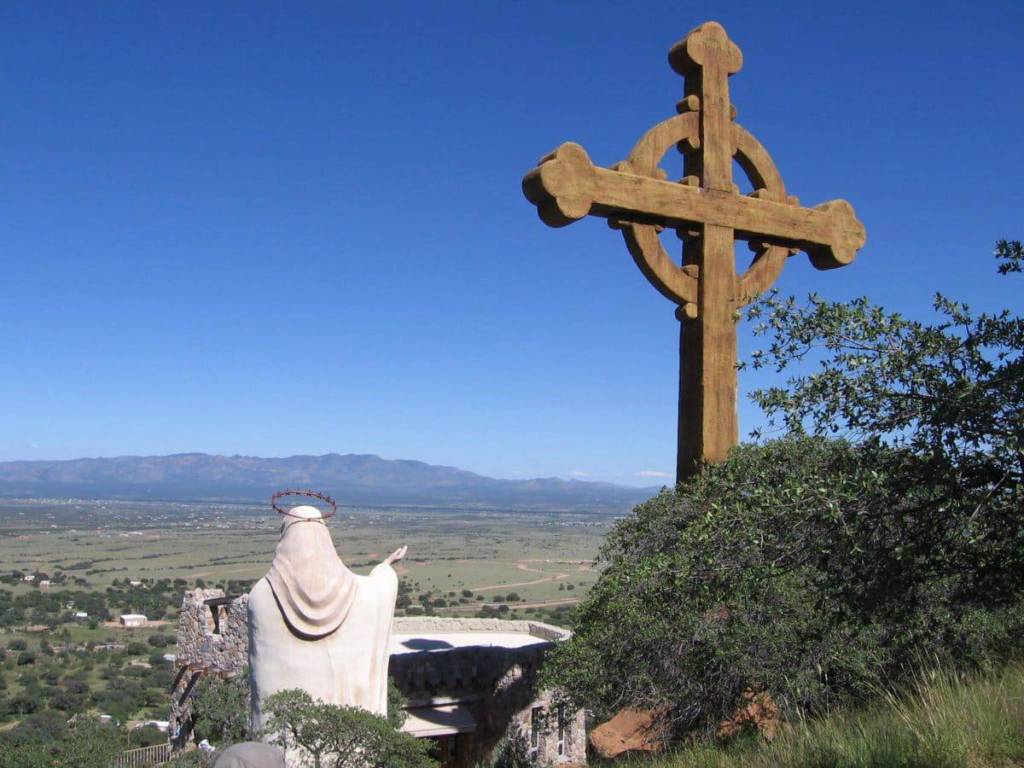
watches over Miracle Valley today
LDT Apr 24, ‘21
[1] The Knoxville News Sentinel. Knoxville, Tennessee. October 6, 1955.
[2] The Knoxville Journal. Knoxville, Tenn. Oct 22, 1955.
[3] The Knoxville News-Sentinel. Knoxville, Tennessee. Oct 22, 1955.
[4] The Fresno Bee. Fresno, California. April 6, 1956.
[5] The Knoxville News-Sentinel. Knoxville, Tennessee. Feb 20, 1956.
[6] ** The A.A. Allen Vision of the Destruction of America ** | Tribulation-Now (tribulation-now.org)
[8] https://youtu.be/vVb4H6DDuq8
[9]https://youtu.be/twTBVP01jFg
[10] Ibid. A>A> Allen Wikipedia
[11] The Fresno Bee. Fresno, California. April 6, 1956.
[12] The New York Times. New York, New York. June 14, 1970.
[13] The Gallup Independent. Gallup, New Mexico. Jun 19, 1970.
[14] San Antonio Express News. San Antonio, Texas. June 16, 1970.
[15] The fresno Bee. Fresno, California. June 24, 1970.
[16] Shootout in Miracle Valley. William R. Daniels. Wheatmark. 2012.
[17] A. A. Allen Ministries (aaallenonline.com)
Video essay on the Miracle Valley Shootout- https://www.youtube.com/watch?v=57QrPKM1B7c
The Invasion of Arizona

1917: The Zimmerman Note
March 1, 1917 began just like any other day in Southern Arizona. The sun came up. The day shift headed for the mines while the weary night shift trudged home. Whistles blew and elevators clanked. A few cars with brass grilles chugged their way up Tombstone Canyon. The milkman left his wagon to trudge up endless stairways. As their morning coffee was brewing, people in nightshirts and robes ventured out to retrieve the daily paper. They would be in for a shock as they unfolded the news.
The headline of the Bisbee Daily Review screamed,
GERMAN PLOT TO JOIN WITH JAPAN AND MEXICO IN WAGING WAR AGAINST THE UNITED STATES IS EXPOSED
…. MEXICO TO GET ARIZONA
Arizona was about to be invaded, conquered and annexed by Mexico! Numbed citizens poured over the article. A coded German telegram had been intercepted by the British. Germany was resuming unrestricted submarine warfare against neutral American shipping. If this should lead to war, the German Ambassador to Mexico was instructed to seek an alliance with the Carranza Government. Mexico would enter the war on Germany’s side. Germany would provide arms and money. Mexico would be rewarded with the restoration of the lost territories of Texas, Arizona and New Mexico. On the outbreak of hostilities with the U.S. Mexico was to seek an alliance with Japan.
Until now Bisbeeites had come to view war as a spectator sport. The Mexican Revolution had been raging ten miles to the South since 1910. On March 12, 1913, the rebel Constitutionalists had defeated the Mexican Federal garrison at nearby Naco, capturing the town. In 1914-15, Pancho Villa’s forces conducted a long-running siege of General Obregon’s base at Naco. Bisbee folks packed their lunch baskets and headed down to watch the war. When the fire of the hostile parties strayed across the border, Sheriff Wheeler was quick to mount his horse and ride between the lines to redirect it.
The present threat was far more serious than that of the ongoing Mexican Revolution. The Germans would “Sick Brown Races on America.” The tiny American troop presence in Naco would be no match for the onrushing hordes of Mexican Soldados armed with German Mausers and guided by German officers. At thirty miles away, Fort Huachuca didn’t seem to offer much protection either. Bisbee’s men checked their weapons and headed for the general store to get more ammo.
It all added up. Mexico’s President, Carranza, had been suggesting an embargo of oil and food to the British. Mexico’s Ambassador to Germany was openly “anti-American.” A high official from the German Embassy had been mysteriously transferred to Mexico City. Two German military attaches who had been expelled from the U.S. had visited Mexico. American Naval officers were speculating that Germany had a secret U-Boat base in Mexico. How else could they be threatening the South Atlantic? Mexico haughtily suggested “that it was the business of the allies to keep German submarines out of western waters.” Mexico had also closed French and British banks and cancelled the notes they held. Carranza’s army was equipped with German machine guns and German gunners. A suspected German agent had been arrested in Nogales for trying to gain military information.
If things weren’t bad enough already, readers learned on page 4 that a German raider vessel had been spotted off San Diego. That, on top of the report of “Three Japanese Warships also Seen Recently Nearby.” (It didn’t seem to matter that Germany and Japan were already at war with each other.) Topping that off, there were clandestine wireless signals that appeared to be German coming from the Mexican coast. German agents hired by the recently convicted German Counsel from San Francisco were operating in Mazatlan, Manzanillo and even San Diego.
Though most of the scary reports were not true, the citizens of Southern Arizona were alarmed. Few bothered to question why Japan would suddenly switch sides or how Mexico, still in the throes of revolution, could make war on the U.S. What was true was that the German Foreign Minister thought it might be a good idea to ask Mexico to join their side should America declare war. This scared Arizonans far more than the prospect of the renewal of unrestricted submarine warfare. The latter had always been seen as a problem for East Coast shippers. It wasn’t something that Arizonans were willing to go to war over.
The Zimmerman Note was never broached by the German Ambassador with the Mexican government. Mexico found out about it at the same time the American public did. It took a few weeks, but the Carranza government soundly rejected the idea. Germany’s duplicity weas confirmed when Foreign Minister Zimmerman admitted to sending the telegram. The British concocted a cover story that claimed they had “bought” the contents of the Zimmerman Note from sources who had presumably stolen it from the German legation in the Mexican capitol. The Brits continued to break German codes with impunity for the rest of the war.
Though America’s Southern border was relatively safe, American ships soon began falling victim to German submarines. On April 2, 1917, President Wilson asked Congress for a Declaration of War against Germany. On April 6, he got it.
REFERENCES:
Bisbee Daily Review. (Bisbee, AZ) Mar 1, 1917.
THE ZIMMERMANN TELEGRAM OF JANUARY 16, 1917. William F. Friedman and Charles J. Mendelsohn. War Department, Office of the Chief Signal Officer. (U.S. Government Printing Office, Washington, D.C.) 1938. (Declassified 11-1-2013.)
-Blue Bird, A Cold Case
The Mystery of Blue Bird
The following is a true crime story from Montana in 1902. It has all the elements of a modern cold case crime scene investigation. Maybe someone should send it to Forensic Files.
DATELINE: Havre, Montana 1902: What was to be his tomb with a SKELETON OF BLUE BIRD
Remains Found in a Canyon in the Bad Lands
Proves to be That of Blue Bird, a Half Breed.
HE STOLE BELKNAP HORSES
Was Followed by a Band of Revengeful Reds and Died Fiercely Fighting for His Life. With a bullet through his head, a gaping wound in his chest, Blue Bird, the renegade breed and ex-government scout, breathed his last as the chilling wind of a December morning sifted the frozen snow over his chilled form. Pursued by men of his own blood over bench and coulee, weak and dying, he took refuge behind a huge rock, and at each bark of his trusty rifle a redskin bit the dust. The life spark snuffed out as the radiant sun cut a glorious vision through the crisp winter air.
This is not the exordium of a dime novel, but the record of the death of Blue Bird, a half-breed killed by the Belknap Indians during the winter of 1887, and over whose body a coroner’s jury held an inquest last Saturday, says the Havre Eagle.
Suspected of duplicity by the government officials and officers at Fort Assiniboine, he was discharged as a government scout. A month later found him working by night and resting by day until he had gathered up a band of “I.D.” horses belonging to the Belknaps*. These he drove west until he reached Chinook, where the Indians overtook him and recovered the horses. A band of braves, seeking his blood, took after him, kept the trail so hot that he was many times exposed to their unerring aim.
Reaching a point on the river where Toledo Is now located, he started up the big coulee for the bad lands. When exhausted from loss of blood and exposure and unable to travel further, Blue Bird crawled behind a huge rock and the wall of the ledge and intrenched himself. At either opening he piled up rocks and brush, covering the top of what was to be his tomb with a tent, securely pinning the canvas down with heavy rocks.
Through an opening in the rock he thrust his gun and for two days kept a band of seven Indians at bay, killing four of them. The remaining three retreated, and Blue Bird later died from wounds which he had previously received.
The coroner’s Jury found the body entrenched behind the rock, his saddle standing leatherless and the skeleton of his faithful pinto pony a few hundred yards away. All were whitened by the passing of time, the maggots of dissolution doing well their work. Twenty-seven empty 50 caliber cartridges, of the pattern used in the army carbine of a decade ago were found on a little knoll five yards from the body. Bits of strap and leather belonging to the saddle and chewed into pieces by the coyotes, lay about the open grave.
The coroner’s Jury assembled about the open hole, one of their number handed up the bones and laid them in the coffin. The skull was intact except for the bullet hole through the side. Two of the ribs were splattered, and upon portions of the blue army coat worn by the dead man were found blotches of blood. These blotches were also found upon pieces of the canvas tent. They could only be identified after polishing off a coating of green. A part of one moccason, two rawhide strings, as well as a bone charm which hung around the arm, were found. The clothes, blanket and cotton batting quilt were found in fragments, all of them so rotten saddle colored that It was difficult to say what their original color was.
The dead man, as close as could be judged wore a brown pair of trousers, an army coat, good underwear, heavy Scotch socks and moccasins. The army coat was the only article of apparel that retained Its color. His cap was not found. With the bones were found what was once a hair brush, a large Bowie knife, a tin cup and a tin pan. The teeth in the skull were all in an excellent state of preservation: the collar bone and right arm gave evidence of being fractured at one time. From the size of the bones It was apparent that the dead man was about five feet nine Inches in height, and of heavy build.
The body was interred and the Jury took the evidence of several persons who had any knowledge that could relate to the dead man. Albert Davie testified that a year ago last fall a man came to his ranch late at night in a half froze condition. Mr. Davie provided him a night’s lodging and breakfast. He believed him to be the man who robbed the Harlem stage. Soon after the stranger left the house a snow storm set in. developing into a blizzard. He was never heard of again. John Lynch, who guided the jury to the body, testified that he first discovered the remains more than a year ago while hunting coyotes. Thinking the body that of an Indian, he said nothing about it, but later when he heard that the body had been found but could not be located again, he was sure he could find it. He knew nothing of the identity of the body.
An employee of the Auld ranch testified that he had often ridden through the coulee but had never seen the body before. He had tried to drive a pinto horse out of the coulee several times but the horse always returned to the spot. The Jury found that the dead man came to his death by some means unknown to them. There was no evidence given at the inquest that would throw the least light upon the identity of the dead man.
The Plalndealer has secured authentic Information, however, since the inquest was held that the body is none other than that of the outlaw breed. Louis Shambo**, one of the pioneers of northern Montana, knew Blue Bird well and remembers the incidents connected with his taking off distinctly, and has passed the place where he fell many times. Shambo and Blue Bird were government scouts at the same time.
*The “Belknaps would be the Gros Ventre and Assiniboine tribes of the Fort Belknap Agency.**Louis Shambo (or Shambow) was the Scout who guided Colonel Nelson Miles to the Nez Perce camp on Snake Creek’ in 1877. This resulted in the Battle of the Bears Paw where Chief Joseph and his band were defeated. Shambo later settled in Havre, Montana.
REFERENCE: Fergus County Argus. (Lewistown, Mont.), 20 Aug. 1902.
Arizona History Bibliography
Available as low-cost Kindle books unless otherwise noted.
Geronimo’s Story of His Life (1906)
Geronimo never said much. He did allow S.M. Barrett to interview him late in life. This book was the result. Though it is a bit jumbled to be used as an historical reference, it contains many insights into Geronimo’s character and Apache culture. He admits to killing a lot of Mexicans, mostly in revenge for their atrocities, but says little of his depredations against the whites. He singles out some frontier personalities that he liked and didn’t like. He trusted General Howard but couldn’t understand why conditions he agreed to upon surrender to General Miles in 1886 were not implemented. He did not like General Crook or interpreter/agent George Wratten. His insights into Apache culture are very interesting. His creation story is strikingly different from other Apache sources. His experiences at the 1904 St Louis World’s Fair are intriguing. The book ends with Geronimo expressing his angst at the impact of two decades of captivity for his people. His fear that they would ultimately die out if they remained prisoners of war was real. Sadly, the Chiricahua Apache did not regain their freedom until after Geronimo’s passing. ⭐⭐⭐⭐ (AMZ)
An Apache Campaign in the Sierra Madre. Captain John G. Bourke. (1885)
This book covers General George Crook’s 1883 expedition to defeat or pacify the Chiricahua Apaches from their stronghold deep in the Sierra Madre of Mexico. It is written by Crook’s long-time aide, Captain John G. Bourke. Bourke has a keen eye for nature, Indian culture and the social an political issues that led to the 1883 outbreak by Geronimo and other Apache leaders like Chato and Chihuahua from the San Carlos Reservation. His understanding of these events and excellent writing skills make this epic campaign come to life. Like Crooke, Bourke has great sympathy for the plight of the Chiricahua who had recently had their first reservation in Cochise County taken away. Crook was a strong leader who understood how to demonstrate power to the tribe, while gaining their trust. He had made peace with numerous Apache bands a decade before. He used the trust he had won with these tribesmen to recruit a force of 200 scouts who were familiar with the hideouts of the Chiricahua in the nearly impenetrable Sierra Madre. He took along only a handful of soldiers, interpreters and Anglo scouts. he knew tat only an Apache could catch an Apache in those mountains. With his Apaches in the lead, he trekked quietly and boldly into the mountains. Only one skirmish was required to convince the hostiles to seek peace. Eventually, the whole tribe came out of the mountains with Crook. Also rescued were a dozen or so Mexican captives. The only disappointment was that the mission failed to recover 6-year old Charlie McComas, who had been captured earlier in Southwest New Mexico. The Apaches told Bourke that the lad had gotten lost during the attack on their camp. (The fate of young McComas is still unknown, but the legends about him abound.) ⭐⭐⭐⭐⭐ (AMZ)
On the Border with Crook. John G. Bourke (1891) See description in Montana section. Covers Crooks Campaigns in Arizona in the 1870’s and 1880’s as well as his participation ion the Lakota Sioux Campaigns of 1876-77. ⭐⭐⭐⭐⭐
( AMZ & Reading AZ)
My Life and Experience Among the Hostile Indians. (1907). General Oliver Otis Howard.
General Howard offers his own first hand account and insight into the much of the 18th Century’s conflicts between the Seminole Wars to Wounded Knee. Of special interest to Arizona history is his account of his 1872 mission as Peace Commissioner for President Grant. Coming on the heels of the 1871 Camp grant Massacre, Howard came to Arizona to make peace and adjust the grievances of many of Arizona’s tribes. Traveling by rail, sea and river boat, he commenced his mission near Yuma on the Colorado River. He made made peace with virtually all of the tribes he met on his way across Arizona. The Pima got their complaints about water rights heard. The Aravaipa got their stolen children back. The warm Springs Apaches got a reservation in New Mexico. Several Chiefs got to make the long trip to the Washington, D.C. to be wined, dined and impressed with the advantages of cavillation. When he returned to Arizona that Summer, he had one more mission to complete. Find Cochise and make peace with the Chiricahua Apache. This would be his most difficult task, as the Chiricahua had been in a constant state of war for 11 years. Howard sought out, and got, the aid of frontiersman Tom Jeffords. Jeffords was the only White man who could get him into camp. The book provides a riveting account of how Jeffords led Howard and a few others in contacting the wily chief. Howard spent about two weeks camped with Cochise. He provides a rich and interesting description of his experiences. The treaty they forged resulted in the end of hostilities and the establishment of the Chiricahua Reservation in Southern Arizona with Jeffords as the Agent. Sadly, that peace would not last. ⭐⭐⭐⭐ (AMZ)
Adventures in the Apache Country: A Tour Through Arizona and Sonora. (1864) J. Ross Browne
In 1863, Writer-Illustrator J. Ross Browne made an important journey to Arizona where he documented what he saw. Browne was accompanied by Arizona promoter, politician and mine-owner, Charles Poston. Browne gives a glowing report about the mineral prospects of the territory, after inspecting a number of properties along the Colorado River and in the area south of Tucson. At the time of his visit, Arizona was experiencing the triple calamities of a drought, the Civil War and war with the Apaches. Consequently, most of the properties he visited in Southern Arizona were not even being worked at the time of his visit. None-the-less, Browne became Arizona’s biggest cheerleader’s next to Poston. He saw every named mine as a potential bonanza with great prospects for investment. it didn’t matter that the machinery was rusted and the last two manager’s were buried upon a nearby hill, “Kilt by Indians.” His optimism seemed unbounded. and no doubt brought many an eastern speculator and aspiring miner to their ruin. Arizona would need more than another decade before it experienced its mining heyday. Though a few of the properties he visited would limp on into the Twentieth Century, none could ever be called prosperous. Browne writes with a satirical, but self effecting wit. His description of Tucson and its residents still brings howls of laughter to modern Arizonans. His disrespect for the citizens of Sonora, however, would be considered racist by modern standards. The primacy defect of this 99 cent Kindle version of Browne’s book is the lack of illustrations. he made sketches of every important thing he saw. it is fun to compare these to the modern sites. Many of his sketches, however, can be found through internet searches. ⭐⭐⭐⭐ (AMZ)
Serving the Republic. Lt. General Nelson Miles (1903). Kindle edition $3.99 (AMZ)
This is General Nelson Miles’ 1903 autobiography. It covers his military career from the Civil War, through the Indian Wars and finishing with the Spanish-American War where he served as the Commanding General, United States Army. Though it is well-written, it seems lacking in detail and even personal observations. The book comes off as though it was ghost-written by someone who didn’t spend much time grilling this American warrior for the facts. Few personal details on the author’s life are offered. The personalities he encountered and great battles he experienced don’t get a lot of ink. There is mostly a lot of unnecessary verbiage and praise for friend and foe alike. Miles does come across as having a good understanding of the causes of the conflicts between Native Americans and the advance of American civilization. He does, however, adopt the prevailing do-gooder attitude of the day that Indian Boarding Schools were good for the Red Man. Of greatest interest to me were his 1976-77 Winter Campaign during the Sioux War, The Battle of the Bears Paw with Chief Joseph and the Geronimo Campaign of 1886. Each gets about one chapter with very little in the way of unique insights or details. I was not aware of his active participation in the latter days of the Spanish-American War in Cuba and “Porto” Rico. In this, as in the Indian Campaigns, he proved to be an effective peacemaker. He also was alone amongst his peers in believing that the USS Maine was not sunk by Spain, something the Navy finally concluded/admitted much later. A good, but not a great read. ⭐⭐⭐⭐ (AMZ)
Vanished Arizona: Reflections of the Army Life of a New England Woman Martha Summerhayes
Experience of a young Army wife in the Arizona territory of the 1870’s. Her first journey involved rail to San Francisco, steamship around Baja California to the Colorado River, traveling up the Colorado on the steamboat Cocopah to reach the forts on the river and her overland trek to Fort Apache. (A subsequent trip was by rail to Tucson.) The book is filled with numerous insights and observations of frontier life in Arizona while the Apache wars were still raging. ⭐⭐⭐⭐ (AMZ & Reading AZ)
Arizona State Library Reading Arizona-(Free E-book loans)
Link: Reading Arizona eBooks | Arizona State Library (azlibrary.gov)
Extensive resource of E-books on Arizona or by Arizona Authors.
Mormon History Bibliography
Early Mormon history can be fascinating. Revelations, Golden Tablets, Polygamy, Blood Atonement, Danite Murderers, the Mountain Meadows Massacre, the Deseret Theocracy….For decades, the Church tried to cover much of it up. There are number of books, new and old dealing with it.
Holy Murder, (1934) Charles Keely and Hoffman Birney
The Danites were a 19th Century secret group of Mormons who terrorized the enemies of the Church. They included men like Bill Hickman, John D. Lee and their chief, Orrin Porter Rockwell. The Danites were known to harass, intimidate, steal from and kill the foes of the LDS Church. Rockwell is assumed to be the one who attempted to assassinate former Missouri Governor Boggs. This book covers Rockwell’s life and activities so much as they can be pieced together. Early Mormon doctrine included the curious concept of “Blood Atonement” wherein a wayward Saint’s blood had to be shed to wash away his sins. Slitting the throat was a favorite method used in Danite justice. A less holy way was to ambush someone and shoot them in the back. Danite murders were often blamed on Indians. Once Brigham Young set up his theocratic rule in Utah few apostates from the church made it out of the Great Basin alive. Gentile travelers were often exploited, taxed, robbed and even killed as they passed through the territory. Rockwell might have been responsible for as many as 100 killings. Though authorities might charge him, no Mormon jury would ever convict him. He grew his hair and beard long because “Holy” Joe Smith told him he could never be harmed by a bullet if he did. To make sure, he never faced his prey or gave them any chance to defend themselves. This book has extensive references, but the footnoting isn’t very detailed. None of the pictures from the print version are in the E-book. A great read for the Mormon historian, not much appreciated by actual Mormons. ⭐⭐⭐⭐⭐
Brigham’s Destroying Angel, Being the Life, Confession and Startling Disclosures of the Notorious Bill Hickman, the Danite Chief of Utah. (1872) Autobiography of William Hickman, edited by J.H. Beadle.
This book contains the notorious Bill Hickman’s account of his time as a Mormon assassin. It reads a bit like a dime novel, but most of it is true. Hickman was a convert to Mormonism about the time of the sect’s expulsion from Missouri. As a hard man and a true believer, he came to the attention of Brigham Young after the death of Mormonism’s founding prophet, Joseph Smith. Young needed to solidify his control over the Mormons and strike back at the Churches’ enemies. He used a secret group called the Danites to terrorize and intimidate enemies in and out of the Church. Upon Young’s command, Hickman would do his duty and “use up” anyone who crossed Young. He was able to avoid accountability for these killings through the cult-like devotion and fear the faithful had toward Young. Brigham was God of the territory. No one dared report Church-sanctioned crimes to the authorities. If a Mormon was charged by federal authorities, no Mormon jury would convict. Eventually Hickman had seen and done enough. He fell out with Young making him a marked man. Tough and arrogant, he believed Young had more to fear from him than he had to fear from Young. His part of the book is his confession for numerous crimes for which he was never charged. Ironically, it also relates a number if incidents where he was charged civilly and criminally by Mormon officials. Hickman’s narrative is sandwiched in between the editor’s introduction and closing comments in the appendix. That editor, J. H. Beadle makes some incisive comments about Mormonism under Brigham Young and backs them up with facts and statements. Of particular interest to me, was the account of the breakaway Morrisite group’s apostacy and subsequent neutering by Mormon militia and the Mormon justice system. A good read, but try not to develop too much sympathy for Hickman. ⭐⭐⭐⭐
Mormonism Unveiled. This book is a trilogy of threee books and associated documents that exposed Mormonism to the world in the 1870’s. The first work is The Life and Confession of John D. Lee. Lee was executed in 1877 for his role in the 1857 Mountain Meadows Massacre. As the only one ever held accountable for this atrocity which took 120 innocent lives, Lee places much of the blame on Brigham Young and his superiors in the Mormon militia.
The second part of the book is an autobiography of Brigham Young’s 19th wife, Anna Eliza who apostatized from the church and sued Young for divorce. This gives a glimpse into the workings of polygamy in the early days of Utah Territory. Anna paints a picture of misery, neglect and jealousy amongst plural wives.
The third section of the book is the confession of Danite Chief Bill Hickman which is described above. ⭐⭐⭐⭐
 Outlaws, Outrages and Outright Lies