THE LOVE STORY OF
EDGAR BROWN COVEY & MYRANDA BELLE DELAY
STARTED IN 1909 & ENDED IN 1960
AT THE DEATH OF ED
BUT THEIR LOVE LIVES ON
ED AND BELLE MET WHEN HE WORKED AS A
RANCH HAND FOR BB DELAY, BELLE’S FATHER
THEY MARRIED AND HAD 10 CHILDREN
THE FOLLOWING IS THE LIFE STORY OF BELLE DELAY
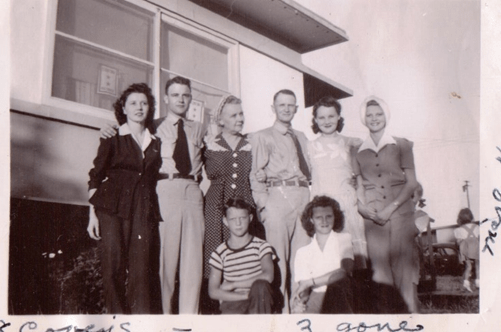
January 9, 1962
Dear Children;
I thought you might like to know of some of the happenings in our lives, so that you could either cherish them or shudder at the stark reality.
Your dad and I, together with our dearest pals (Pearl and Walter) eloped when we girls were seventeen and the boys were twenty-two. [May 29, 1909] We hired a team and two seated surrey (with the fringe on top) and drove twelve miles to the little town of Verden.
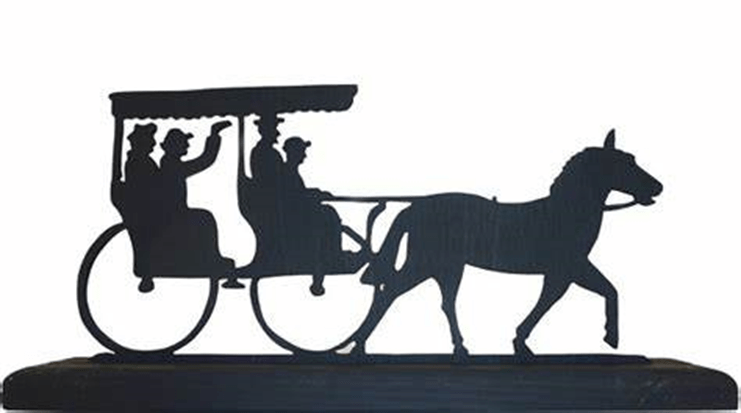
A Surrey with a fringe on top
reminiscent of the musical “Oklahoma”.
We drove around looking for a minister, but they were either busy or out of town, so we settled-for the Justice of Peace. By that time the townsfolk had scented a marriage in the offing, and were gathering in with rice and old shoes. We were all scared, but your dad. He kept us from running back home by his wit and advice. Your dad and I stood up first, he was so brash (to keep me from fainting) that he really overdid it. The people that were peering in at the door were his audience. One lady whispered to another (and we heard), “That young man has been married before, I’ve been married four times and I know.”
Finally, the ceremony was over and we ran down a back stairway, to avoid the crowd we got into our surrey and drove down the Steet, while the crowd was watching the front stairway to shower us with rice and old shoes. They saw us as we drove by, but the traditional rice missed us.
Your dad reassured us by saying, “Verden is a good omen as it means green and beautiful.” “The girls,” he said, “are beautiful and the boys are green!” He also said, “Our lives will be Verden, just one beautiful landscape — our sorrows and worries are over.”
We got back to our home town, and as the boys had no money, we decided to walk the four miles out to my home. I had new slippers, which were hurting my feet, so your dad put them in his pocket and gave me his shoes. He walked in his sock feet, stepping on ‘sandburs’ and yelling, to keep us all laughing. He was singing an old song, “Cornbread and coffee is good enough for anyone, cornbread and coffee is good enough for me,” as we joked about not having a penny.
We planned on that walk, and decided we would never have children, as they were so messy, and we wanted our lives to be free of all the work and worry that children are. (How naïve can you get?) We met neighbors going home from a dance, it was late, and, as we wanted to keep this our grand secret, we would bend over and walk with sticks to look like old people and no one knew us.
Your Dad rented a farm from two Comanche Indians (Mable and Elmer) so eventually, we had to tell my parents, as he wanted to move to this farm. They were very sad about the whole thing but wished us well. So, we moved to our first home a three roomed house, on the bank of a river. The Indians lived near us in their tepees. They had both been to college, and would talk to us, but would be dead silent when strangers were around. They seemed to love me and wanted to help me in any way they could, so I spent a lot of time in their tepee, learning a little of their language and some of their beadwork.
At one time during that summer, the Cheyenne, Arapahos and Comanches held a big dance. It was about one-half mile from our cabin. They had signs posted around “No white people allowed,” so Mabie and Elmer gave us Indian blankets to wrap around us, and we went with them to the Indian dance. It was really something to see. They had a big bonfire, and the Braves danced the war dance around the fire, dressed in the feathered war bonnets, bending over to the ground then throwing their heads up and yelling. Then they danced the ghost dance, and our friends told us to join in with them. The dance was a single file of Indians, stepping forward then back; so we danced with them and they never knew we were not Indians.
I was a big coward, and by that time, much to our surprise, I was pregnant, so your Dad and our Indian friends tried to take good care of me. We lived near a railroad, and one day I was working (or reading, probably) in our house. I heard a noise and looked around and there stood a hobo looking at me. He was standing on the lower step, with one foot on the top step. (I’ll never forget how terrified I was). I threw up my hands, yelled, and practically ran over him. I knocked him off the step in my wild flight, and ran for my Indian tepee, crying. Mable saw me and thought I was in labor. She ran for Ed, who was working in the field. He came running but the hobo was gone.
Your dad said, while he was home, it was dishwashing time anyway, as we washed dishes about once a week. He would bring in the tub, heat the water on the stove, then we’d wash up our two sets of dishes we had received as wedding presents.
We had no time in the evenings, as I read aloud to him. He was entranced with the books, among them were “Darkness and Daylight,” “The Mississippi Bubble,” “The Brigands,” “Buffalo Bill” and many others. I had many terrifying experiences there [on that farm], and maybe I grew up a little.
Finally, our first baby was born, a beautiful brown-eyed boy. We named him Theron Leon and completely forgot all that we had said about “messy babies.” He was the most wonderful thing that had ever happened to either of us. We adored him. Our darling baby looked so little and red that we thought he was overcome with the heat, so we would lay him near the door and put a damp cloth over him, and your Dad would fan him. He developed a cold which stayed with him.
We then rented another farm from a dear old friend of the family. He wished to help us by giving us chickens and lending us cows to milk (he said) and I quote, “To pay your expenses until your crop is gathered.” Foolish kids that we were, we were just not interested in milking a lot of cows or tending chickens, so the cows’ milk dried up and the chickens ran wild.
Four of your Dad’s brothers and three of mine came out to help us gather the crop, which they could have accomplished in one month, but the rains came and they stayed all winter. We wished for the cows’ milk and wished we could find the hens nests before that winter ended. Finally, they got other jobs and departed, “Oh! Happy Day.” We loved them but were glad to have our little household again.
Your dad loved our little Theron so much, he would take him out to ride on the cultivator with him. The baby seemed to love it, but I missed him so in the house that I would go out to the field, too. Then he took sick with a high fever and cough, so we called a doctor. He came everyday but shook his head and terrified us. We loved Theron so much.
Then we called the Doctor again and he said, “There’s nothing else I can do.” These were the cruelest words we had ever heard. Our baby sunk into a coma, and as I was pregnant again. Our neighbor lady (who was helping me) did not want me with the baby. I went in anyway, and he knew me and raised his little arms up to me, the neighbor lady gave me a shove out of the room and he died right then. That was our first tragedy to endure. | could not have endured this sorrow without your precious Dad. He talked to me and tried to explain “ours not to question why,” and in a way, I was comforted. Things like this are so hard when you are so young. I tried to be interested in the new baby on the way, to relieve my suffering, but everything, everywhere reminded me of Theron. But we live on.
Two months passed. I decided to go into town, stay overnight with my parents, and bring the groceries home the next day. Your Dad hitched our old buggy horse to the buggy, kissed me goodbye, and warned me to be careful. I jolted that nine miles into town, hoping that maybe this baby would be born, as I was so lonely and also, tired of being so big and unattractive to my darling husband.
Fifteen minutes after I got to my parents home, our second baby was born. We named her Nelle. She had grey eyes and black hair, like your Dad. (She crept into our hearts and stilled the throbbing sorrow.) My mother sent word to your Dad to bring the baby clothes in and meet his new daughter. He was so excited that he could not catch our wild horses in the pasture, so decided to walk or run [the 9 miles to town]. He said he cut across fields, ran into fences, and fell into ditches, but finally got there. He had baby’s bonnet, a pair of safety pins and a can of talcum powder in his pockets. Of course, he went back the next day and brought the little trunk of baby clothes. We gave our Nelle the love that we had so much of.
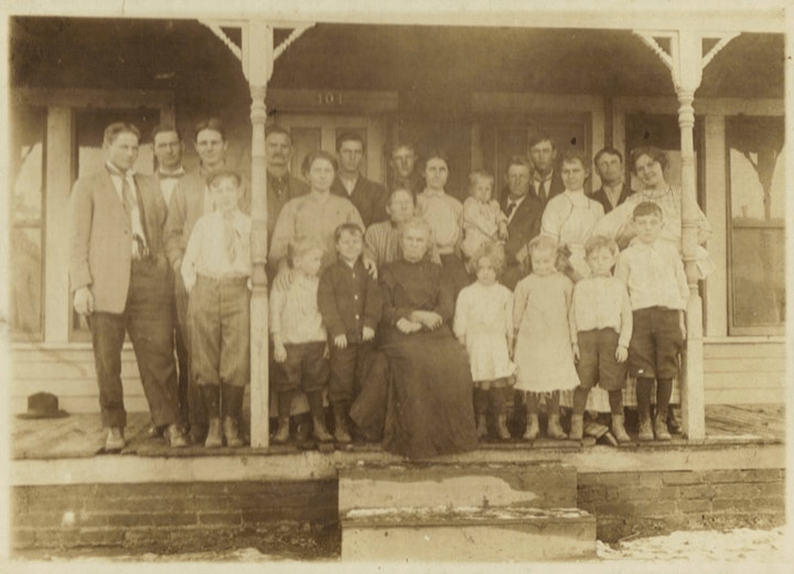
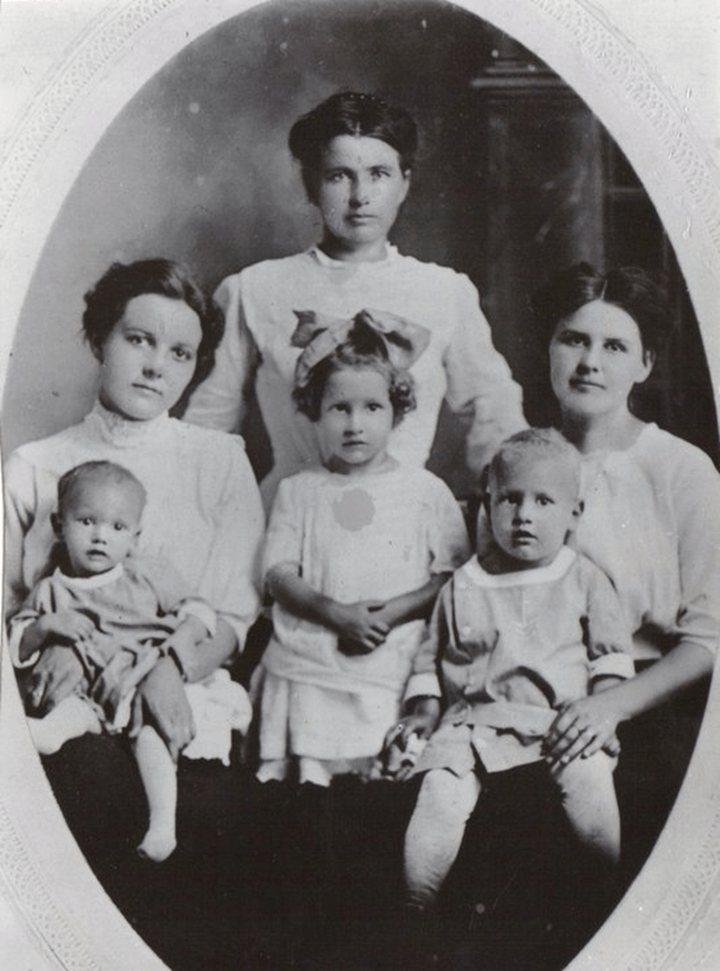
Back row, left to rt: Lloyd, Walter, Floyd & B.B. DeLay, Fred Acton, Carl Covey, Belle Wiley, De Stockton being held by father Calvin Stockton, Frank Covey, Leona (DeLay) Stockton, Ed Covey, Belle (DeLay) Covey holding Nelle Covey.
Front: Hubert Wiley, Nelle Ann (Wiley) DeLay (2 kids in front are Oren “Bud” Acton & George Acton), Hallie Wiley Acton, Amanda Rebecca (Buckmaster) Wiley, Belle Stockton, Leta Acton, Marion Wiley and Leo Wiley. Many of these family members had moved to Valley County, MT by 1914.
Then we decided that we were failures as farmers, and as your Dad had heard of so much work in Fort Smith, we planned to go there. So, we gave away our little accumulations, our two sets of dishes we had received as wedding gifts, table linens, bedding and our old grandfather clock that this man we rented from had given us. It was an old Seth Thomas, and even told the month and the day of the week, but it had to be wound every week, so we left it in the house as we just couldn’t be bothered.
We arrived in Fort Smith with enough money to rent a small house, buy a few groceries, and milk for our baby. Then your Dad proudly started out to give the town his services, but the town was not impressed, and after trudging the streets until he was exhausted at night, he finally, got a job in a feed mill. He worked there three weeks, and contracted pneumonia from the dust of the mill. I knew he had pneumonia as we had so recently gone through it. I worked with him day and might to keep the fever down and to keep him breathing. God, and my little Doctor book finally got him on his feet again.
We knew by now that this was not the “Haven” we sought, so your Dad left me the little money we had, enough for milk for our precious Nelle, and strawberries for me as they were the cheapest thing on the market. Tears ran down his cheeks as he told me “Goodbye, and said he would send for me soon.
He hopped the freight train and went North. In about two weeks, I got a letter from Wichita, Kansas with the money for me to buy my ticket, telling me not to be scared as he would be right there to grab me in his arms the minute the train stopped.
It was a good thing that he told me the name of the street car, and to ride to the end of the line, (which would be near my parents’ home), for I arrived in that fabulous City, with my Nelle and suitcases and no one to meet me. So, the little “chick from the sticks” found the street car, and started to ride to the end of the line, when your Dad boarded the car. He had met the wrong train and had started to walk out, but decided to ride. and there I was.
Needless to say, we were overjoyed to be together, and your Dad said, “Never again will we be parted.”
Things were real bright for us in Wichita. We worked on a ranch for a horse buyer. You Dad would help him break the horses and I was a lady of leisure. This man we worked for, furnished me a beautiful mare, a stick-wheeled buggy, and long leather fly nets for my mare, a very impressive rig.
Your Aunt Loney came out to visit us, with her children, Belle and De. We decided to go to town to visit Mother, so we sat Belle and De down by the dashboard, with their backs to the horse, and started to town. Aunt Loney was holding Nelle, and I had the horses lines wrapped around my hands, as my mare was a high stepper and very skittish. I had been raised around horses, and was not afraid of any of them. We met a car, (a very rare thing), and my mare stood up on her hind legs, fell back on the buggy, and broke one buggy shaft, set the bits in her teeth, and ran away. Since the buggy was only fastened on one side, it zigzagged across the grade. Aunt Loney threw Nelle out into the weeds by the side of the road, then she fell out as the buggy went off the grade on her side.
I was still trying to hold the horse and losing my nerve at a fast rate. Then the buggy went off the grade on my side, and I fell out. I mediately ran back for my little Nelle, and she was crying lustily, where she had fallen. I was so glad to hear her crying, as my heart had almost stopped beating when she was thrown out. The other two children were in the buggy, and a neighbor man ran out and stopped the mare. We were none of us, seriously injured, where once again “God was not ready for my demise.” That did it, for the farm, we moved into town where your Dad got a real good job on the Railroad.
We really enjoyed our life in Wichita, going to the shows at night, or just strolling up the avenue at night. Nelle, by this time, could stroll along with us. We were so proud of her, as she knew where to walk to stop a streetcar. She could sing all of the latest songs, such as “Nobody’s Little Girl,” “Trail Of The Lonesome Pine,” “There’s A Girl in the Heart of Maryland,” and many others.
Then my parents wrote us about the many advantages for the homesteaders in Montana; so, we packed our belongings this time, we did not give them away as before, and boarded the train for our long trip to Glasgow, Montana. We had passes on the Railroad as your Dad’s boss told him not to tell the Company he was quitting, so he gave us round trip tickets. We sent back the return ticket after arriving in Mont.
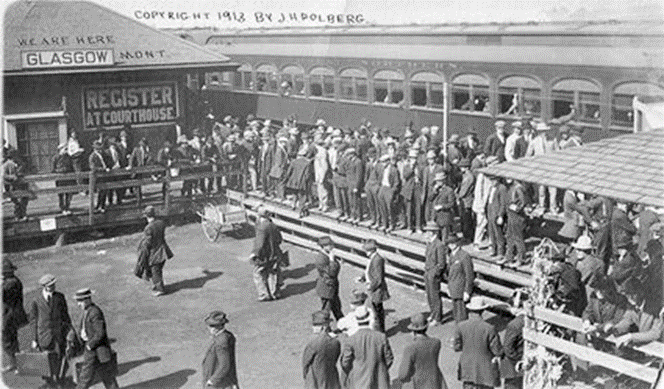
We arrived in Glasgow, Montana, and went to one of the two Hotels there. As this was before the days of the car, your Dad set out to find a livery stable, to hire a way out to Lismas – twenty-five miles away. The stable man told him there was a lady and her daughter at the other Hotel, also, wanting a way to Lismas. He said the lady’s name was Mrs. Porter Flint, and your Dad had heard me speak of her, my Aunt from Colorado Springs, Colorado.
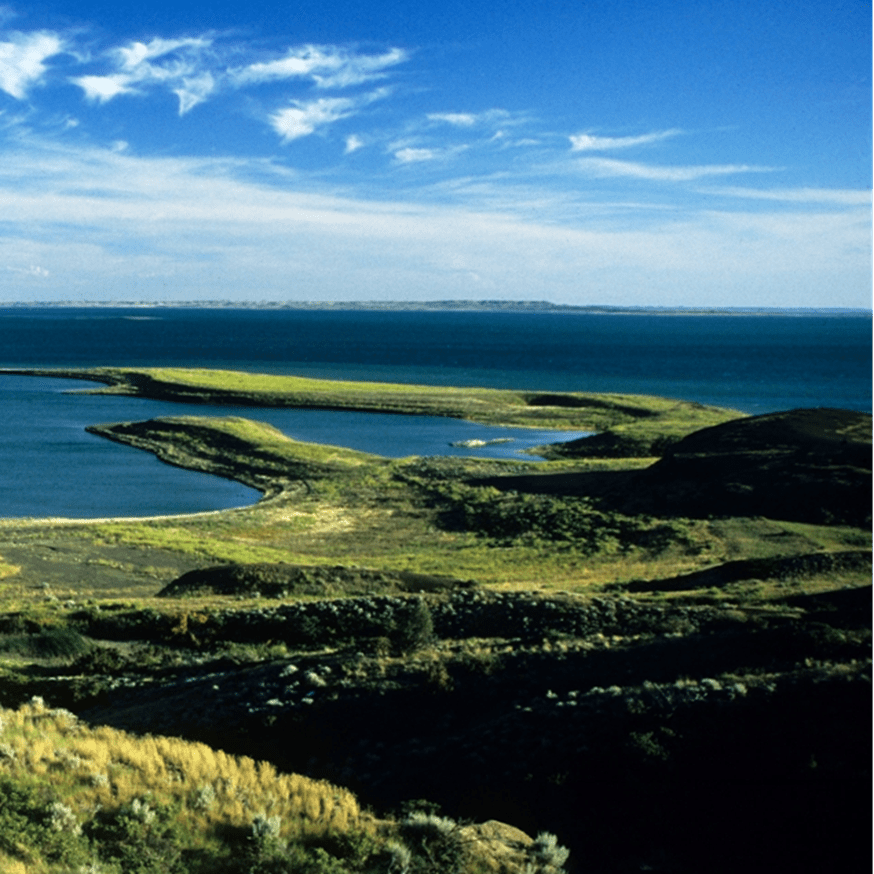
He went over and introduced himself. Nelle and I were walking up the street and we saw your Dad coming with these two beautiful ladies holding his arms and waving at us. I had not seen them since I was eight years old.
We all went together with the mailman to Lismas. Lismas consisted of a Post Office, dance hall, roadhouse and saloon. On the twice weekly mail days, the community 10 general, was at the post office. So, it was a Red-Letter Day, this day of the mail’s arrival, as it had four passengers, and a little girl. The Cowboys all gathered around removing their sombreros, grinning and bowing. I told my Aunt to look at that old mountaineer, standing alone. He had long whiskers, but I looked at his twinkling brown eyes, and leaped from the mail wagon. I grabbed this mountaineer and hugged and kissed him. He was my Dad, gone native.

To make a long story short, we took a homestead and built a little log cabin ten by twelve. I can honestly say it was the most beautiful and loved home I ever had. As I was expecting another baby, I became interested in the Medical field. I sent for a large book I called “Vivalore” explaining all about child birth, and advocating Tokione tea for the mother when labor started. This tea was to completely relax all the muscles, making child birth natural. I sent for the tea and had it ready for the great experience.
As soon as we were settled, we were asked to play for a dance at the Lismas Hall. We went over and the orchestra had come out from town. They asked us to fill in, then they (the cowboys) wouldn’t let us quit, so the orchestra went back to town. I was 25 and your Dad was 28 (if you can ever imagine us being that young). We were named “The Fiddler and his Wife” and furnished music all over that country in those early days.
It was characteristic to “nickname” everyone there, so I’ll try to recall some of the names as we knew them by. “Scotty” ran the saloon there. He was an old guy from Scotland and our most ardent fan. “Billous Bill” was a rancher near by; “Wolf Tooth” was horse raiser on the Big Dry. Needless to say, he had buck teeth. “The Sage Hen” was a lady with a homestead near us.
“Rattlesnake Pete [Sikes]” lived up the river about thirty miles, and was sleeping in his cabin one night. He heard a noise, put one foot out of bed on the floor. Something stung his foot. He put it back. He put the other foot down, the same sting hit that foot. He lit a candle and saw this huge rattlesnake coiled near his bed. He had his revolver under his pillow, so he shot the snake then went out and stood in the mud, as he had heard that was an antidote. Then he got his saddle horse and rode thirty miles before he fainted. He was cared for and lived — hence the name “Rattlesnake Pete [Sikes].”
“Four Eyes” was another rancher who wore glasses. “Rawhide” was a Missouri River rancher and alfalfa man. “Booger Face” was a very ugly man, poor guy? “Bear Track” was an old bear hunter nearby.
My parents had filed on a very wonderful ranch on the Missouri River bottom, where they could foresee “alfalfa” after the land could be cleared. This land had been fenced by a man who claimed the land, and had kept it from being homesteaded by telling everyone it was his. My dad went to the Land Office and found out that this was Government land and an open to filing, so he immediately filed on it. This other man tried every way to run them off the land.
By this time, they had built a log cabin from their own trees, and were clearing the land and selling wood to the “bench farmers.” (This being the people that lived above the river bottom lands.)
My dad had a plan that anyone could have the wood free, if they would clear the land as they went along. He, also, would give them their dinner while they were working. You Uncles, Walter and Floyd, as well as your Aunt Lonie, Belle and De [my sister’s kids], all lived in this place with our parents. Your Dad loved my parents as his own, as he had been an orphan living first with one uncle then another. [Note: This last sentence is lined through with pencil. Why?] One day while the folks and some of the woodcutters were eating dinner, someone pounded on the door. Your Uncle Walt saw quick as a wink, this was the one that wanted the land). He had a rifle and had knocked on the door with it. He was on a horse, and as my Dad swung the door open, your Uncle Walter leaped and grabbed the rifle. The man intended to kill my Dad, but the bullet (thanks to Uncle Walter) went into the floor at my Dad’s feet. Then your Uncle swung up on this man’s horse as he tried to run away, took the rifle from him, and drew up to shoot him, when one of the woodcutters grabbed his arm, and the bullet went wild.
This man then went into town and had my Dad arrested, as the sheriff and the lawmen were in cahoots with these illegal land holders. My Dad had to pay a fifty dollar fine, but they did not get him off his land.[1] By this time, we were playing for all of the dances for forty miles around, saving our money and living fine. We
[1] I found this in the Jan 8, 1915 edition of the Glasgow Courier, which may relate to the same incident: “S. H. Miley was taken into custody Tuesday charged with assault in the second degree, the complaint being sworn out by B. B. DeLay. The hearing will be held on Monday.” Apparently, this incident resulted in a trial a few months later. The Courier reported on Mar 19, 1915, that Miley and several members of the extended DeLay family had been granted witness allowances by the county commissioners.
would make twenty dollars per night at these dances, which were more like neighborhood gatherings, as the ladies took the cakes, sandwiches and coffee for the midnight supper. They always had a wash boiler (I know you don’t know what that is) but it was a large container to fit on the cookstove to heat water in. They would make it full of coffee — delicious -delicious!! I’ll never forget those midnight suppers.
The women were so few and far between, that we gals that were there, were really popular. The cowboys would come sliding across the waxed floors, whenever I could stop playing the guitar long enough to dance. The first one there would be my partner. Half of the cowboys tied white handkerchiefs on their arms to replace the girls; that way they could all dance, and they did love to dance.
It was a custom among the cowboys to try and break up the married couples. One nice couple came out and bought the road house near the dance hall. Soon these cowboys started their little game of stealing the wife away. One cowboy named “Shorty” fell hard for this woman and danced with her all of the time for a few dances or a few weeks. Then the fatal night was there. Shorty came and danced with her continually until midnight. After supper, he started to dance with her again. Her husband went to him and grabbed him by the back of his collar, and jerked and walked him out of the door. “But the dance must go on” so we kept on playing, and the others danced. Three other cowboys went out to help Shorty, but this husband had an iron bolt on the outside window sill, had used it as a club, and whipped all four cowboys. He came back into the hall, went up to his wife, bowed, and asked her to dance. They danced awhile, then he said “Stop the music. I just wanted you all to see I could dance with my wife! Now you can have her.” He left the country. She got a divorce and married Shorty. This is just one of the stories of early Montana.
By this time, it was getting to be a task to hide behind my guitar, as my time was almost over, and the new baby would be with us. I told Nelle, she was going to have a little brother, and she danced for joy. There was to be a big dance at the hall this night, but I told your Dad I was going to stay home. He did not want to leave me, but I told him, if I should get sick, I would put a light high up in the window. He had to go, as we had hired out to play for this dance. He said he would watch for a light and God pity the dancers, as he would run for home, if he saw the faintest glimmer. Your Aunt Loney came to stay the night with me.
I asked her what she would do if got sick this night. She said, “Why I’ll deliver the baby as your Doctor book tells how.” She said she was not afraid. Soon I caught my breath and gasped with a sharp pain in my back. She was petrified with fear. She said, “I’m going after Mother.” Mother lived two miles away, and the snow was three feet on the level. Your Aunt Lonie got into her overshoes, overcoat and helmut (sic) and ran out into the snow.
By that time, I was having pains periodically, so I got my Tokione Tea, brewed it and started drinking all that I could hold. I then, boiled the scissors and cord, prepared the bed for labor between those awful pains. I forgot to put the light in the window, as you see I was too occupied. I was very confident that I could deliver this baby alone. My pains were coming steady now, so | got my Tea and implements, also, my Doctor book, and put them near my bed, where I, finally, had to lie down. Ten minutes before my baby was born, my Mother and Aunt Lonie lurched into the room. By the time they got their coats off, our beautiful baby was born, another precious brown eyed boy.
Soon your Dad got home from the dance. I can see him yet as he came into the door, when I said, “Come and see your boy.” He Just stood there and stammered, “Why didn’t you put the light in the window.” We were so proud of this new addition to the family, but Nelle was disappointed as she said, “I thought you said he would be big enough to play with me.”
We named him Elijah Boen for his two grandfathers; the greatest honor (we thought) a boy could have. Scotty, the old Scotchman that owned the Saloon, told your Dad to come over to his place, as he had a potato digger to give him. The “potato digger” turned out to be an old baby buggy. We really appreciated it, as it made a wonderful bed for Boen.
Our garden was about one-fourth mile from the house. Your Dad planted potatoes, but I didn’t know just where, so I planted radishes, peas, beans, etc. When they came up, it was a mess, as I had planted them right in the potatoes. So, our garden was the laughing stock of the whole country. Neighbors would drive over just to see “that garden.” We had a little of everything and hoped to do better next year.
One day, I had Boen in his buggy, and Nelle with me. We went to the garden. Two herds of cattle were coming from different directions. I saw two bulls running to meet and start fighting. I ran with the buggy, dragging Nelle until I was safe in the cabin. Mexico could never put on a more thrilling, scary bullfight and we watched it with horror, until the dust and darkness obscured it.
In the winter, we melted snow or ice for water, but in the summer, we hauled it in barrels from the river. One barrel of water would last a week, used sparingly. One day will always be in my memory. Your Dad was just coming into the gate, with two barrels of water on the wagon. Nelle ran to meet him, started to climb up into the wagon on the wheel. The team started up, and she went down with the wheel, and the wagon with the barrels of water passed over her body. She threw up her arms, which kept the load from crushing her chest.
By that time, your Dad, who was closing the gate, ran and picked her up. She seemed lifeless. He was shaking her to get her to breathe as I ran to them,I told him to stick her head in the water, which he did, and she caught her breath. It was late in the evening, we had no way to get her the twenty-five miles into town, so we sat by her bed all night; waiting for daylight.
The long night finally ended. She looked up and said, “Daddy, did you know the wagon ran over me?” She seemed to be alright, so we did not go into town and the Doctor.
We had saved enough money by then to build our house, (frame, not logs), and after weeks of hauling the lumber and materials, we started it. With the help of our neighbors, we soon had it ready to plaster. We were determined to plaster it, although we were told the plastering might freeze. We said we would keep a roaring fire in the little air tight heater and thus keep it from freezing. So, we plastered it. After a few days, we were sitting in our beautiful living room. Dad was holding Boen and Nelle and I was cutting out paper dolls. A horrible crash came and the plastering all fell from the ceiling. Dad ran with the baby, and I held Nelle, shielding her as best I could. What a mess it was! Old cement and dust, dust was everywhere. We knocked the rest down and the clean-up started, which eventually ended. We then put deadening felt and paper on as we were advised at the first to do. At least, we learned another lesson.
We were still playing for dances for forty miles around us. I remember when we played at the “Hole In The Wall” Ranch. It was owned and operated by a former World’s Champion wrestler, Edward Gotch.
A young tenderfoot had recently moved into the community. The cowboys initiated him that night. As he rode up on his horse, they surrounded him (on their horses), and chased him over the hills, down the coulees, yelling, yelling at him that they would hang his hide on a fencepost. He was a terrified boy when he got back to the dance, and just couldn’t believe that these “cowboys” were just friendly neighbor boys trying to get acquainted.
By now, Boen was big enough to enjoy Nelle’s stories, and the new baby was ready to join us. My dear parents came to help us usher this new life into the world. After hours, our Lotie was born, a little brown eyed girl, and a little doll.
By this time, we were noticing Nelle was becoming extremely nervous. We knew we had to take her to the Doctor which was twenty-five miles away and the temperature was fifty degrees below zero. We prepared for the long bobsled journey. We heated huge rocks and bricks, took jugs of boiling water and blankets galore. We wrapped her in the blankets and with the help of the crude heating devices, left the other children with my mother and started out.
We stopped twice on the way in, as there were only two houses between us and town. Finally, we got to the Doctor. He told us that she had Chorea, (a neurological disorder) caused very probably by a spinal injury. Of course, it was the wagon running over her. He gave us some medicine, advised us how to care for her, so we started the long journey home.
We stopped at the two farm houses again, warming her and giving her hot soups to drink, and started the last fifteen miles of our trip. A terrible blizzard came up and it was getting dark. Your Dad could not see how to drive. We could not see the horses, as the snow was swirling as dense as a wall.
Somehow, we got off the packed trail and the horses were floundering around in the four feet of snow. Your Dad gave me the lines, got out of the sled, and in front of the team so he would not get lost from us. He was trying to find the packed trail. | was thinking fast, we could burn the sled one piece at a time, turn the horses loose (as they were broncs and we could not ride them), burn the harness, and try to keep Nelle from freezing. Maybe we could hold out until the dawn when someone might find us. If we were not found, it would be just another case of people freezing to death, which was common in those hard early days in Montana. Luckily, your Dad found the trail, and the horses took us home.
We brought the other children home and life went on. Nelle grew much worse that winter, as the Doctor had said. She could not talk or walk, but we worked steadily with her and it was a happy, happy day when she walked across the room again.
When Lotus was fourteen months old, our blue-eyed boy came to make his home with us. We named him Edgar Loyal. Now our family was complete, a blue-eyed girl and boy, and a brown-eyed girl and boy.
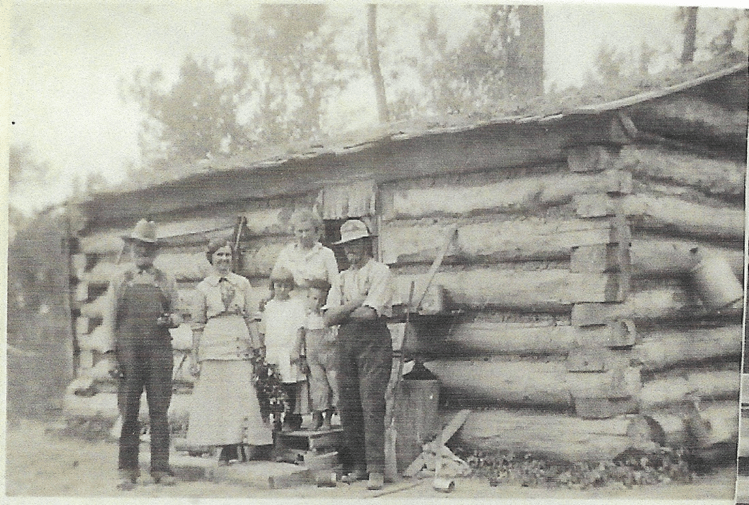
We sold the homestead and bought a river bottom farm at Nashua, but had to build a house. We finished it on the outside and moved in to complete it later. We brought our chickens down in a huge box, sat it in the barn-yard, and would bring our cows later. We got beds ready that night and had our belongings in bundles al] over the floor, as we were so tired we decided to forget it all until morning.
We heard an awful roar, just like forty freight trains coming right at us. The kids were asleep, so your Dad and I ran out into the yard. It was the river “breaking up.” The ice on the river was three feet thick. The river was about 1/4 mile from our house. Your Dad said as long as we could hear the noise, we would know that the ice was running, but, if it got quiet, we’d better run as that would indicate that the ice had jammed. Anyway, the neighbors around has told us that the river had not flooded that point for twenty years, but I was scared.
We went back into the house. I picked up my violin, shoes and Doctor Book and placed them on a shelf, jokingly saying, “that I would at least, have that much left if the water came in.” We went to bed and to hard earned sleep. We both awakened at the same time. It was deathly quiet, and we could hear water gurgling, as if bottles were being filled. Your Dad jumped out of bed into ice water, just ready to run into the beds. The water was so cold that I can hear the gasp yet as he caught his breath and started sloshing his way to the matches and the kerosene lamp. Just losing his breath at every step, he lit the lamp, and what a terrible sight.
The water was going right through the house. Chunks of ice were bumping from outside, trying to get in. “What to do with the kids!!!!” — We were frantic, so we put the bed springs on the rafters above (as the house was not completed), put a mattress up there, and I climbed up. Dad handed me the children, who were still sleeping. Daylight finally came.
There is always something funny to think of, regardless of the dire circumstances. I thought of Nelle saying the evening before, “Mother, what is April Fool?” I explained by saying, “In the morning I will tell you that a little girl is coming up the road pushing a doll buggy,” then when you run to see, I’ll say “April Fool!” But this morning, the road was a roaring current.
Our house was built in a park of trees, which was all that kept the ice from smashing it to bits. The ice cakes were about one-half acre in size. All around us, the small trees were cut down, but the larger ones held the ice back.
When the kids started to awaken, they were so surprised and Boen looked down and said “Mother, who put the river in our house?” Your Dad and I were parked on the dining table, ready to fix breakfast, and what a breakfast! I had “set” yeast the night before, to bake our daily bread, and that was our food.
We took the oilcloth form the table and tied it around Dad’s feet, as his shoes were gone. We went into the ice water waist deep in the yard, and pushed limbs up to the window. I would grab them until we had enough to build a fire, as the water was not over the firebox in the range. We sat the children on the table with us.
Nelle and Boen were enjoying life, as she told him stories and he loved it. Loyal was the baby and we had him propped up in the corner, with our dry bedding that we had saved. I can see him yet, how happy he was, watching the kids and smiling.
Our little sunshine, “Lotie” got real sick, and her fever got so high that she had a convulsion. We put water on the stove to heat, and bathed her in the hot water, put cold cloths on her head. Finally, she relaxed, but was a very sick little girl.
It was quite a feat to cope with all these things sitting on a table, and the ice water swirling all around you. Your Dad was the one that took it upon himself to cheer and entertain. He told us “I’m Tarzan,” and started swinging across the room, reaching from one rafter to another. The kids were hilarious, but he hit a faulty rafter, it broke, and down he came. The Lord was with him, though, as he landed on a chair, and didn’t fall completely into the ice water.
I sat on the table and read my Doctor Book (Thank God, I had saved it), so I could help Lotie. She soon was laughing at her Dad’s pranks. We put marks on the door at the water level to see if the water was falling. At four o’clock, it started rising at the rate of one inch in fifteen minutes. Our courage almost left us. I wrote a note, telling our names and ages, put it in a bottle (that was in the window), and threw it out into the current.
Dad sloshed out in the ice water to try and find the harness. Our two broncs were stamping around and looked as though they were wondering what it was all about. The chickens had drowned, but that was the least of our worries. Your Dad poked around in the water and found the harness, talked and cajoled the broncs, as he could tame the wildest horse with his soft talk. He hitched them to the wagon and backed it to the door. I carried the children out, one by one by walking on chairs and sat then in the wagon.
We could see a neighbor’s house about one-half mile away that looked as though it was above the water, so we started down there. We got into water so deep, that the wagon box with us all in it, raised up and almost floated away. Luckily, we hit a high spot and it settled back on the wagon. Can you blame us for being scared?? We were! And were proud of it.
We stayed with these people three days, and the water fell rapidly turning into mud and sediment. We went back home, took hoes and shovels and threw the mud out of the house, washed the floors and moved back in.
Our alfalfa seed was in one-hundred-pound sacks. Your Dad noticed the sacks were bursting, as the water had caused the seeds to sprout. He took the seed in pails and broadcast it over the ground that we intended for our alfalfa. It grew, and we had the most beautiful alfalfa of any field in the bottomland.
The sun was shining once more for us. We brought our cattle down home and started living again. We had some very good friends in this new neighborhood, “Brade and Bitha.”
We organized a Literary at the consolidated school, met each Friday Night, and we four put on plays. We really had the audiences, even from the town nearby. Your Dad was a natural at this work, and people, even in the town, thought that he was and ex-actor!!! Each Sunday, the family attended Church at the Galpin School where we both played violins in the Choir.
Time passed rapidly, and a new girl came to us. I went into town and had a DOCTOR, and tiny “Leona” with her big brown eyes, came to stay.
About this time, a new Norwegian neighbor came to our house, and calmly asked me if I could come over, as his wife was sick. We were eating breakfast, and I asked him what seemed to be the matter. I was electrified when he drawled that she was going to have her baby. I grabbed my Doctor Book, and coat, and left Dad (out of the field) with the kids and went with the neighbor. The lady was in hard labor in a very cold room. I made him put up a heating stove in her room, and put water on it to boil. I rolled up my sleeves and went to work. Finally, a little girl was born. I prepared everything, but I would not sever the cord, but showed him how to do it. I was ready to go home, shaken up so bad that my teeth chattered. That was my first at delivering babies, of which I did a lot after.
We put a floor in half of the attic, and made a playroom for the kids. They could play with their dolls and little cars, and really enjoyed it. We put building paper over the rest of the rafters for a ceiling in our living room. One evening, your Dad and I were reading, baby sleeping, and the rest in their playroom. Suddenly, there was a scream and Loyal came flying through the ceiling paper, and lit, rolled up like a ball at our feet. I could not move. I told your Dad to pick him up, and see if he was still breathing. The breath was knocked out of him for a second, then he started crying and saying “Lotie pushed me.” She was also crying, and denied it vehemently. To this day, it is one of the unsolved mysteries in our lives.
Our Doctor advised us that Nelle would be better off in a warmer climate as she was extremely nervous. We sold the ranch, cattle and our beloved horses, (probably glad of an excuse), packed what we could in the car, with our five treasures (children), and started South. We were so happy and just knew that all would be well when we got there.
We settled at a little town called Purcell, and tried everything, even to picking cotton. Don’t hang your heads in shame, my dear ones, for we were either so confident or ignorant that we were completely happy. We just knew that just ahead was “Verden,” the beautiful green land.
We rented a farm from a real nice old Indian, Mr. Perry. His wife was a white lady and they had many farms around there. They really treated us royal. We were very successful that year in more ways than one. It was there that our little “Buck” was born. We sent for a Doctor when the time came, but he did not get there until the baby was two hours old. It was a terrible experience as he just could not be born. (I’d forgotten all about my “Vivalore” and tea by this stage of my life.) I was almost completely disillusioned, and almost dead when he finally was born. He was another beautiful brown eyed boy. We all adored him and I soon forgot all the torture of the birth. They could all sing like larks so we became very popular in the neighborhood, as we still played the violin and guitar and the children sang with us.
Dad, Boen and Loyal were working in the broom corn. Your Dad cut his wrist with the sharp dry leaf of the broom corn. It severed the leaders (sic?) and he had a terrible arm. I doctored it by bathing it in hot water and applying a salve that I concocted from Vicks and iodine. It healed rapidly.
The next thing that happened, your Dad had a most prized leather jacket. He hung it on the corral fence and was working around and our old cow chewed one sleeve up and had started on the rest, when he discovered her. It was an awful loss as we were not able to replace it. These were trivial occurrences compared to the day I saw them coming home.
Your Dad was ahead of Boen and his face was as preen as “Verden.” I rushed to meet him and he was very sick at his stomach. I got him in the house and asked him WHAT caused it. He did not know. I knew he must have been poisoned by eating something. Finally, he remembered that he had plowed up a root, and thinking it was an artichoke, had tasted it and had given Boen a bite, but immediately knew that it was no artichoke. He told Boen to spit it out quick. I fixed warm water with mustard in it and made him start drinking or gulping it down. I then ran to meet Boen who was weaving in the wind. I got him in and to bed and made them keep drinking the warm mustard water. Finally, they started to throw up the green poison. We found out that they had tasted a deadly poison root called “Poke Root.”
After the children had finished that school term, we rented another farm and moved, to Lawton, where we really drew a “meanie” for a landlord. He and your Dad disliked each other from the start. We planted our crop and it came up beautifully. Baby Buck walked, Nelle was so much better. What more could anyone ask of life?
Loyal started to school that year. He came home so proud of himself and said, “The teacher said ‘who can spell “Cat” stick up your arm,’” and it seemed that he was the only one that ‘stuck up his arm.’” Of course, he meant hold up your hand.
We played for dances at Medicine Park, a summer resort near us, which kept us going until the Autumn.

This landlord had a grandson about Boen and Loyal’s age. He left Boen alone as he was afraid of him, but he would hit Loyal with a whip when he could catch him alone. Finally, Loyal had enough of it, and jumped on the boy, and gave him a sound threshing, much to the landlord’s horror. Your Dad was hitching up the horses and watching out of the comer of his eye. The landlord grabbed a leather whip and ran to Loyal and said to your Dad, “I’m going to whip that brat.” Dad looked him in the eye and said, “Go ahead if you feel lucky.” He did not whip Loyal, and the feud went on. We raised a wonderful crop of cotton that year, and your Dad hauled his own cotton to the market. No renter had ever done that before with this landlord, but your “Irish” Dad was too much for him.
Then we moved to Anadarko, bought a corner lot, built a small home, and got the kids in school. Your Dad got a job and time went on. I was pregnant again, but at three months, had a miscarriage. I was combing Nelle’s hair when I started hemorrhaging. She ran for Dad. My brother (your uncle) Walter and Aunt Anna were there, or I would probably have died. I had lost so much blood that I was fainting away. Your Uncle Walter called a Doctor then rubbed and slapped my arms to keep me awake. Finally, the Doctor arrived. He was disgusted, and said, “What have you done to cause this?” He gave me something to clot the blood and left. Then I was soon back to work, a little thinner and whiter but able to care for my precious family.
Poor little Boen and Loyal had a hard time when we first moved into town. There was a boy that would catch them singly and whip and chase them home. One day Boen came home with the buttons all torn off his shirt, and just messed up in general. We said a bunch of men had put a chip on this big boy’s shoulder and told Boen to knock it off. A fight ensued, and Boen fought gallantly, but this boy was too big for him. Boen and Loyal planned a way to get him to fight them together. Their plan worked and they whipped him to a “fare you well.” That ended their trouble with the Law boy.
Nelle was in High School by this time and belonged to the Glee Club. She loved to sing. Boen was the top student in his grade and Loyal was, also, a top student. Lotus and Leona were doing fine, skipping to school with a song in their hearts. Boen and Loyal were both interested in the guitar and were doing real well, especially Boen as he put more time to it. They both had paper routes and were boys to be proud of (and were we ever!)
Your Dad bought a beautiful “Chevy,” (it was second hand) but as shiny as new. We decided to go to Montana and visit our loved ones there, and also, show off our new car. We planned to surprise them. We locked up our house, and took off for the Summer, as your Dad could help my Dad in the hay. We could make expenses, then be back for school. Oh happy Day!!!! when we finally started. We drove the first two days in perfect peace, enjoying the scenery, the children singing, the baby happy as the rest.
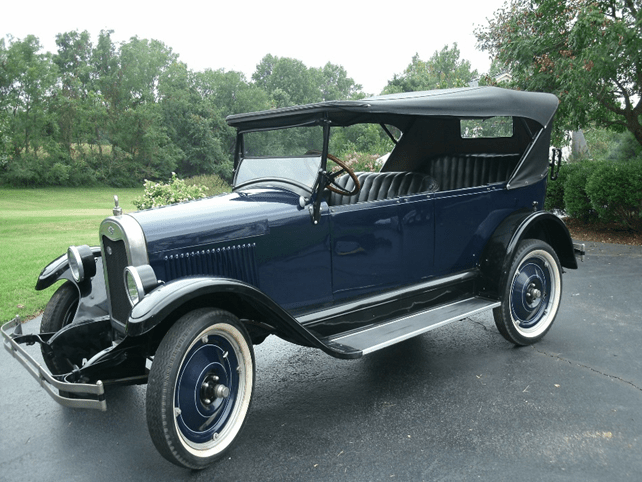
Then our Lotie got sick. She was such a delicate child, took a high fever and had a convulsion. We stopped by the side of the road, your Dad drained the hot water from the radiator of the car. We bathed her and after two hours, we started on again. Nelle was holding baby Buck and I held Leona.
Buck was not a baby by this time, but we all babied him and adored him. (He and Leona were constant pals. She was really no larger than he, but thought she was “big sister. He slept with your Dad and I. The boys, Boen and Loyal wanted him to sleep with them. He would go to bed with them, they would tell him stories about “motorcycles, and try to keep him with them. We just couldn’t sleep without him, so your Dad would begin, “I wish I had a little boy to sleep with me.” Then I would say, “I’d cover him up with a little blanket,” and here he would come, with the boys protesting, “Oh Mother!!! ”
Another two days and we were in Casper, Wyoming. As we neared Casper, a black cat crossed our trail, and shortly after, we saw this drunken driver coming. Instead of making the curve, meeting us, he headed straight for our car. I yelled, “He’s going to hit us,” and WHAM!! He hit us so hard that he cut our front wheel off, dropping the axle down into the pavement. This threw the car back on the railroad track, where a freight tram was coming down grade. Our windshield, the old heavy glass, flew right through the car. A small bit hit my forehead and Leona’s cheek, just enough to bleed a little, and completely missing the precious kids in the back seat. The glass went for two hundred yards back on the road.
Loyal was thrown completely out of the car and hit the railing that shielded a ravine one hundred feet deep. This happened in a split second. Your Dad leaped from the car ran onto the railroad and tried to wave the train down.
The engineer was blowing the whistle in a constant blast, but the train was an oil drag, and too heavy to stop on the down grade. I herded the crying children up the road, and held my breath awaiting the crash. SLAM!! BANG!! And away went our beautiful Chevy down into the ravine one hundred feet deep, smashed to “Smithereens.” Cars were stopping and people all around us were watching. The train finally stopped, and the engineer came back to see how many were killed. (But God still had use for us and spared us.)
The car that hit us had a man and his housekeeper in it. His windshield has broken and the glass had cut her head real bad. While the train was stopping, she had fallen out of the car, and he ran away in his car, and left her crying there. Her head was bleeding profusely. She told us who he was.
The engineer had your Dad sign a paper not to sue the Railroad Co., but that he would see that we got a new car and $100.00. We were too dumb then to know that we could have sued for a large amount, but I don’t think your Dad would have anyway. As it was, he was so honest and above board, he figured it was not the engineer’s fault (and it really wasn’t).
The people that gathered around us were kind. I was hushing the children from crying, and trying to see if Loyal was hurt, when a kind lady put her arm around me to offer kind words, and I burst out bawling louder than any of the kids. They took the kids and me to a hotel for the night, but your Dad wanted to stay with the wreck, as our clothes and so forth were there. Boen and Loyal begged to stay with him. He said they could sleep in the bedding from the car, as the authorities would be out in the morning to investigate. I could not sleep for worrying about them, and I knew Loyal was hurt from the fall, and maybe Boen and Dad were hurt and we didn’t know it.
I got up at four in the morning, told Nelle to look after the kids, and to stay in the room until I got back, and started to walk out to the wreck. It was six miles, I found out, and I thought I’d never get there.
Boen and Loyal were having a “Jubilee” when I got there. They were singing “The Wreck of the Old 97″ to the curious people that were gathering. Loyal’s neck was swollen and black and blue where he had hit the railing in his fall, but otherwise, they were alright. I had heard from some of the kind people that that ravine was a rattlesnake den, so I ran most of the way. I was bringing them something to eat, and they were happy as larks, but your Dad was upset and worried. I tried to tell him that we were the luckiest people in all the world, as we were alive. He shook his head and said, “You are my mainstay.” Then I was happy again.
The police soon arrived, measuring the road and observing just where the axle went into the pavement. They discovered that your Dad belonged to the Odd Fellows Lodge, so told us to go into Casper for a few days, then we would get a new car and settlement. We went into Casper and rented a motel, which was called a Tepee Motel, where the floor was lumber but the tepee covered it. We all became real sick, with a fever and sick stomachs (perhaps from the terror and nervousness of the wreck.)
Our tepee was on a sharp slope of a long hill. We were all lying on the floor, almost too sick to raise our heads, when the brakes of a huge car above us, gave way. It came flying down the hill, hit the edge of our floor and smashed into a tree nearby tearing the car all to pieces, scaring us all half to death. Our fever went up, I know, and again we all cried, as we couldn’t take much more.
Then we started on with our Chevy, not a new one again, but a lovely second hand car. Somehow, no car would ever be as wonderful again, as the one we lost. A wreck just does something to your nerves. I could not stand to see a car coming to meet us. I held my hands over my eyes until it had passed. It seemed it was bound to hit us. I know your dear Dad was nervous but he dared not show it.
We finally arrived at the Missouri River, where we expected to cross on the ferry, but the river was out of its banks and the ferry could not operate. The ferry men had large boats (row boats) to take the passengers across. They would take the boat a half mile up stream (the river was one mile wide) then row like maniacs to hit the bank at the crossing. The river was very swift and the current swirling with whirlpools. We loaded into the boat with three other passengers and started across. The boat was so loaded that the water would slosh into the boat in the swift current. I prayed fervently that we would get across.
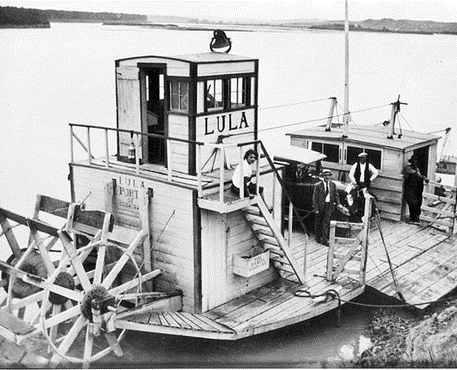
The Lismas, Montana Ferry
We landed at the shore, and there was Aunt Anna and Uncle Walter grinning at us. They had just gone for a ride, and decided to go see how the river looked. Of course, we’d left our car on the other side. We got into their car, and they took us to my parent’s ranch. We were so glad to see them, but had been denied the pleasure of their “umming and ahing” at our new car. I thought of a saying of my Mother’s, “Pride goeth before a fall,” and after years, I realized the meaning of it.
The time came to go home, I hated so much to tell my parents “Goodbye.” I managed to kiss Mother, but went up to my Dad (whom I loved so much) and noticed that his eyes were misty, so I said, “Dad, I just can’t tell you goodbye.” We had promised them we would come back the following Summer. I never saw my Dad alive again, and I wished with weeping, that I had hugged and kissed him goodbye. We had an enjoyable trip home and got the kids in school.
Then we got the telegram that my Dad had died with a heart attack and they sent me a ticket.[1] Oh, how I dreaded to leave! My family needed me, and I felt indispensable, but I knew my mother needed me now, if she ever did. Your Dad hustled me off to the train, and I was gone before I hardly realized it. The sadness of it all was crushing. I stayed with my dear Mother two days after the funeral, and went back home.
I had been gone almost two weeks and could visualize the children in the yard playing, and how they would run to meet me. I took a taxi out to the house, not a child in sight. I opened the door and stepped in. Buck saw me and started to cry saying, “someone hit me,” and there were the others all sick with the measles and mumps. Your Dad had taken you swimming, not knowing that you were taking the measles, so it hit you all pretty hard. Loyal and Buck were the only ones up, the others, Nelle, Boen, Lotus and Leona were delirious with a high fever. I went to work and soon had the fever down and everything under control, knowing for sure that I was indispensable. They were so glad that Mom was back that they soon were well again and back in school.
Your Dad was working at carpenter work so Boen, Loyal and I put in a share crop for some old friends. We had forty acres of cotton and made $500.00 for our share. After debts were paid, we put some in the bank for our next trip to Montana. We had to await the new baby’s arrival, so while waiting, we sold our house, but did not give possession. The baby was now due. I had engaged a lady to come and stay with us. I took sick on a Sunday, and could not get a Doctor. The lady was called out of town, so once again, my baby was born the hard way. This was a tiny blue-eyed girl with light hair and a very cute little doll. The day she was a month old, we loaded our truck and started to Montana.
I could tell of other trips, but I know you are weary, so I’ll just say we settled in Glasgow, bought a little house and got the kids in school. Buck was so eager to go to school (as Leona had told him so much about it), he asked, “When will I go to school and unroll,” as the others had to enroll.
When Ardy was almost two years old, Myma was born. I had a Doctor in attendance and all the trimmings. She was our third little brown eyed girl, with the dark curly hair and again I say, a real doll. When she was three months old, I had a mastoid, caused from hanging clothes out in the freezing weather. I went to the hospital and had this delicate operation. Your Dad stayed with me through this operation. He said they chiseled the bone in my head within one-sixteenth of an inch of the brain to relieve the pressure. I was home in a week and back to work.
We rented my Uncle’s alfalfa farm for one year, and kept our place in town but moved out to this little cabin. One of the neighbors gave Boen and Loyal a baby colt, whose mother had died. They raised him on the bottle and named him “Smokey.” They also, had two pet sheep that had been left when the herd passed by. We, also, had our old faithful dog, “Wooley.” My mother had given it to Loyal, when he saw him as a puppy and had fell in love with him. It was a common sight to see the boys with the horse, two sheep and dog following them over the hills.
One day I had my back to the door, and heard this “clump clump” and thought the kids were walking in on their stilts, looked around and it was Loyal, and “Smoky” had followed him right into the house. Boen was riding a mower and got a bug in his ear. It was a terrible
Missing Page
(Probably Page 22 on original manuscript.)
As soon as Boen finished High School, he started working there also. Then Loyal followed just before he finished High School (he later got his diploma). We begged him to go on to school but his mind was made up. Lotus worked at Penney’s and Leona at the Fair Store. Buck had a paper route, and, also, worked for a Bakery, and kept us furnished with bread, rolls and cakes. By this time, Ardy, Myma and Cleve learned to sing as a trio, and they were good enough to get on the Radio, where they broadcasted from KGCX each Friday for fifteen minutes.
Boen started to college at Bozeman, working in the summers at Fort Peck, and college in the Winters. He worked his way through, with very little help from us. While in College, he met his dream girl, and he and Sylvia were married when he finished college. She was a student nurse and a beautiful girl. So, another of our household had done out on his own. We were so happy for him but sad to give him up.
We also quit the orchestra, as so many strangers had come into the country, with the Fort Peck Dam, that the dances were getting rough, so we decided to quit.
The next year, we gave up three more of our household, Lotus, Loyal and Leona. Lotus married Marland, an old schoolmate, then Loyal married Helen, the girl he adored, and a doll, and Leona married Don, to use her own words “the handsomest man I ever saw.” I had used the same words years before when I first met your precious Dad. Lotus and Marland went to California two months after precious Marla was born. Loyal, Helen, Don and Leona went to Texas to seek their fortunes, and we were left high and dry in Glasgow with Buck, Ardy, Myrna and Cleve. Our house all at once got real quiet without all the young people that were constantly there. You might say, “you still had four, but the four were just as lonely as we were. So, we held a conference at home and said that we could still be a family without the dear ones that were gone. We shook hands all around that we would go on living and pretend that we had always been just four.
When Loyal and Helen found out that they were going to have a baby, they managed the hard way to get back to Glasgow for that important event. Eventually, their sweet little Jackie was born. They lived in an apartment near us. The baby got sick with a very bad cold, and as Loyal and Dad were working at night, I went down to help Helen with the baby. The Doctor has told Helen to keep the room filled with steam, by putting a boiler (a huge vat) on the stove, put vicks in it and keep it boiling. We had the boiler on the gas stove. Helen got a terrible headache. I told her to go for a walk, up to my house and see how the kids were (which probably saved her life).
By the time she retuned I was feeling dull and far away. She still had her headache and went to bed near the baby. I thought I’d bake them a cherry pie, but I’d forgotten how. I tried but it was no use. Finally, I could not get my breath, so I stepped outside by holding onto the walls, but the air did not help me so I went back in and decided to lie down. The next thing I knew, Buck was yelling at me from the door. He said the room was blue from the gas. He would run into the room and grab a hold of one of us and drag us to the taxi, and ran in and got the baby from her crib and rushed us home, called a Doctor and dragged us into the house. The Doctor came, and stayed the night as we were in a terrible condition. He said the baby was so much better off than we, as she was lying quiet in her low crib. I remember vaguely of Helen falling on her face on the floor.
The Doctor and our household were taking turns piloting us out in the fresh air, as fast as we fainted. The weather was twenty below zero so we couldn’t stay long. I think the reason the Doctor stayed with us so faithfully was, he had told Helen to put the boiler on the stove and keep it boiling, never thinking of the monoxide gas that the sweating vessel caused.
So finally, after testing us every half hour, he said the gas was out of our bones, so left. Your Dad and Loyal were really surprised and scared when they got home from work. We kept the kids at our house for a few days until the baby got over her cold, and Helen felt like going home. So once again God needed us and spared our lives.
When your Dad was laid off at the Dam, we sold our little place, paid debts and left for Texas, still seeking that Verden. The Denison Dam was just beginning, what with your Dad’s experience in Dams, we thought we would help them out a bit. I took the kids, Buck, Ardy, Myrna, and Cleve and drove the Oldsmobile. Dad took the truck with all our earthly possessions, even the dear old piano (Let’s stop here a minute while I tell you about this wonderful piano.) We will have to go back to the boys’ High School days.
Boen and Loyal were working at the theatre in Glasgow, janitors and whatever there was to do. The man that owned the theatre, had heard them singing and trying to play this old piano. When the new theatre was built, he gave them this beautiful piano, and we all loved it.)
Back to the trip to Texas — I drove until we came to Billings. I just couldn’t drive in that large city (5,000). So I made Buck drive, and when we got through the twelve blocks of that fabulous city, Buck sighed and said, “I’ll never be afraid of anything again.” He had driven through Billings and thought nothing would ever be as scary. It’s a good thing that God never lets us see ahead or we could never go on. [Note: Buck was later killed in 1950 in an airplane crash.]
We left Boen and Sylvia and baby Gaye, Loyal, Helen and baby Jackie in Montana, and Nelle, Guy, Terry and Patsy in Wyoming. Leona and Don were still in Texas. We were so homesick to see them.
I’ll never forget our first view of Sherman, Texas. Buck was driving steady by now, as he had conquered the traffic in many large cities, and would not trust me to drive. It was about nine o’clock at night when we drove up on this high hill and saw this city below us. We stopped the car and just looked. Ardy said, “Just think!! Somewhere in that city Leona lives.”
She (Leona) marveled at how the kids had grown, and Buck, she said, was a young man. Another thing she said that she had discovered was that Mother was a person and not just Mother. We were so glad to see them, as Leona had lost a baby and had been very sick. We rented a lovely four- bedroom house, Leona and Don fixed up an apartment in part of the house, and the kids started to school.
The Southern dialect was so pronounced that it was hard for the three little ones to understand it, but Buck had a ball (to use his expression). He was very popular in the school there, as he was an expert basketball player, as well as a good student. He said, at school, when he had to talk on any subject, the others just laughed aloud at the way he clipped his words so short. They called it “Yankee way of speaking.” When they talked, he laughed at them, but alone. Ardith, Mryna and Cleve broadcasted there from the Sherman Theatre and got many fan letters.
The Dam didn’t need your Dad to help them build, so he finally found a job of carpenter work helping build a broadcasting station. He was paid fifteen dollars a week. Our house rent was twenty dollars a month, and that was too much even with Don and Leona paying their part.
When Dad’s job was done, we had heard of another Dam being built in Oklahoma. We packed the old truck again and moved to Eagle City, Oklahoma, rented a three-bedroom house for eight dollars a month, got the kids back in school, and your Dad went out to the Dam to humbly ask for work. When they interviewed him, they bluntly told him he was too old — next man please.
School was just about out, and the kids were a singing trio at all the commercial club meetings. Buck played the guitar with them. When each school in the County was asked to represent Eagle City schools, we went to the County Seat where they sang and Buck played the guitar. They, again, received all kinds of fan mail, but that doesn’t pay the rent or fill the larder. The kids sang at Baccalaureate. We were so proud of all four of them, but we were really getting beaten down (almost).
Your Dad and Buck decided to go North into Kansas and work in the Harvest. They left the three kids and me there. They were happy to see a little future in the Harvest, not building up too big this time, but still not whipped.
Ardith, Myrna and Cleve and I played the piano and listened to the radio, and got lanker as the days went by. I got a job doing housework for some people. They paid me fifty cents a day. I worked a week. This was a hideous place to live as there were so many mentally retarded people around us.
We lived next to a Church with large trees all around us, and I was a coward, but tried not to let the kids know it. Then one night, here comes our “men” from the Harvest, and such a story they had to tell. On their way up to Kansas, a man offered them a job, one dollar and a half per twelve-hour day. They refused him, as they could make much more in Kansas. When they got to Kansas, times has changed since the old days when your Dad had gone there to work. Now the combines did all the work, and they did not hire the hands, as of yore.
They, immediately, turned back to hurry to that job they had refused, but when they got back there, the man did not need them anymore. So, they were home again.
A man about 140 miles from us had told your Dad that he would give him $45.00 cash for the truck, if your Dad would deliver it, so he drove the truck down there, got the money and walked home.
In the meantime, Leona and Don had gone to Los Angeles to find work. Leona and I made a pact that if ever we were desperately in need, we would put an X on the top of the letter, and the other would send money, if possible. So I put an X on the letter to Leona, and she immediately sent me a dollar. They had just started to work, so the dollar was all they could spare, but it came in mighty handy. Your Dad had gone to Texas to find work, and the forty-five dollars paid up our bills and rent.
Your Dad found a job building a house for $1.50 per day and paying $5.00 per week board. We still had our old car with [last years] Montana licenses, so we covered most of it with mud so we could drive when we needed.
At this time, there was a typhoid epidemic, and we drove into Watonga to get our shots. Buck had gotten a job stacking hay. The workmen all laughed at him, said he was a “young sissy” and couldn’t take the work. After her got his typhoid shot, he went on to the field, and fainted in the heat. The shot had made him deathly sick. He slept that night and got up in the morning and said, “I’ll show those men that I am not a sissy,” went back to work and stayed with them until the haying was over, about one week. So that seemed to be “it” as far as work was concerned.
He had taken the saxophone to the little grocery store near us, and asked to pawn it for $8.00 worth of groceries. The merchant said, “I don’t want the saxophone.” Buck said, “I do want the saxophone and will redeem it in about a week.” The man told him to get the groceries he needed, and it took the wages from the haying to get the sax back.
Then he and I decided to go and ask for relief. We dolled up and drove into town, but they, evidently thought we were fakes and would not consider our polite wants. The others pushed us out of the way. We started home. I couldn’t help but cry, as it seemed we had done all that could be done. On our way home, a man asked us to pull his car out of a mud hole, which we did and he gave us five dollars. We turned around, went back and got groceries.
The next week, we tried the relief office again. We did not doll up. I went to the Court House and told the Judge our circumstances. He wrote a note for me to present at the relief window, and Wowie – – groceries, oranges and sugar. We had to go but once, but that was the most-wonderful thing. Your Dad came home with $10.00 after he had paid everything.
He and Buck put fresh mud on the license and went into Oklahoma City to find work. Your Dad got a job again $1.50 a day, carpenter work. Buck got a job in a grocery store for $2.00 for sixteen hours per day. Buck’s job was over in a week. Your Dad was going to bring him home. They had parked the car in a back car lot and when they went out to get it, there was a log chain closing the lot and padlocked. They took up the comer post in the lot and quietly slipped out for home. Dad, of course, went right back to work.
Buck decided he would go to Montana. He had four dollars and your Dad had given him four more which made $8.00. He said he would hitchhike up there, go to work and send us our new car licenses. We still owed $100.00 on the car and the man that sold it to us still retained the pink slip.
Buck packed his little bag and would start out to catch a ride, and I would cry so hard that he would say, “Now, Mother, I’ll not go today.” Finally, the day came, I told him not to took back. He ran out to the Highway, and got a ride with a truck and was gone We all cried. You probably think that was all we did, but tears were pretty near the surface in those days. He was only sixteen years old and I could imagine all sorts of things happening to him.
In one and one-half weeks, we got a letter from him. He had stopped and visited Nelle and Guy, then went on to Glasgow and to Aunt Loney’s. He and Bob Thill got a job as Section hands on the Railroad where they worked two weeks. Then they both got better jobs in stores. Much to the consternation and amusement of the section hands, they took off their dirty clothes and burned them, got into their clean jeans and left the Railroad forever.
The week that Buck sent us our license, Miss Appel sent us $20.00 that she owed Dad for a hay rake, and Boen and Sylvia sent us a gas card and told us to come to Oregon. We packed the car (leaving our precious furniture, old piano and the rest in the house) telling the man that we rented from that we’d be back before too long to get the furniture and pay the back rent. We put the large radio in the back seat so that a youngster could sit on each side of it. That way, the radio would separate them, and they couldn’t fight. They took turns, one riding in the front seat with us, and the other two fighting in the back seat, as they would reach around the radio and fight in comfort.
We arrived in Oregon, where Boen, Sylvia, Gaye and Buck met us, and took us out to their home. Your Dad went to work in a plywood mill, Sylvia worked in a drugstore, and Boen in an engineering office. They were kind enough to want us to stay with them until things looked brighter. I took care of the home, and sweet little Gaye for several months.
Then we bought an acre in Sweet Home, built a garage and moved into it. Buck, Ardy, Myma and Cleve started to school again. The first thing we did, after moving in, was to pay off the money we had owed on the car so long and get the title. We lived in the garage one winter, and in the Spring we built a three bedroom house. Buck met Dot at school, they graduated together, and became engaged.
World War two came along with a bang, and our darling Buck enlisted in the Air Corps., and was called too soon. We were all crushed at his going and shed many bitter tears. But War is war, and we tried to change our tears to prayers that he would return to us safely.
Leona and Don were in Washington, and we went to visit them as it was time for Jerry to be born. We wondered why all the guards were all over the streets and later found out our President Roosevelt was there. Your Dad told about it in our home town, and it came out in the home paper that “President Roosevelt” was in Bremerton to help us usher our new grandson into the world. “Grandpappy” Covey was so proud that he busted all the buttons off his vest.
We kept Gaye during the days that Boen and Sylvia were working and she was so cute, and we marveled at the way that she expressed herself. Her “grandpappy” was her idol. One day, your Dad, Gaye and I went to the Bank, which was crowded and your Dad had to wait in line. Gaye and I sat on a chair at the front, waiting. Everything was real quiet and dignified, as such an institution usually is, when Gaye yelled out, “Grandpappy, why don’t you hurry?” Everyone, including us, yelled and laughed — hence, the name “Grandpappy”.
In the meantime, Don enlisted in the Air Corps. Buck and Dot had gotten married in Louisiana. He was sent across the ocean when he was nineteen years old, as a pilot with his crew. We were all praying for his safe return. I thought of the beautiful Twenty-third Psalm, “Yea though I walk through the valley of the shadow of Death, Thou art with me.” I know that God was with Buck during that awful War, as he flew fifty-six bombing missions over Germany and had many narrow escapes.
While the World was in the terrors of War, Denny, Laney, David and Mike came into our lives, to be loved and cared for.
Then Capt. [Kermit Beahan] (Note: “Capt. Doolittle” is crossed out.)[3] dropped the Atom bomb on Japan, and the war ended. We packed up and decided to go to Colorado and put in a filling station. We went to a small town near Colorado Springs, located a station that we could buy, rented a motel and wrote to all the kids of our location. Buck and Dot were in Texas, Leona and Don in Los Angeles, Boen and Sylvia m Washington, Loyal and Helen in Washington, also, and Lotus was in Bakersfield. We stayed a week in this motel with the cockroaches, looking for a home to buy. I hated this place, but had made up my mind to like it or else.
One night, we were all in bed, and your Dad said to me, “Do you really want to live here?” Quickly, I said, “No, do you?” He was so relieved, as he said he hated it, too, and was trying to make the best of it. He said, “Let’s go to California.” We jumped up, shook —the cockroaches out of our clothes, packed up with our three happy kids, and left for Bakersfield. Marland was in Japan, and Lotus had taken the two little ones and gone to Bremerton to see us. It’s a good thing that Loyal and Helen were there. She visited them.
On the way there, she had stopped in Vallejo to see Boen, Sylvia and family. Of course, at that time, he was seeing Marland for the last time before he sailed for Japan.
We wrote to the kids all around, and told them we were going to California, but our letter did not reach Buck and Dot in time. They arrived in Colorado the day after we left. They went to the Post Office and found out we had our mail changed to Bakersfield, and trailed us there. Leona and Don were packed to move to Colorado when they got our card, so also, went to Bakersfield. We wrote to Loyal and Helen and told them to “hold everything” until we found a place. Boen and Sylvia were thinking of Alaska. Buck and Dot went to Oregon to visit, so we wrote and told them to meet us at the Post Office in Modesto at four o’clock on Thursday afternoon. Don, Leona, your Dad and I set out for Modesto, and the minute we rode into town, a peace settled down on us, and a conviction that this was “it.”
We just had time to get to the Post Office, and there we met our darlings Buck and Dot. They could just visit a little while, as he was in the Service. Of all places in the world, they sent him to Guam Island for a year. Dot was so excited, as she planned on taking little Mike and going with him, but in her medical Army checkup before going, they found that she was in early pregnancy, and a pregnant woman was not allowed to accompany her husband out of the United States. They were broken hearted about it. She went to Oregon to be with her people, but came back to Modesto and Joe was born here.
Loyal and Helen came and we sat out to find a station to buy, located on Highway 99. We wanted Boen to go in with us, but he said his policy was “never go into business with relatives.” The three kids and me, Ardy, Myma and Cleve stayed in Bakersfield until Spring, as Lotus was still alone and your Dad had no place for us.
Finally, midst weeping and wailing of the three kids, for having to leave their Bakersfield friends and school, we were settled in Modesto. The day before they entered the Modesto Schools, they were playing ball, Cleve threw a baseball to Ardy and it hit her in the eye, S0 she started to Modesto High with a huge black eye.
Our first Christmas in Modesto, I fixed a dinner for us all at our house. We were just about ready to eat, when we heard a low plane over the place. We ran out and the people were waving at us. I’ve had many thrills in my time, but that is one I’Il never forget. It was Boen and Sylvia and the kids to spend Christmas with us.
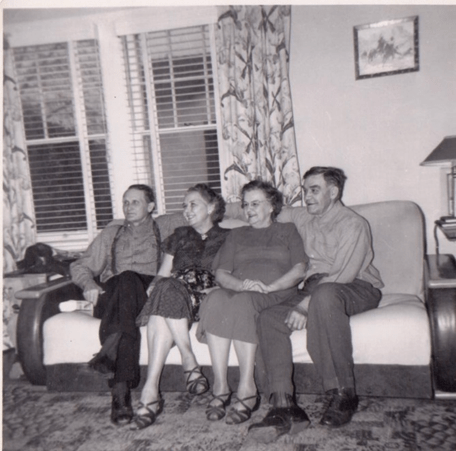
Ardy and Myma went to work in a dress shop [and Cleve in a grocery store], after school and Saturday[s]. After about two years, we sold the Station, and our little group went their ways. Loyal and Helen went to Washington, where he went back to the Navy Yards.
Don and Leona moved to Merced where Steve came along to make his home with them. By this time, Ardy had met her fate in High School and she and Bob were married not long after they graduated, and immediately went to Washington. We missed her so much that we sold our home on Los Flores, stored our furniture, and went to Wyoming to visit our dear ones there, Nelle, Guy, Terry and Pat. Then we went on to Glasgow, Montana, our old home town of twenty years. We came back by Washington, where we saw our Ardy and Bob, and Loyal and Helen, but Boen and Sylvia had gone to Alaska. We, then, came back to Modesto.
We bought our nice home on Normandy Drive. Myrna and Cleve were in High School and your Dad worked at the Gallo Winery, then from there to Frozen Foods. Buck was sent to Panama and Dot and children, Mike and Joe, met him there in a short while, then he was stationed in Las Vegas. By this time, his rank was Captain, so he decided to make a career of the Air Force.
Myrna met her future husband in High School, also. She and Bud slipped away to Reno and were married soon after graduation. Punky and Denny were staying a week with us at that time. They could not understand “why” Granny was crying. They tried everything to make me forget, such as dropping things, breaking dishes, and swinging on the clothesline. They were so precious and had a philosophy on Life to be envied by older people, trying to divert my thoughts to things happening around me.
Ardy and Bob moved back to Modesto so their sweet Cathy could be born here. She was a sweet little doll, and we all treasured her. Loyal and Helen’s third was born about this time, and I can honestly say, she was the prettiest baby I’ve ever seen. She had the blue, blue eyes and black curly hair. Another doll had entered the Clan. I should slow up here and count them and see if I’ve forgotten one. At this writing, there were two Pointers’, two Boen Covey’s, two Beachlers, three L. Coveys’, two Potters’, Buck’s two and Ardy, one, fifteen at that time.
Then Cleve graduated from High School, and Boen and Sylvia sent him $100.00 for a trip to Alaska, (his graduation present from them). We hated to see him go, as he was the last, but after Myrna had gone, he didn’t feel right at home, I know, and he was glad to go.
We were left in this big place with just the two of us, back where we started, a little older and much wiser. Our loved ones had dwindled away, as they came to us, one at a time. If we had not had the old love for each other, we could not have endured the losing of them.
Don and Leona came after us one Sunday to go to the Mountains, which was our favorite pastime. We packed our lunch and were off. Such a beautiful day in the Autumn, and we sort of hated to come home that night. When we got home late, the phone was ringing. Don answered it, and we heard him say, “Oh! No! No!” Then he told us that Las Vegas was calling to tell us that Buck had crashed in a Jet plane. Only God knows what a shock and heart break it was. We, immediately, packed a few things and drove with some of the kids the six hundred miles to Las Vegas, stopping in Bakersfield to tell Lotus. She was not home, so we left a note, to tell her the awful news.
We arrived in Las Vegas. Dot was pregnant, and expecting the baby in one month. She was grief-stricken and horrified. The Air Corp. put on a spectacular funeral service, jet planes swooping down over the Casket, and soldiers marching. It is not clear to me yet, as I could not see for the agony and pain.
Boen and Cleve had flown down to Seattle by transport, then picked up a plane belonging to Sylvia’s brother, and on to Las Vegas. They were almost killed twice on the way down, having to make two emergency landings. The Air Corps had this service at Nellis Air Force Base in Buck’s honor, then flew the casket to Modesto for his final resting place. We were all completely heart broken, but had to go on to our work as usual. Then I went back to Las Vegas to help Dot when Janie was born.
Our dear Cleve was home with us for a while, but was so hurt and restless that he joined the Air Force and left. I will never forget your Dad and I, after Cleve left. We sat on the davenport together, so lost. I was crying dejectedly, and your Dad was trying to comfort me, but the tears were rolling down his cheeks. If we could only wish the years away ——.
Your Dad went back to work, and just one month later, they brought him home. He had had a heart attack. The Doctor said he only had two weeks at the longest, to live. He advised us to send for the kids, if they wanted to see him alive. They gathered in from far and near. Your Dad was lying in his bed with his faithful companion, his Bible. He received so much comfort from the Good Book. He told the kids to quit looking so gloomy. – said, (and I quote) “Get the guitar and harmonize for me.” So they sang, and they laughed and he kept time by knocking on the Bible, and grew better by the minute. You dear children perhaps, never realized how much he loved you, as he could not express his feelings. In a week, I went in to take his medicine to him, and he was up and dressing, saying, “I’m not going to lie here and become paralyzed.” Then our dear children left for their respective homes. He, gradually, became better and could walk, first to the yard, then to the corner store. Then of all times, I became ill and had to go to San Francisco for a major operation.
I hated to leave him alone, in fact, we could not leave him alone. The kids took him up to Loyal and Helen’s in Vallejo, so he could be nearer me and could visit me. In two weeks, I came home again. He had had two slight heart attacks while I was gone, but no one told me. When they brought me in, and left us two alone again, he said, “Well, Hon, how do you feel?” I started to cry and he joined me, but we were together again and both gained our health in a way.
Myrna and Bud were so proud of their Danny, who came along about this time. He was a dear little blond boy. Cleve had met his Mary at a DeMolay dance, and not too long after that, they were married.
Once again War had entered our World. Cleve was sent over Seas and was a gunner in a bomber, flying over Korea. We prayed together for him. Oh! Those awful days of War! We hoped and prayed for it to end. I know that God heard our feeble prayers. The War was finally over and Cleve came safely back to be greeted by his much loved wife and son Gary.
About a month before Gary was born, Myma’s second boy Mike came along. He was another blue-eyed boy and he and grey-eyed Gary were just like twins. They even loved each other from the very first.
We got a telegram from Bob and Ardy, and they had a brown-eyed boy. They named him Kenneth, so we had the three little boys so near the same age, we called them “The Three Musketeers.” If I’ve counted right, that made us nineteen grandchildren.
We decided to sell out, as we did not need the room, and there was so much yard work. We had worked hard all of our lives, and decided to give away things we held most dear, and let the rest of the furniture go with the house. We would keep our suitcases and travel, travel, travel! We sold out soon, packed our suitcases and went to Washington to visit Boen and Sylvia. We stayed two wonderful days and got homesick. We came back in time to help “Linda” come into our lives. Sweet darling little Linda! She belonged to Myrna and Bud legally, but she belonged to the whole clan. That made our twentieth grandchild.
We rented an apartment, but it just did not seem right. We were sort of lost, so walked and walked looking for a little place to buy. We found it at 405 Cedar Avenue, Modesto.
Oh, the wonderful contentment and happiness, as we would sit out on the front porch. We would talk and laugh about our seeking our “Verden” and finally finding it. We liked this
poem:
The World We Made
Before we met, my world
was incomplete,
And I could find no way
to make it whole.
It needed spice, or
something tart or sweet
I could not name to save
my troubled soul.
And then you came, and
what a world we made,
And gazed upon with our
believing eyes!
A world we savored, glad
and unafraid,
And found so full of stars
and lullabies
That even now we speak
of it in tones
Of two young dreamers :
and it fires old bones.
It took us a long time to find this contentment, as we celebrated our fiftieth wedding anniversary two years later. We decided that Verden was within our hearts. We had it where ever we went.
You all know of the ending of this story. God took your Dad away from us to sadden and break our hearts completely, or to soften us and make us to love and understand God
THE COVEY FAMILY:
(This article seems to have been taken from a book about Valley County pioneers)
Ed and Belle (DeLay) Covey arrived in Glasgow in the early summer of 1914. They were originally from Okla. They brought with them their young daughter, Nelle, who was about two and a half years old at the time. Ed filed on a 320-acre homestead in the Duck Creek area about 25 miles south of Glasgow. This homestead property has since been inundated by the Fort Peck Reservoir.
While living on the homestead, three-children were born; Boen, in Feb. 1915; Lotus, July 1916; and Edgar Loyal, Oct. 1917.
During their years on the homestead, Ed and Belle furnished music for all the country dances at Lismas as well as other locations. Ed played the violin and was accompanied by Belle on guitar. Their music was in demand at all area functions.
Sometime in the summer of 1918, they sold the homestead and purchased a farm south of Nashua. The new farm was in the so-called bottom land adjacent to the Missouri River.
Again, they were called upon to furnish music for all the country dances in the area. In Aug. 1921 a daughter, Leona, joined the family. Ed and Belle were told that at spring ‘ice break-up’ some years, the ice would form a dam across the river causing low lands to be flooded. After being flooded out twice, Ed sold the farm and moved the family to Glasgow.
In the fall of 1923, Ed and Belle decided to move back to Oklahoma so the family moved to Purcell, Okla. Ed leased a farm and moved the family on it. Here, again, Ed and Belle were in demand for their music. While living in Oklahoma, two more little Coveys were born. In July 1924, E. Wayne was born and in March 1929, Ardith Rae made her appearance.
Ed and Belle began longing for old Montana which resulted in their selling their property in Oklahoma and moving back to Glasgow. The family moved into a house on Glasgow’s north side in the summer of 1930. Ed kept busy as a carpenter on residential work. A daughter, Myrna, was born in Jan. of 1931 and Cleve, the baby of this happy family, made his appearance in August 1932.
The older Covey children, Boen, Lotus, Loyal, and Leona went through high school in Glasgow while the younger children were in grade and junior high school on Glasgow’s north side. Ardith, Myrna, and Cleve became known as ‘The Covey Trio’ and Sang at many church functions.
Ed Covey was one of the very first workers hired in the building of Fort Peck Dam. He continued in that employ until the project was practically completed. Boen, the eldest Covey boy, was employed part time in the U.S.E.D. Soils Testing Lab located in Glasgow during his senior year in high school. After high school graduation in May of 1934, he was employed on a full-time basis. During vacations from Montana State College, Boen was employed at Fort Peck.
All during the thirties, the Coveys continued to furnish dance music in and around Glasgow. The orchestra had enlarged to include Boen on guitar, Lotus on mandolin, and Loyal on drums. A cousin by marriage, Merrill Wilson, also became a member of the orchestra, playing his saxophone. The orchestra was generally known as “The Covey Serenaders’ or just the ‘Covey Orchestra’.
The older Covey children grew to adulthood in the Glasgow area. Nellie married a rancher, Guy Pointer, from south of Glasgow. Boen married his college sweetheart, Sylvia Richardson, from Antelope, Mont. Lotus married a former high school classmate, Marland Beachler, and they moved to Bakersfield, Calif. Loyal married Helen Hunter of Poplar, Mont. Leona was married to Donald Potter from Flaxville, Mont. and he was employed at Fort Peck.
By early 1941 all of the Coveys had moved to the west coast. WW II’s effort against the enemy called upon participation by family members. Ed was employed at Taft AFB in Calif. Loyal, a civil service electrician, was at Puget Sound Naval Shipyard, Bremerton, Wash. and was later transferred to Mare Island Naval Shipyard to work in submarines. Boen was commissioned as an Engineering Specialist im the Navy. Wayne (Buck) went through Air Force Cadet training and was commissioned. He became a B-26 Medium Bomber Pilot and flew some 50 successful missions over Germany. Buck decided to make a career in the Air Force and transferred into jet fighters. He lost his life in an accident while flying an F-80 training mission in Sept. of 1950.
Ardith, Myrna, and Cleve continued their singing in harmony at various USO functions as well as their church during the war. Their singing was well received by all who heard.
Ed and Belle lived out their days in Modesto, Calif. Ed passed away in Feb. 1960. Belle lived to a few months over 94 before she left us in June 1986. On Belle’s 90th birthday, her chi grandchildren put on a party for it “THE GAY NINETIES’! There were 95 descendants and relatives present at the party. Her comment was, ‘To think I am responsible for most of these people!’
Ed and Belle remain side-by-side in the Masonic Section of Modesto perpetual care cemetery.
[1] B.B DeLay died on 23 March 1928. B. B “B.B.” DeLay (1861-1928) – Find a Grave Memorial
[2] Ed’s account of the collapse of Fort Peck Dam: The Day the Dam Slid – Outlaws, Outrages and Outright Lies (azrockdodger.com)
[3] The pilot of the first plane that dropped the Atom Bomb on Hiroshima was Col Paul Tibbets
Also by Belle Covey: The Girl From The Ozarks: https://azrockdodger.com/2022/08/02/the-girl-from-the-ozarks/
More family history at: Thill, DeLay Family History – Outlaws, Outrages and Outright Lies (azrockdodger.com)
Larry’s website: http://www.azrockdodger.com
 Outlaws, Outrages and Outright Lies
Absolutely LOVED this memoir. Wish there was even more detail, but it so captured life for a large, close, loving, hard-working, smart family of the era. I am passing the story along to a friend who also started life in OK and moved to MT (then WY) and who will enjoy the history and the wonderful way Belle described her family. Mr. Thill, thank you so much for finding and posting this story. It was actually given to us in print form (most photos didn’t print) by friends Tom and Mary Robinson, but I then found it at your website and could also enjoy the pics. I will read more about your very interesting and colorful family! Thanks again! Bess Harris
LikeLiked by 1 person
Glad you liked it. It is typical of what many families must have experienced from the homesteader days to the Depression and war years. I was fortunate to figure out a way to turn a bad xerox copy into a word document thanks to an on-line OCR program.
LikeLike
Sooo glad you did (resurrect the bad Xerox)! I since spoke with Tom Robinson and learned that you two were schoolmates in Glasgow. He also regaled me with some hilarious stories of your cousin–I think he said his name is/was Billy Stockton. There’s one incident in the Selective Service Office that made me fall off my chair!
LikeLike
Yes, Billy was my cousin. Cowboy, hunting guide, poet.
Never heard the Selective Service Office story, but he was a true character.
LikeLike