(Or Why I Hate John Walker)
Keeping your plans an operations secret from the enemy is an essential part of military security. If your enemy knows your plan or your operational problems, he can devise his own plan to counter them and exploit your weaknesses. Ciphers have been used for millennia to keep military foes in the dark. Washington used letter-substitution cipher keys to communicate with his spies. By the Civil war both sides were using ciphers to encrypt telegraphic messages.
Intercepting and decoding the enemy’s most secret messages is an essential component of counter-intelligence. It has never been easy, but the strategic benefits can be enormous. In 1917, the Allies were on the verge of losing World War I. Fortunately, the British had access to the underwater cables being used by the Germans to transmit messages to non-aligned countries. The Germans were so confident of their cryptography, that they routinely sent such messages through neutral American lines to communicate with their embassy in Mexico. Unbeknownst to the Huns, the British were intercepting and decoding their messages. Then the German Foreign Office sent the infamous Zimmerman Note proposing that Mexico join the Central Powers in the war and gain the return of Texas, Arizona and New Mexico as their reward. Not wanting the Germans to know that their code had been compromised, the British broke into the German Embassy in Mexico City and stole a copy of the message. This, they shared with President Wilson. The decoded message along with the resumption of unrestricted submarine warfare led directly to America’s entrance in the war. The rest was history. Thanks to America’s help, the Allies won.
By the time World War II had begun, cryptography had become more sophisticated. The Germans had a machine called Enigma that encoded and decoded messages as they were sent. The Nazis blithely assumed the machine and its code was unbreakable. They were wrong. Thanks to some help from the vanquished Poles and French, the Brits had a good idea of how the Enigma machine worked. They established a team at Bletchley Park under the leadership of mathematician Alan Turing. The team developed a massive early computer to break the code. They called their decrypts “Ultra”. Countless British and Allied war operations and countermeasures resulted from these decrypts. In the Battle of the Atlantic, intercepts from German U-Boats made convoys safer and nearly extinguished the threat by sending hundreds of subs to the bottom of the ocean.
America had its own decryption successes in the Pacific during World War II. We decoded the diplomatic message telling the Japanese Embassy in Washington to break off relations on December 7, 1941. The U.S. Navy broke the Japanese Naval Code, leading to our victory at Midway. Our own cryptographic efforts remained relatively secure during the war. The Marine Corps used Navajo Code Talkers to devise an unbreakable code used in the Pacific Theater.
In a way, I was a newer version of a Code Talker when I served in the Marine Corps in the 1960’s. Part of my job was repairing the KW-7 Crypto device. The “Seven” was cutting-edge for its time. Using transistorized circuitry, it far exceeded the ability of earlier encryption devices to encode teletype messages. Its main components were solid state flip flop switches that scrambled and unscrambled the inputs and outputs of traditional teletype machines. It was compact, quiet and had no moving parts. The circuitry inside was classified as Confidential. Each day it was programmed with a key list using patch cords to re-rout the signals to the internal components. The key-lists were normally classified as Secret. Messages requiring a higher level of classification were double encrypted. This means they were encrypted in five letter code groups before being sent over my machine. They were coded and decoded by a mechanical device somewhat similar to a German Enigma machine. (I can tell you this without fear of getting a knock on my door tomorrow from the FBI. The Kw-7 has long-since been de-classified.) The KW-7 turned out to be an incredibly reliable device. I spent most of my Marine Corps career drinking coffee and delivering messages to staff offices and various subordinate units. I got out of the Corps in 1966. I soon forgot about my electronics training and the machines I worked on.
In the mid-1980’s I was working in Frankfurt Germany. Walking out of the rear of the Abrams Building, where the U.S. Army’s Fifth Corps was headquartered, I happened to notice two G.I.s loading some grey box-like items in the back of an enclosed truck. I had to get a better look. Yes, they were KW-7’s. “How could the U.S. military still be using this antiquated device in the age of computers?” I asked myself. Enter John Walker.
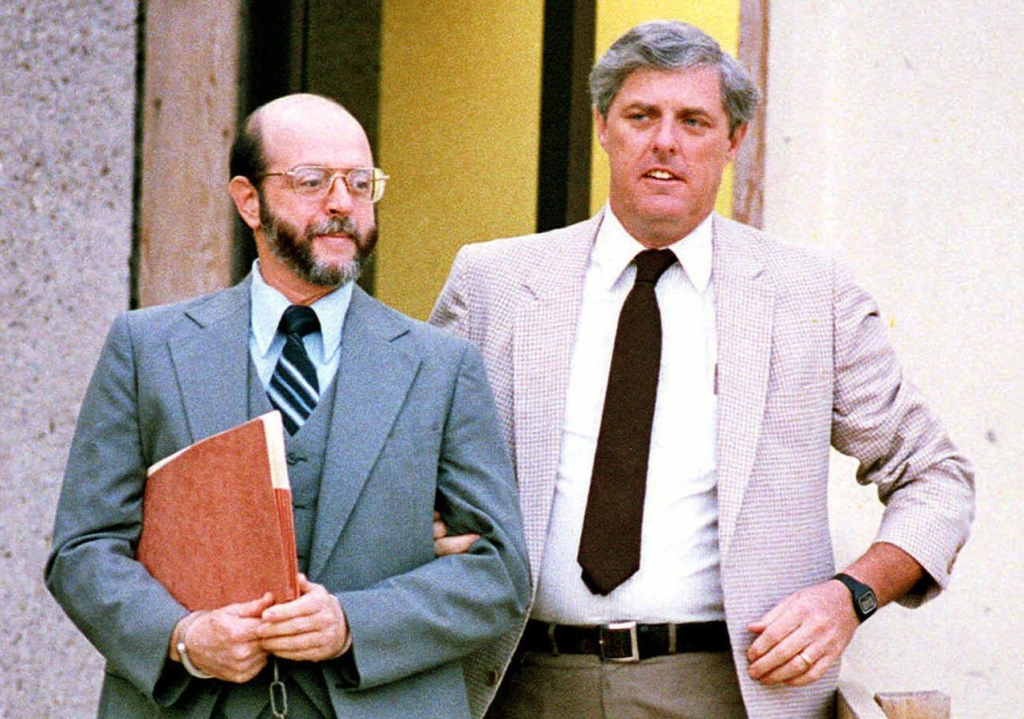
John Anthony Walker Jr. was a U.S. Navy Warrant Officer. Like me, he worked in Communications. Like me, he had access to cryptographic devices and other classified materials. We went to the same Cryptographic Equipment Repair Course at Mare Island Naval Shipyard one year apart. To most, he seemed like a good sailor, working his way up the ranks. To supplement his income, Walker opened a bar in Charleston, South Carolina. His wife helped him run it. She drank too much. The bar was losing money.
In 1967, at the height of the Vietnam War, Walker approached the Russian Embassy in Washington, D.C. He had information. He brought a photocopy of a secret document to establish his credentials. Were they interested? The Russian Security Officer was elated. He gave Walker a spy camera and a crash course in secret drops. Then Walker was snuck out of the embassy in a car. Walker would supply the Russians with the Tech Manual for the KW-7 and the daily key lists for the next twenty years as well as many other classified documents. Almost immediately, North Korean forces attacked and captured the USS Pueblo, an American electronic spy ship operating in international waters. Their haul of sensitive materials included two KW-7’s. From that point on, the Russians knew damn near everything about our military. Troop deployments, ship locations, operational plans, intelligence assessments, the list went on forever. American military operations throughout the globe were deeply compromised. We may never know how many missions in Vietnam went awry because of Walker’s treason.
No one noticed when Walker began showing signs of sudden affluence. His past money problems over, he learned to fly and bought an airplane. Walker went on to recruit his best friend, Jerry Whitworth, into his growing spy ring. His brother Arthur, a retired Lieutenant Commander with access to classified information on submarine design, joined up. Then Walker recruited his own son who had joined the Navy. Finally, his ex-wife Barbara had had enough. She got drunk and called the FBI.
Walker was eventually arrested in 1985. He avoided the death penalty through a plea bargain that helped U.S. authorities assess the damage he had done to our security. His friend Jerry, his brother and his son all received long prison terms. His ex-wife got to keep his Navy retirement pension for her cooperation.
After the end of the Cold war, a Russian general was asked, “What would have happened if we had gone to war with Russia during the time of Walker’s spying?”
“We would have won,” was his answer.
John Walker died in prison in 2014.
LDT July 8, ‘21
For more information: Family of Spies: Inside the John Walker Spy Ring. Peter Early. (2012)
Postscript: Since the circuitry of the KW-7 was classified, I always worked on them inside of a Crypto Vault. I was often alone. Recently, a former Navy Cryptographer told me that no one is allowed to be in the vault by themselves. There is always another person there to ensure that documents can’t be photographed or stolen. This simple rule would have prevented John Walker’s treason.
Main Menu: http://www.azrockdodger.com
 Outlaws, Outrages and Outright Lies
What a fun lesson in crypto! I’ve seen a couple movies…the Bletchley Girls and one about the Navaho code breakers, but not anything about Walker. Any recommendations? I love to see the bad guy lose!
LikeLike
I’ll check on the book about the Walker Spy Ring. Bletchley Girls sounds interesting. The 2014 movie, The Imitation Game, focusses on Alan Turing, the leader of the code-breaking effort at Bletchley Park. You can probably find it streaming somewhere.
LikeLike
There used to be a book on Walker at the library, but I can no longer find it. There was a TV movie called Family of Spies about Walker.
LikeLike
I guess Bletchey Circle was the series about the gals who worked on the codes, but it’s but what they did afterward. I looked for the one I was thinking of, but maybe it was in some movie I can’t recall the name of. Were the girls focused on in Enigma? Did you see that?
LikeLike
I found Family of Spies free on Amazon with ads!!!
LikeLike