After a few days of recuperating at home, Reuben rode into Centerville. He had some letters to mail and was anxious to get fresh news from the front. The post office was in the back of the Square Deal General Store. As he strode up the steps a man leaving the store hunched over as if to avoid contact.
“Odem?” he queried. “That you Ezra?”
The man paused and looked up sheepishly. He was indeed Private Ezra S. Oden of I Company, Third Iowa Cavalry.
“Uh, good to see you, Lieutenant.” The man responded as if seeing a ghost.
“You made it?” Reuben asked incredulously.
“Yep. Though I ain’t findin’ much of a welcome hereabouts.”
Reuben thought he knew what Odem was talking about. The circumstances of his early departure from Andersonville were bound to put him under suspicion. Lots of suspicion.
They had been through a lot together. Long, dreary marches, moments of sheer terror under Rebel guns, losing comrades to disease, accidents, and enemy fire. Odem was one of the men Reuben had commanded to lay down their arms when the Tennessee Cavalry had them surrounded and outgunned. Odem was still Reuben’s responsibility as they went into the prison at Camp Cahaba and later at Andersonville. He was a good trooper who had served loyally and valiantly for three years. His choice was not a good one, but it was understandable. Collaborate or die.
Rebel officers had often come to Andersonville to recruit men for the Confederate war effort. The South needed men skilled in trades like blacksmithing, carpentry, shoemaking, railroading, and masonry to replace those lost to Confederate conscription. Skilled tradesmen were offered parole if they would serve the Rebel cause. Even more insidious were the efforts to recruit prisoners into the Rebel army. The Rebs had promised such men the moon; decent rations, good uniforms, enlistment bonuses, and free land at the end of the War. They were told the South would establish its independence upon winning the conflict. This would make all their sacrifices seem in vain. Men whose enlistments had already expired were prime targets of the recruitment effort.
There were few takers. Most of the prisoners would rather die than face the disgrace of serving the South. Those who did sign up were often professional bounty jumpers. These men had enlisted in the Union Army to collect the bonuses paid to enlistees. At the first opportunity, they would desert. Then they would travel to a different location to repeat the process under an assumed name. Many of the Raiders who had terrorized the prisoners at Andersonville were bounty jumpers. Some of these men had ended up joining the same Confederate artillery unit that had its guns pointed at the prisoners.
Odem had come to Reuben after one of the pitches by the Confederate recruiters.
“Sir, I don’t think I can last much longer in this hellhole,” he said. “My bowels are rejectin’ what little bit of food they give us and my teeth are getting loose from the scurvy. I need to get out of here.”
Reuben was keenly aware that his once-healthy men were beginning to waste away on the camp’s poor rations and contaminated water. Odem was probably in the worst condition of all of them. Even the wounded Solon was getting on better than Odem. The men in the camp were dying at a rate of 100 per day. Soon the I Company troopers would become part of that gruesome number.
“There are tunnels underway. Have you thought about escaping?”
Odem raised his downcast eyes. “I’m too weak to last long in them woods,” he said gesturing toward the pine forest surrounding the camp. “I’m not even sure I could climb a tree if’n the dogs ketch me.”
He paused for a moment. “I’m thinkin’ ‘bout enlistin’”
“You want to join the damn Confederate Army!” Reuben exploded. “What the hell do you expect to get from that?”
“My plan is to join up, get healthy, and desert Sir”
“You sound like one of those New York bounty jumpers. Plenty of ‘em have switched sides and become galvanized. What makes you think you can pull that off?”
“I’m fadin’ fast. It’s my only hope. It’s either stay here and die slowly or join ‘em and maybe die quick.”
“You know it’s long odds. If the Rebs find out, they’ll hang ya. If’n you make a break for our lines, you’ll be shot at by both sides. If’n you do make it to our lines, you’ll likely be shot as a deserter. I don’t see nuthin; good a-comin’ from it.”
“Hell, you know me. I kin talk my way outa anything. If I make it, I’ll let all the folks back in Appanoose County know yer alive. Maybe I can carry out some letters.”
“I cain’t tell you that it’s gonna be OK. At best, it’s desertion. People are gonna call you a traitor. I cain’t stop you, but if’n yer mind’s set, I wish you the best.”
The next day at Roll Call, Odem’s name wasn’t called. The men of I Company never mentioned their galvanized Rebel again. That is until Rueben met him on the steps of the general store.
“So how did you get away?” Reuben queried.
“That part was easy,” responded Odem. “After they assigned me to a unit, I jumped off the train near Atlanta. I walked toward the guns until I found the lines. Pretended to be a Reb returnin’ from furlough. Snuck through their lines when no one was a-lookin’.”
“And then?”
“Well, things got a bit complicated. I was in a Rebel uniform carrying an Enfield rifle when I crawled up to one of our pickets. He got a little twitchy on the trigger when I didn’t know the password. Made me drop the gun and stand up in full view of the Rebel works. Had to do me some fast talking to get him to take me prisoner. He didn’t believe I was an escaped Yankee. Neither did his Sergeant. A Captain interrogated me for an hour, then told a Colonel I was a Rebel spy. The Colonel, at first wanted me shot on the spot. He finally relented and sent me to Sherman’s staff where I was grilled about Rebel positions and strength. I figure I gave ‘em a good account as they passed it on to Sherman hisself. Then I was sent to the Memphis for Court Martial.”
“How’d that go?”
“Well, they decided I was a deserter, but under the circumstances, they gived me a dishonorable discharge. I had to walk most of the way back to Iowa beggin’ for food from farmers. Some of them folks in Tennessee and Kentucky don’t cotton much to Yankees, deserters or not.”
“So, how’s it been since you got back?”
“Folks don’t understand. There’s been words. Kids call me names and throw rocks at me. I don’t git out much. My Pappy keeps me busy on the farm. I’m headin’ west as soon as I kin.
Reuben knew he was the only person in Appanoose County who understood what Odem had gone through. The war was nearly over and it was time for the healing to begin. He decided he had to help Odem if he could.
“I need you in church with me on Sunday. Can you come?”
Odem looked back quizzically. Being in church with a bunch of his critics and tormentors was about the last place he wanted to be.
“Church?”
“Yeah, church. I got some things I wanna say to people. It may or may not go over well. I feel like I owe it to you. I may not have approved but you did what you had to do.”
The two men shook hands and Odem departed wondering what Reuben might have to say. He wasn’t looking forward to what was bound to be an inquisition.
When Sunday came, Odem held back on the street until he saw Reuben and the DeLay family enter the church. The Pastor shook Odem’s hand limply and mumbled a welcome. At least he hadn’t been ordered to leave.
Inside the sanctuary, he saw Reuben had saved him a seat. He walked the lonely aisle trying not to make eye contact with anyone. Then he sidestepped into the DeLay pew. Reuben had stood on his approach. He shook his hand warmly and introduced him to Margaret and the kids. They sat down as the organ began to play the call to the service. No one else acknowledged Odem’s presence.
The service began with an opening prayer. The safety of the troops in the field was prayed for. No one wanted their loved one to be the last man killed in the War. Then the Preacher asked for the sharing of joys and concerns. Reuben stood and faced the congregation.
“Friends,” he began. “This war has been a test for all of us. We’ve lost some fine young men from hereabouts. On June 11, 1864, I was captured along with seventeen other Appanoose County men at Ripley, Mississippi. I was separated from those men a few months later and regret I’ve no new news on them. I only know that one of them has made it home safely. He sits next to me.”
“Private Ezra S. Oden is a veteran of the Third Iowa Cavalry. When the War came, he answered the call for volunteers. He served beside me in a dozen battles in Missouri, Arkansas, and Mississippi. He never wavered, he never flinched. He did his duty as he was called. He cheerfully obeyed all orders and went the extra mile to ensure his comrades were safe. As a loyal cavalryman, he rode deep into enemy territory to disrupt Rebel railroads, interdict supplies, and keep the Rebel rear in fear. Like me, he reenlisted when his time was up.
“As you all know, our last foray into Mississippi didn’t go so well. We hit a wall of Confederates at a place called Brice’s Crossroads. Like the rest of the Third Iowa, Private Odem did his best to hold the line against Nathan Bedford Forrest’s troops who had a far better position for the attack. Running out of ammunition, exhausted from the long march in the mud and two hours of intense fighting, we were ordered to fall back. We retreated in good order, bringing out all our dead, wounded, horses, and equipment. We were replaced by infantry who were even more exhausted than we were from the long, hot race through Hatchie Bottom. If it had not been for the incompetence of General Sturgis, we might still have won the day.
The next day, June 11, I was second in command of the rear guard outside Ripley. We had expended much of our ammunition keeping the pursuing Rebs at bay. Suddenly, the 16th Tennessee Cavalry came rushing out of the adjacent woods. Fighting on foot, we were quickly surrounded by a far superior force. Only Captain Stanton, who was mounted, and a couple of the horse-holders managed to escape.
“It pains me that I was by then the senior officer on the field. It was my call to surrender your sons, brothers, and husbands. There was no choice. We no longer had the means to carry on the fight. Private Odem was among the last to obey my command to put down his saber. There is no shame in an honorable surrender with no means left to carry on the fight.
“Odem stayed strong during our march into captivity. He helped the other prisoners and shared their privations. When interrogated, he gave nothing up to the enemy. We kept our honor and held our heads up high as we entered the cars that would take us to hog pens the Rebs call prisons. Odem was always there to help the sick and the weak.
“Escaping from Andersonville was an impossibility. Anyone crossing the deadline was shot. The stockade walls were unscalable. Those who tunneled out were quickly hunted down with mean dogs. The food was deficient. The water was befouled. Medical care was almost nonexistent. Men were wasting away from starvation and disease. By August, we were sending 100 corpses a day to the Dead House. You all heard about those conditions in Prescott Tracy’s Report to Congress. It was even worse than what Tracy described. Believe me, I was there.
“It was under these conditions that Private Odem came to me with a bold plan. He would escape by pretending to show allegiance to the Confederate cause. I thought I was crazy, but we were all probably going to die anyway. If he was willing to take the risk, I had no objection.
“It took incredible courage and stamina for Odem to thwart his Confederate companions and find his way back to Sherman’s Army. He could have been killed in a dozen different ways. Now he sits among us, a testimony to his courage, stamina, and ingenuity.
“How many of you would not know that your sons, brothers, and husbands had survived the battle had it not been for Ezra Odem? How many wives drew on your husband’s pay because Odem proved they were still alive? How many of you got letters he smuggled out? How many of you got better prices for your grain when Vicksburg fell, opening the New Orleans trade? It was troopers like Odem that kept Johnston from rescuing Pemberton’s garrison at Vicksburg. How many of you cheered when Sherman telegraphed, ‘Atlanta is ours and fairly won?’ Private Odem briefed his staff on how the Rebels were deployed in one sector of the line. He saved lives and shortened the War.
Then Reuben, is browdamp with sweat, turned and looked at Ezra.
“Private Odem, you have stood by my side through many trials and troubles. Would you now stand by my side, again, as a loyal brother in arms?”
Odem looked up at Reuben, slowly rising from his seat. His body quivered with anxiety. The preacher looked down from the pulpit and slowly raised his hand as if seeking the intervention of the Almighty. The church was silent as everyone held their breath. People shifted uncomfortably in their pews as they contemplated what Reuben had said.
Then from the back of the sanctuary, someone began clapping lightly. Then another joined in. And another. A wave of enthusiasm moved toward the front of the church as more people stood and clapped. The organist began to play “When Johnnie Comes Marching Home.” There were loud Hurrahs. Reuben stood proudly as a flush of relief flashed across Odem’s face.
Private Ezra S. Oden was home.
NOTE ON HISTORY: This story is based on the Roster and Records of Iowa Soldiers, War of the Rebellion. It reads:
Oden, Ezra S. (Veteran.) Age 20. Residence Caldwell, nativity Ohio. Enlisted Aug. 20, 1861. Mustered Sept. 6, 1861. Re-enlisted and re-mustered Feb. 2, 1864. Taken prisoner June 11, 1864, Ripley, Miss. Dishonorably discharged Aug. 31, 1864, Memphis, Tenn.
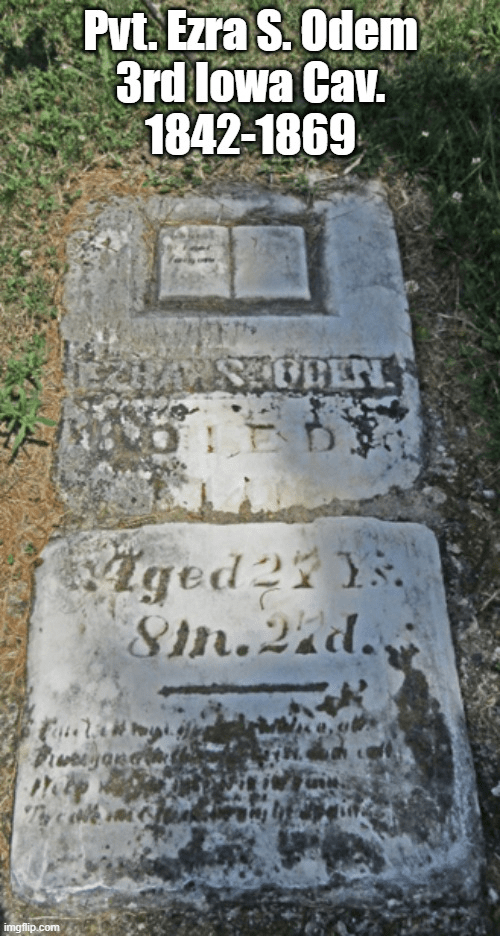
I have found no record of what Oden did to earn a Dishonorable Discharge after being a prisoner at Andersonville. Whatever he did, it was not considered serious enough to prevent him from returning to Appanoose County. There he got married, had a child, and died in 1869. He was given a GAR (Grand Army of the Republic) grave marker to commemorate his service. Today the marker is broken in half. In 1887, his former company commander, Cornelius Stanton, recognized Oden’s service as being with “fidelity and courage” in an article about I Company troopers in the local paper.
LDT January 4, ‘25
Main Menu– http://www.azrockdodger.com
 Outlaws, Outrages and Outright Lies
I read the last 2 posts in one sitting and find that learning about history is a lot easier in this form. I also found you’re an amazing writer! This mix of fiction and history is a great way for me to learn a little more about family history…well, history, period, as a matter of fact! Loved reading it once I set aside the time!
LikeLiked by 1 person
Thanks. A little encouragement goes a long way.
LikeLike