(Excerpt from Chapter 17: But like Midwestern schoolboys anxiously awaiting the arrival of their first circus, they had yet to “see the elephant.”)
The glass tinkled outward as the butt of Rueben’s revolver crashed through it.
“Stay put!” he hissed to his little brother, Willis. “You are going to get some covering fire in a minute. Then run for it.”
Willis was lying in the street behind a water trough. His dead horse was a few yards away. A bullet from the sharpshooter in the courthouse had pierced the other end of the tank. The more the water ran out, the less protection it provided to the stranded trooper.
Initially, the attack on West Plains had gone well. The south-central Missouri town had been a haven for secessionist views. It was also a recruiting center for the Confederacy. The recruiter was Colonel William O. Coleman. Coleman had a sure-fire way of getting men to join the Southern cause. If they refused to sign up, he’d arrest them. Most were never seen again. A few lucky families found their dead loved ones before the hogs did.
Companies I and K had been detached from the 3rd Iowa to garrison the closest Union-held town of Salem, Missouri. They were under the command of Major William Drake. Drake and Colonel Wood of the 6th Missouri Cavalry (Union) became aware of Coleman’s activities and decided to go looking for him. Their combined force of 252 men, including the 4 DeLay boys, left Salem on February 17, 1862.
The winter march through the Ozarks was cold, snowy, and wet. Their route caused them to miss an encounter with Coleman’s main force. He was headed North on a parallel road. They got solid intelligence that he left a small Rebel force to garrison West Plains, Missouri. This became their objective. They left their last encampment at 1 AM on the morning of February 19th. The town’s garrison was caught off guard when they arrived at 3 PM.
The little town was the county seat of Howell County and had about 200 inhabitants. Coleman had been using the courthouse in the town’s center as his headquarters. It stood in the middle of the town square. The town’s streets were aligned with the center of the building. This gave the defenders a good view of troops approaching from any direction. A few stores, saloons, and houses were located on the streets intersecting the square.
Colonel Wood decided to split his force, surround the little town, then attack from two directions. Major Drake, with his Iowans, attacked from the East side. Wood positioned his mountain howitzer on a hill north of town. It had a clear shot at the courthouse.
The Iowans made a charge on the Rebel pickets at the edge of town. The frightened Rebels mounted their horses and fled, with the Iowans in hot pursuit. Mounted on good horses, Reuben and Willis were at the head of the charge. They emptied their pistols on the retreating Confederates. A couple of them fell from their saddles, wounded.
As the fleeing Rebels raced through the main thoroughfare of the town, it became clear they were headed for the safety of the courthouse. Upon arrival, they dismounted, fired a few shots at their pursuers, and raced into the building. The Iowans stopped at the edge of the square as abandoned rebel horses ran willy-nilly about. More shots rang out from the courthouse. The Iowans turned their mounts and sought cover. As he turned, Reuben noticed a puff of smoke from the window above the door of the courthouse. Then Willis’s horse went down. Reuben pulled out his second revolver and fired a few more shots as Willis scrambled for the water trough. Then he rode behind a nearby store. There he found his cousin John.
“Willis is still out in the street. We need to rescue him fast!”
“Got any ideas?”
“Well, it would be nice if Wood showed up with his howitzer. Barring that, we need to lay some covering fire on the damn courthouse so Willis can get to a safer place. There’s a sharpshooter in that middle window who needs to be suppressed. Let’s get those men behind that building on the other side of the street to help. If we all jump out and fire at the same time, they’ll forget Willis and duck for cover.”
“Sounds good,” said John, already making hand signals to the troopers on the other side of the street.
“Good. I’m going to get into this store and see if I can get a clear shot at that Rebel sharpshooter. When you hear me start shooting, get everyone to blaze away.”
Reuben was calmly reloading his revolvers as he spoke. Then he broke the latch on the back door of the store and entered. Approaching the front window, he could see that he’d have a clear shot at the sharpshooter if he leaned out the window. He’d have to act fast. His brother’s position was getting more precarious by the second.
Kapow, kapow, kapow, his shots rang out. More shots were fired from behind him. He saw the glint of a rifle barrel as the sharpshooter ducked. Willis was up and running. He dived through the open window to safety.
“Thanks,” he said, panting.
“It was nuthin, little brother. Maybe next time Mom sends you some goodies, you could share ‘em.”
BOOM!
Wood had finally fired his howitzer at the Rebels in the courthouse. The Iowans could hear the grapeshot rattling against the building like hail. Awesome as it was, the pellets did little damage to the sturdy structure. The men looked worried. The howitzer was supposed to save them from having to charge the fortified building.
“He’s gotta do better than that. Them Rebs ain’t movin’ an inch.”
A minute later, another boom shook the earth. A cannonball whooshed through the air, hitting the courthouse wall. The men watched as it came out the other side and rolled across the square. A dud!
Dud or not, it had frightened the Rebels inside. They began fleeing the building through every door and window. Several men were shot down as they fled. Others stopped, turned, and raised their arms in surrender.
The two Third Iowa companies had now seen the elephant. It had been both exhilarating and foreboding. All that was left was to secure the town. Then they could enjoy the spoils of victory.
The triumphant Union cavalrymen quickly converged on the courthouse, where they rounded up the surrendering and wounded Rebels. Major Drake grabbed Reuben and a dozen other men to clear the courthouse. Entering cautiously, they found the place a shambles. The cannonball had gone through 3 interior walls and exited on the south side.
“Hey, lookie here!” exclaimed a trooper as he stared at a portrait on an interior wall. “That ball near took off Jeff Davis’s fool head! No wonder they skedaddled so fast.”
Reuben inspected the window where the Sharpshooter had been perched. There was a trail of blood leading out the door. Perhaps he was one of the wounded outside.
Major Drake found a cache of documents in what appeared to be Coleman’s desk. Did they contain any intelligence? Names of recruits, correspondence with commanders, locations of guerrilla bands? He scooped them up along with some Confederate currency. He’d have to scrutinize them later.
Outside, Colonel Wood was organizing squads of men to search the town. Like Reuben, he was a former Kansas Jayhawker. He knew exactly what to look for. This time, he had Frémont’s declaration of martial law to back him up. He’d seize everything of value to the Confederacy. He’d burn what he couldn’t carry. He ordered his troopers to arrest any men or boys old enough to carry a gun.
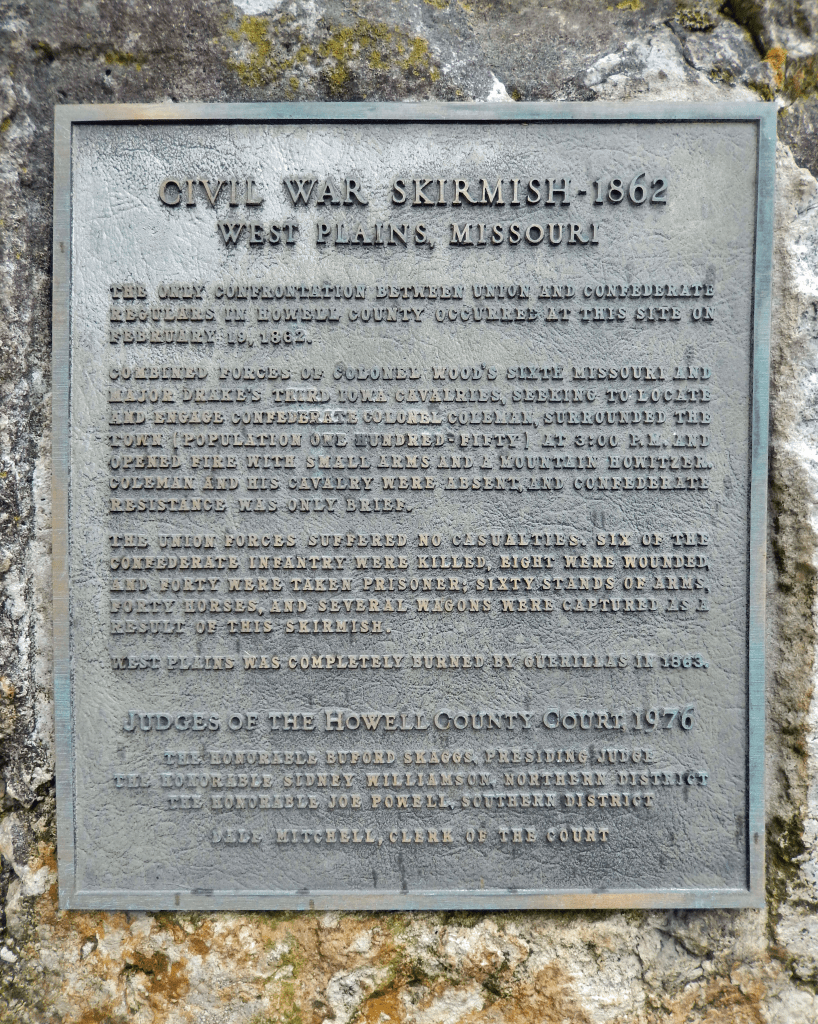
The squads went from house to house, searching every barn, chicken coop, or root cellar. They picked up dozens of men along with arms and equipment. They took them back to the courthouse. All told, the prize amounted to 60 prisoners, 40 horses, and 60 guns. Several wagons were confiscated under martial law to take the men and materiel back to Rolla. Six Confederates were killed in the battle, and 10 were wounded. Twenty of the prisoners were subsequently determined to be innocent civilians. They were released. The combined Union force had no casualties.
Not long after the battle at West Plains, complaints from citizens began reaching St Louis. Colonel Wood had gone too far in his determination of contraband materials of military value. People wanted their wagons, animals, and gold watches back. Moreover, Lincoln didn’t want to alienate the citizenry of Southern Missouri. They were still in the Union. To cover himself, Wood issued General Order Number 2, “Plundering and pilfering by troops in camp or field is a disgrace to our army and command….” He even offered to return some of the booty. Had the old Jayhawker abandoned his thieving ways?
After the battle, Woods sent a written report to his superiors. He credited the victory to the 6th Missouri Cavalry he led. He barely mentioned the role of Drake’s 3rd Iowa Cavalrymen. An upset Drake responded with a letter to his regimental commander, Colonel Bussey. Drake pointed out that his force was the first to rout the Rebel pickets and enter West Plains. Then he underplayed the role of Wood’s mountain howitzer in taking the courthouse bastion. Despite the friction, the two commands continued to cooperate effectively.
Back in camp, the men kidded Willis DeLay for his last stand at the water trough. The ribbing lasted until the company’s next fight, which came sooner than they expected.
Index- Unbowed: The Saga of a Civil War Cavalryman- Unbowed: The Saga of a Civil War Cavalryman-Index – Outlaws, Outrages and Outright Lies
 Outlaws, Outrages and Outright Lies
No button pushing in this little battle. A lot more real for those involved. Interesting statistics, too. I love that more were taken prisoner than died. It sure would be a lot of work to take care of them.
LikeLiked by 1 person
Good point. For the first few years of the Civil War, prisoners were usually paroled and/or exchanged. The next chapter, unfortunately, includes the Battle of Pea Ridge, where the 3rd Iowa suffered more deaths than wounds. There is evidence to suggest prisoners were murdered and scalped by Indians allied with the Confederates.
LikeLike
Oh my! I’ll have to catch up. I’m a chapter or so behind. Thanks for the little added note.
LikeLike