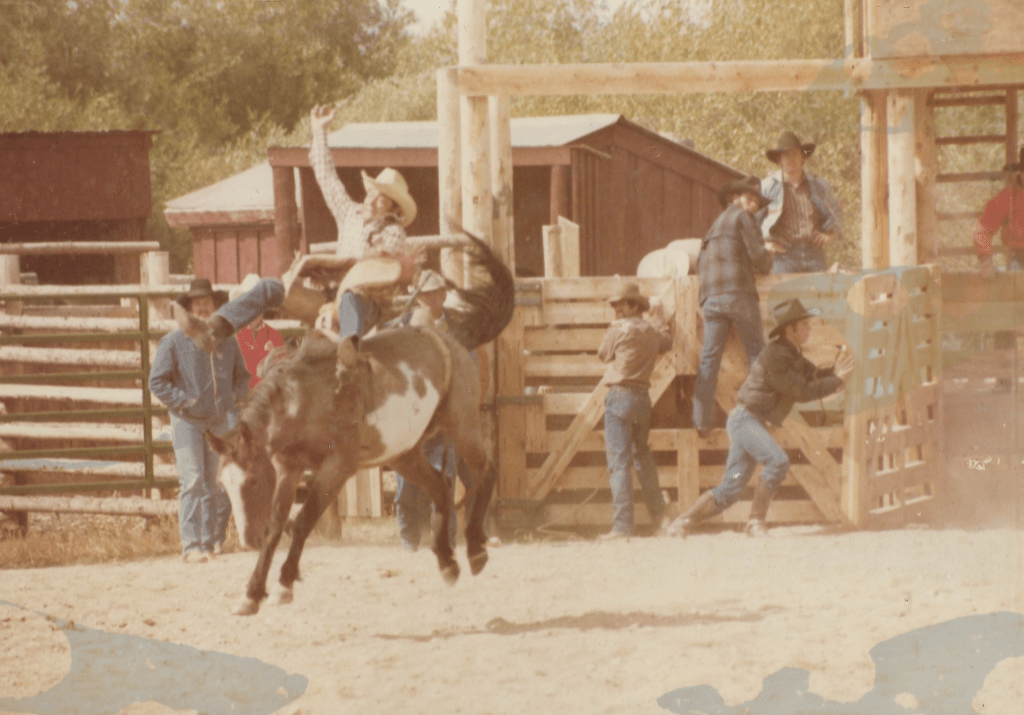
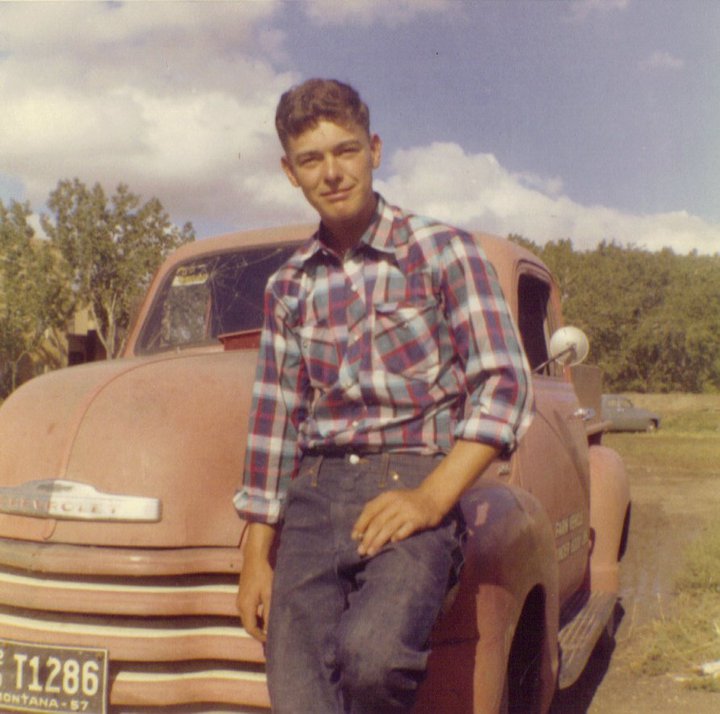
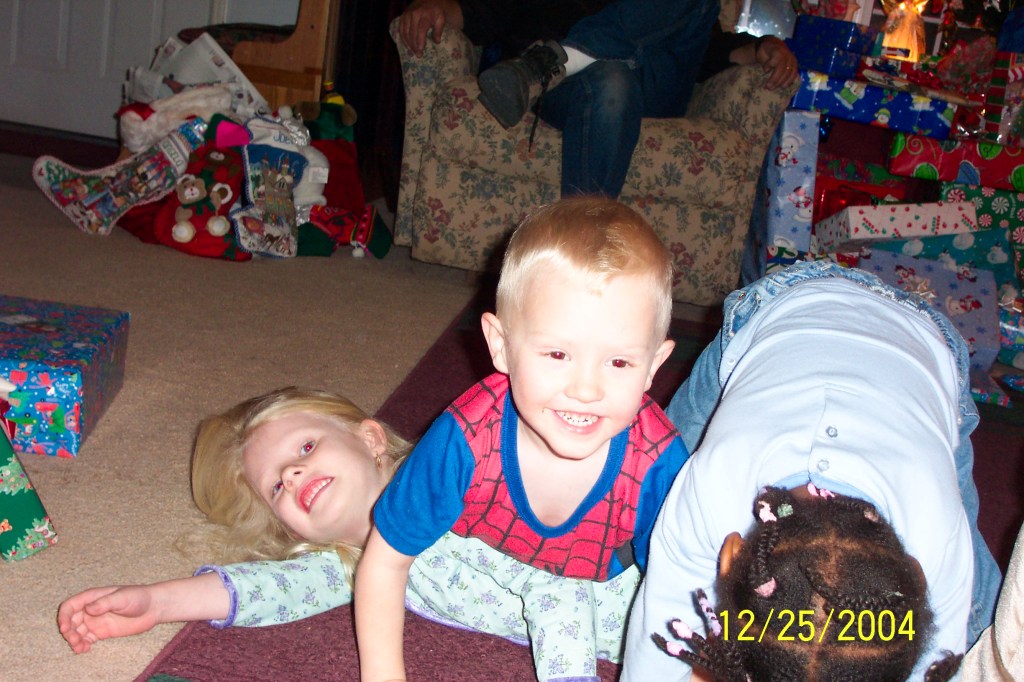
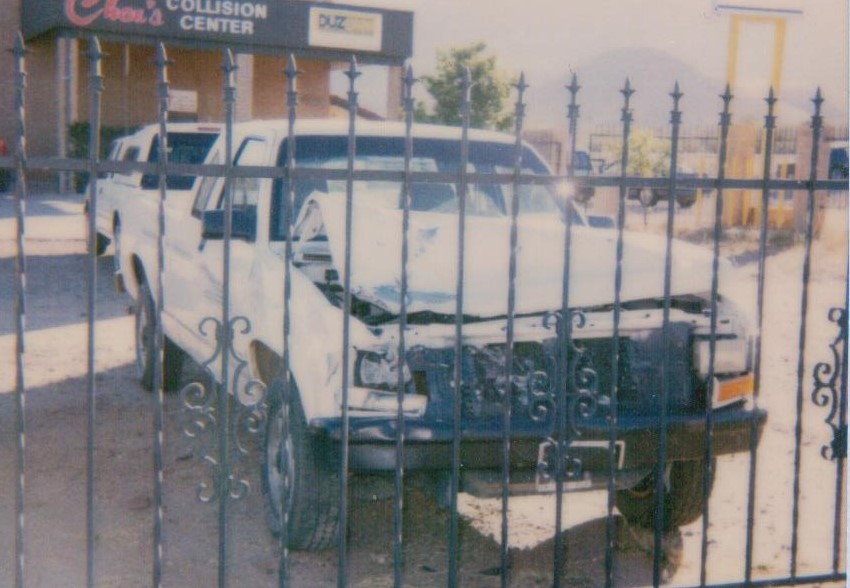
Virgil with Dad’s 1950 Chevy P/U The cracked windshield is left over from the time I nearly put Dad through it.
That old truck was faded red,
it had a big hole in the bed.
Blue Flame Six beneath the hood,
as I recall, it ran real good.
Granny gear to get it goin’
no matter what it was towin’
Cowboy tough, like the Old Man,
it made the Thills a two car Clan.
Starter pedal on the floor,
mash the gas, let her roar.
Broke off key in the switch,
Johnny says, “That ain’t no glitch.”
Old screwdriver does the trick,
that ignition lock to pick.
Livin’ at the edge of town,
might as well drive around.
Mom and Dad, they won’t mind,
got no license of any kind.
Johnny takes the wheel with pride,
Virgil sits on the passenger side.
They had me ridin’ in the back,
Mom would have a heart attack.
We can’t drive it on the street,
we take the dike to be discreet.
Weave along the bumpy trail,
we’re too young to go to jail.
Johnny steers while Virgil shifts,
Tie rod’s loose, the front-end drifts.
Brakes are fair, tires are rotten,
but look how far we have gotten!
Cross the tracks by the river bank,
far from home, damn good prank.
See that cop out eyin’ us,
hope he don’t make a fuss.
Jurisdiction is a damn good thing,
city cop can’t end our fling.
Grindin’ gears, we turn around,
time to be homeward bound.
Oh, to be that kid in the back,
drivin’ on an old dirt track.
Learnin’ how to make our way,
In that beat-up Chevrolet.
LDT Jan 1, ‘22
Eventually all three of us got to drive Dad’s ’50 Chevy pickup. My first drive was probably the most catastrophic. I missed my turn, jumped the barrow pit, took out a fence and put Dad’s head into the windshield. I was 12.
My first and last cars were both Fords. Black. Peppy. Small. In between them I had about 20 other Fords including 5 Mustangs and 6 Rancheros. I am partial to the Falcons, Fairlanes and Mustangs of the Muscle/Pony-Car Era. For me, putting a V-8 in the ’63 ½ Falcon was one of Henry’s greatest triumphs.
1963 1/2 Falcon Futura V-8
I’ve owned at least one of every V-8 made by Ford from the ‘50’s to the ‘90’s. My first two Fords both had flathead V-8’s, compact, and powerful for their time. I’ve had Windsor small-blocks in every shape and size, 221. 260, 289, 302/ 5.0 and 351. I’ve owned a Y-block (292), an FE (390) and a Lima (429) powered Ford. I’ve had 2 Clevelands (351) and 2 400M’s along with an OHC (4.6). It would be a tough call to ask me which ford V-8 I liked best. Like Henry, I think 6-cylinder engines suck.
Towing my newly purchased ’69 Mustang Fastback home with my ’77 Ranchero.
I learned early on to change the timing chain on an early Windsor engine at 80,000 miles. I can tell you how to swap an anemic Falcon 6 for a small block V-8. I can do a disc brake conversion on an early Mustang. Need a better tranny for your Torino? I can walk you through an AOD conversion.[1] I can look at the top 2 bell housing bolt holes on a transmission and tell you whether it is meant for a Big Block or Small Block engine. (Except for those pesky 351M’s that are drilled for both patterns.)
This is how you double the horsepower of a ’64 Ranchero in a couple of weekends
People who drive X-brand cars (Chevy’s) sometimes joke that Ford means Fix Or Repair Daily. Indeed, I have always enjoyed working on Fords. Over time, one develops a familiarity with the brand. There are little tricks that only a Ford fanatic knows. Like the screws hidden under a piece of weatherstrip that have to be removed before the windshield is replaced on a Torino. Make damn sure you don’t use the original factory spacer when installing an aftermarket timing gear on an early Windsor. If your late-model Ford won’t charge, turn on the ignition, pull the headlight flasher back 5 times and step on the brake 3 times. You have just re-set the battery monitor system.
Our 2016 Ford focus had a lot of amazing technology. It cost me a $90 dealer scan to learn about the Battery Control Module.
Over the years I have gotten good at swapping parts on old Fords. Trips to the junk yard were usually preceded by memorizing a section of the Parts Interchange Manual. Did you know that most old Ford starters are the same? All you need to do is swap out the nose piece to get them to work with a different engine or transmission. V-8 Falcons are built much stronger than their 6-cylinder counterparts, but the bigger brakes, more robust V-8 transmissions, differentials and suspension parts are easily swapped into them.
Others have found that swapping Ford parts is pretty eas as well.. My ’39 Coupe had a bigger ’48 engine and column shift transmission in it. Someone swapped an awesome 429 into my ’77 Ranchero. I was once overhauling what was supposed to be a 351 Cleveland engine in a ’73 Mustang. The crankshaft looked kind of big to me. Upon checking it turned out to be a 400M engine, never installed on any Mustang by the factory. I popped a ’67 Mustang 200 CID 6 cylinder and heavy duty 3 speed manual transmission into a ’62 Comet, making it a much better car. A 289 V-8 doubled the power on my ’64 Ranchero. Thanks to the US Forces Junk Yard in Wiesbaden, Germany, I replaced an ailing automatic transmission in my ’73 Ford van with a manual tranny in our parking lot. (I had to use a 928 Porsche to fetch some of the parts.) My ’70 Ranchero came from the factory with the highly desirable 351C 4-barrel engine. By the time I got it, it had a different Cleveland block with 351/400M heads on it. I got some of the lost ponies back by adding an aftermarket 4BBL and a mild cam. Then I swapped out the clunky cast-iron FMX transmission for an AOD from an ’88 Mustang. Adding to the confusion was the fact that the car had a ’71 Grill and late ‘80’s Lincoln wheels on it. It ran well on regular gas.
My ’70 Ford Ranchero
My Fords rarely let me down. When they did, it was usually bad gas or a dead battery. I once drove my ’63 Fairlane from Omaha to Utah without using the starter which kept sticking. I got pretty good at roadside repairs and have only been towed twice in my Fords. My ’62 Pickup broke a flywheel flex plate on the aptly-named High Lonesome Trail and our ’00 Mustang GT Convertible had the battery die on Interstate 25. I used to carry a spare ignition module for my late ‘70’s Fords. One cold morning I flooded out my ’69 Mustang after it stalled at stop sign. Then I got into my ’77 Ranchero and flooded it while trying to rescue the ‘Stang. It took our Mercury Zephyr to jump start the 2 of them. (Note to self: Keep good batteries in your cars.)
The battery died on the Mustang IH -35 in New Mexico 2016
My driving days are now over thanks to bad vision. I hope my Uber driver shows up in a Ford. Meanwhile, I still bleed Ford Blue.
-and yes. that was me with the “I’d rather eat worms than drive a Chevy” bumper sticker.
Patrick Murphy reportedly flew a war surplus Curtis Jenny
The Border has its tales, and some are epic fails,
the boldest man bewails, those Mexican jails.
One of them was Patrick, of the Murphy clan,
a flyer and mechanic, a lad with a plan.
Bought a plane in Texas, a Jenny for a song,
Momma don’t you fuss, nuthin’ can go wrong.
At seventeen he takes off, compass pointin’ west,
ain’t no surly bonds aloft, at flyin’ he’s the best.
He follows the tracks, don’t need no stinkin’ map,
not much that he lacks, aviator boots, aviator cap,
His airfield was a pasture, he sold the farmers rides,
a five buck adventure, he soars and he glides.
That Jenny ran on tractor gas, siphoned with a hose,
almost smooth as glass, as through the air it rose.
Then he hit the desert, out Arizona way,
his carb was full of dirt, and he had bills to pay.
Thorns in both his tires, he’s hungry and he’s broke,
does anyone require, a Jenny that don’t smoke?
He finally lands in Bisbee, and hears about a war,
there’s a possibility, he can make a score.
With Federales holed up, in tiny Naco town,
there’s gonna’ be a dustup, with rebels all around.
People packin’ lunches, on the Arizona side,
watchin’ the trenches, as the troops collide.
See the battle flow, like a picture show,
Murphy has no dough, to Naco he must go.
Swoopin’ over San Jose, the rebels cheer him on,
he will make a foray, he’ll attack at dawn.
A suitcase full of dynamite, Murphy’s in the fight.
he’ll cut the fuse just right, the Federals to smite.
But in the stratosphere, he’ll need a bombardier,
one who has no fear, a valiant buccaneer.
Enter Juan Solis*, a disturber of the peace,
he’ll drop that valise, on Naco beneath.
Fillin’ up with booze, a cigar for the fuse,
a braver man ensues, what’s he got to lose?
They take off in a rush, stirrin’ tons of dust,
the Federals they’ll crush, the rebel cause is just.
That Liberty engine roared, as aloft they soared,
let history record, the hits to be scored.
There’s just one little flaw, in their battle plan,
Murphy couldn’t draw, the layout of the land.
There’s another Naco, on the border line,
Murphy didn’t know, the Nacos were entwined.
There’s Naco Arizona, a peaceful little ville,
and Naco Sonora, where he can bomb at will.
The people cheer him on, as he makes his run,
the battle line is drawn, the crowd will have its fun.
The Federales panic, under aerial attack,
Solis lights the wick, there’s no turnin’ back.
He pitches out a bomb, a second and a third,
they’ll shatter the calm, and scatter the herd.
All their eyes are glued, on that little plane,
as the bombs are strewed, the Federals fire in vain.
Down below a boom, and a smoky plume,
can we assume, a Federales’ doom?
But two bombs go astray, on that fatal day.
Murphy missed his prey, and there’ll be hell to pay.
He’s hit the wrong Naco, the people are aghast,
and added to his woe, a bullet hits his gas.
One bomb hits the street, just missin’ a mesquite,
citizens on their feet, are makin’ their retreat.
The other hits a Garage, blowin’ up a Dodge,
and Murphy can’t out-dodge, the aerial barrage.
The engine coughs and sputters, a bit before it stops,
Murphy has a rudder, but he does not have a prop.
Headed’ for the ground, he’s gotta’ get her down,
just outside of town, No Man’s Land is found,
The landing wasn’t pretty, he nosed into the ground,
now Murphy’s movin’ slowly, as the troops surround.
Tangled in the wreck, he coulda’ broke his neck,
though he gets no check, at least he’s on the deck.
In the little Naco jail, they hold him without bail,
But justice won’t prevail, thus ended Murphy’s tale.
LDT Dec. 7, ‘21
This Dodge Touring Car blown up by one of Murphy’s bombs reportedly belonged to a Mexican General.
In 1929, a decade after the end of the Mexican Revolution, a small revolt broke out in the state of Sonora. Naco, being a Port of Entry, was a prime objective for the rebels. They besieged the Federal troops guarding the economically vital town. After failing to dislodge the troops with a rolling boxcar full of dynamite, the rebels hired a seventeen-year-old Texan, named Patrick Murphy to bomb them out. A drunken rebel served as his bombardier. High winds and poor aim caused some of Murphy’s improvised suitcase bombs to land on Naco, Arizona. These bombs caused some minor injuries and damaged several buildings. The Dodge touring car destroyed when one his bombs hit Newton’s Garage was said to belong to the Mexican General defending the other Naco. Though captured and briefly jailed on both sides of the border, Murphy suffered no real consequences. *My apologies to my old friend Juan for the use of his lyrical name. The actual bombardier is unknown.
The Dragoon Mountains. Sometimes referred to as Cochise Stronghold
Somewhere in the Dragoons, in a secret place,
lie the bones of Cochise, left without a trace.
Beneath a rocky temple, a sepulcher so grand,
rests a mighty warrior, his spirit guards the land.
A stronghold in the mountains, ramparts made of stone,
where the canyon deepens, his resting place unknown.
His wikiup was burned, with everything inside,
he only took his pony, for his final ride.
His name was never spoken, for fitty years or so,
not whispered in the wind, does Ussen* even know?
A warrior’s shadow dances, on a tumbled rock,
Unseen by the coyote, the eagle or the hawk.
The Mountain Spirits haunt, the trails that he tread,
The intruder they taunt, Do not disturb the dead!
And everywhere you see him, though you see him not.
Guarded by the spirits, his final battle fought.
LDT Nov 27, ‘21
*Ussen- Main Apache God
The rugged Dragoon Mountains are located in the center of Cochise County, about 10 miles east of Tombstone, Arizona. After a decade of war Cochise made peace with General Howard there in 1872. Cochise died in 1874 and was buried in a hidden crevice.
Hands are those things at the end of your arms With fingers that can hold many charms. Hands may touch a child’s cheek To wipe away a tear he weeps. Hands can bring a baby to life For a loving, caring husband and wife. Hands can hold that baby dear Snuggling her close and kissing her ear. Hands may create a work of art Profoundly touching a person’s heart. Hands can make a healthy meal To help a neighbor’s body heal. But hands can also do much harm. Hate abounds, so sound the alarm. Hands are much better when in an embrace Full of love, kindness and grace.
Available as low-cost Kindle books unless otherwise noted.
Nez Perce Summer, 1877: The US Army and the Nee-Me-Poo Crisis. (2001) Jerome A. Greene.
A comprehensive look at the Nez Perce War of 1877. Covers all the events taking place in Montana from Fort fizzle to the Battle of the bear’s Paw. Well-written and carefully researched. Available free on-line from the National Park Service at Nez Perce NHP: Nez Perce Summer, 1877 (Table of Contents) (nps.gov) Also available from traditional booksellers like amazon.com.
Forty years on the Frontier Granville Stuart (1925) Kindle $2.99
Granville Stuart was an early arrival in what became Montana Territory. This book is a journal of his activities from the 1860’s-80’s. He came Montana to be a businessman then branched out into a large cattle operation. Along the way, he was active in the territorial legislature and affairs of the Stock-growers’ association. He offers a lot of unflattering opinions on Native Americans, the frontier Army and the failures of the Government’s Indian policies. The reader gets sketches of history, but Stuart, perhaps deliberately, detaches himself from major events where he may have been a participant in vigilante activities. He recounts events like the attack on a rustler’s camp in some detail, but only refers to the participants in the most general of terms. Reading the book, one gets some appreciation for ranching in the days of the big outfits and long cattle drives. Before starting the ranch with his partners, Stuart toured much of southern and central Montana looking for a suitable range which he found in the Judith Basin. The book ends with the devastating Winter of 1887 which drove him and many others out of the cattle business. Worth reading mainly for his eye-witness accounts and sometimes slanted opinions forged by the conflicting forces of his time. ⭐⭐⭐1/2
My Life and Experience Among the Hostile Indians. (1907). General Oliver Otis Howard.
This book provides General Howard’s own story of his involvement the Nez Perce War of 1877. As Commander of the Department of the Columbia, Howard was tasked with responsibility of relocating the Nez Perce to the Lapwai, Idaho reservation. After what appeared to be a successful negotiation, things went horribly wrong. Renegade Nez Perce warriors murdered a few settlers and the war was on. Howard and his troops would pursue Chief Joseph and his allies for nearly 1200 miles across Oregon, Idaho, Wyoming and Montana. Outrun, outfought and outsmarted by the Nez Perce at every turn, Howard would never catch Joseph. That honor would fall to Colonel Miles at the Battle of the Bear’s Paw. Writing 30 years later, Howard was still defensive about his failure to ensnare Joseph. He did, however, accord the Nez Perce with high accolades for their successes in the campaign. The book also covers other experiences by Howard in more successful Indian campaigns in Florida and the Pacific Northwest. Of special interest is his 1872 peace mission to Arizona and New Mexico where he adjusted grievances of numerous tribes and made peace with the Warm Springs Apaches and Cochise of the Chiricahua Apaches.
On the Border with Crook John G. Bourke (1891)
This book is a primary resource for all those interested in both the Apache Wars of Arizona and the Sioux (Lakota) Wars of 1876-77. It was written by his admiring aide, Captain John Bourke. Bourke is no professional historian, but he is a first-hand witness to much of the history of the West. He provides keen insights into the conditions, personalities and critters facing the US Army during Crook’s Indian campaigns. The book begins with the Apache Wars of the 1870’s. When Crook arrived in Arizona, he took immediate action. First he made a long ride about the territory to gain an understanding of its geography, conditions and inhabitants. Then he did everything he could to make peace with the hostiles resorting to war only when it was absolutely necessary. Gaining the trust of the natives, he forged a lasting peace with most of the tribes. During the campaigns of the 1870’s, he had little to do with the Chiricahua Apaches who would become problematic in the 1880’s. As Commander of the Department of the Platte in 1876, Crook led several campaigns during the Sioux Outbreak. Bourke’s account covers the 1876 Battle of the Rosebud, which preceded the Custer Massacre. Also covered is the “Horse Meat March” to the Black Hills later in the campaign. Bourke describes many of the native American personalities from his time at the Sioux Reservations. The final chapters deal with Crook’s final campaign against the Chiricahua in Arizona in the 1880’s. Bourke mentions that a fuller account of these events is found in another book, An Apache Campaign. Throughout the book you feel the great admiration and warmth that Captain Bourke had for the general. It is a fitting tribute to Crook, who was one of the more competent and decent commanders during the Indian Wars.
Wooden leg: A Warrior Who fought Custer, (1931) Interpreted by Thomas B. Marquis, M.D.
This book is a treasure trove of Native American history and traditions. It is the account of Wooden Leg, a Northern Cheyenne warrior, who fought in the Plains War of 1876. It contains a great deal of ethnographic information about Cheyenne life, beliefs and customs. It also provides a young warrior’s perspective on the Rosebud and Little Big Horn Battles. Wooden Leg was in the camp when Major Reno launched his attack. After driving the soldiers off, he then joined the besiegers of Custer. It is from Wooden Leg that we get some of the most accurate, though incomplete, native perspectives on these battles. He reported what he saw, not knowing until later that it was even Custer’s forces he was fighting. It is also from Wooden Leg that we learn that many of Custer’s men took their own lives at the end of Custer’s Last Stand. Wooden Leg gives a full accounting of his tribe’s movements after the battle. His account includes the surrender of the various Northern Cheyenne bands and their subsequent removal to Indian Territory in Oklahoma. He chose not to join the band that fled Oklahoma in a vain effort to return to their home country. He did, however return to Montana’s Tongue River country with the Northern Cheyenne when they were allowed home five years later. Thankfully for history, Wooden Leg lived a long and productive life. Dr. Thomas Marquis, who served as a physician on the reservation recorded Wooden leg’s experiences for posterity. This great book was published in 1931 when Wooden Leg was seventy-three.
The Montana Column: March to the Little Big Horn. (18XX ) Lieutenant James h. Bradley
Engrossing first-person account of events surrounding the Battle of the Little Big Horn. Bradley’s journal is a primary source for many later volumes on Custer and the Little Big Horn. Considering it is a journal written by a combatant in the field, it is extremely well written and easy to read. Though Bradley wasn’t with Custer at the Battle, he was with Gibbon’s column advancing from the west. He was present when the first accounts of the battle were received from Native American scouts and was involved in the burial of Custer’s men. Bradley was later killed at the Big Hole Battle during the Nez Perce Campaign.
Warpath and Bivouac: Or the Conquest of the Sioux. (1890) John F. Finerty
I feel badly about only paying 99 cents for the Kindle version of this remarkable book. I got it to learn more about the history of General Crook’s column during the Great Sioux War of 1876. The author, John F. Finerty, was a correspondent for a Chicago newspaper in 1876. He was asked to embed himself in Crook’s command for the campaign against the hostiles. A self-confessed tenderfoot, he got more than he had bargained for. He experienced and reported on the troubles, trials and battles of the campaign, suffering all of its hardships. He was present and gives his own first hand accounts of the first skirmish on the Tongue River, the Battle of the Rosebud, the perilous Sibley Scout, the famishing “Horsemeat March to the Black Hills and the fight at Slim Buttes. Reading his accounts, one gets the feeling that many of the later accounts on the campaign are based on Finerty’s narrative. For me the great bonus of the book came in Part II which covered the 1879 Milk River Campaign of General Nelson Miles. He accompanied the expedition from Fort Peck, Montana Territory to the Canadian border just south of Sitting Bull’s camp in the Cypress Hills. Crossing the border with a small party he met with Mountie Major James Morrow Walsh who was single-handedly keeping Sitting Bull’s Lakota and White Bird’s Nez Perce from raiding across the border. He even visited Sitting Bull’s camp and gave a lively description of it. Improbably he was accompanied back to the American camp by a British Sergeant major who had survived The Charge of the Light Brigade. On the negative side, the book paints way too positive a picture of George Armstrong Custer. Custer was a “hero” at the Little Big Horn. The Massacre of Black Kettle’s peaceful Cheyenne camp at the Washita “was certainly one of Custer’s most brilliant victories.” To be fair, Finerty was not at either battle with Custer and was only reporting what he heard from other sources. For 1890 standards, Finerty generally gives fair treatment to the Native Americans he encountered. Still he throws in the occasional derogatory term , like “savages.” Reader beware.
Metis and the Medicine Line: Creating a Border and Dividing a People. Michel Hogue. (2015)
This is a scholarly book describing how the Metis became a unique people and their struggle to fit in on the Northern plains. Not White, not Indian, they wandered freely across the vague 49th parallel border between the US and Canada. Principally occupied with trade and buffalo hunting, they followed the vanishing herd into the the prairies of Dakota, Montana and Canada’s prairie provinces. Eventually they were so far from their Red River Valley homeland, they established a semi-permanent presence in the West. They got along well with the fur companies and most of the tribes they encountered. Then Manifest Destiny reared its head. Ranchers, miners and settlers began asserting themselves filling up the Northern plains. The Metis were squatters on land belonging to these newcomers and the Indians. They had little claim to the property and few rights as Indians, Canadians or Americans. Their struggle to belong was epic. They staged three insurrections. Some were allowed to be enrolled in tribes. Others mingled with the Whites, settling on the land or in towns. Others became footloose wanderers. The book brings the readers up to the 1920’s when two families were dis-enrolled at Fort Belknap after living there as long as 40 years. It is a sad story, making the achievements of modern descendants of the Metis that more remarkable. Being a newer book, the Kindle version costs ten bucks.
Strange Empire: A Narrative of the Northwest. (1952) Joseph Kinsey Howard
This book is an excellent resource for those wanting to know more about Louis Riel’s life and involvement in the rebellions of the Metis people of Canada. It was written by Joseph Kinsey Howard who sadly died before putting the finishing touches on it. The noted historian Bernard DeVoto did the final editing. Using historical documents and interviews from pioneers of the era, Howard pieced together a credible narrative of the events of Riel’s life and the two Metis rebellions he was a central figure in. You get a good picture of the man and the events that shaped his life and the history of Canada. A gifted man subject to being overcome by religious excess emerges. The reader pulls for Riel and his people while anguishing over the futility of their cause and methods. As someone who grew up on the plains of Montana, I was hoping to learn a bit more than I did about the Metis who settled there beginning in the 1860’s. This, however, was not Howard’s focus. He did cover Riel’s time in Montana.
Currently Reading:
“Yellowstone Kelly” The Memoirs of Luther S. Kelly. (1921/1973) Kindle version: $4.99
This work is the autobiography of Luther S. “Yellowstone” Kelly. Kelly earned his nickname from his adventures in the Yellowstone and Upper Missouri Country of Montana and Dakota Territories. The book takes you from his days as a Civil War Soldier to his life in the wild and unsettled west. Along the way he broke trails, fought battles and witnessed history. Discharged from the Army in the Red River Country, his adventurous spirit led him further west. His considerable wilderness skills allowed him to survive and remain in this unsettled country for many years. He was an excellent hunter, a good fighter and ultimately a hell of an Army scout. He could survive brutal winters in primitive conditions while dodging hostile war parties. He spent entire winters wolfing, an odious practice involving poisoning the animals. His most important job was serving as a scout for the Army. Bvt General Nelson Miles found his services indispensable. Kelly should get some of the credit for helping Miles intercept the elusive Nez Perce at the Battle of the Bears Paw. As the frontier was closing, Kelly briefly served as an Army scout in Colorado. The book ends with this service, leaving out his later career in Alaska, Arizona and the Philippines.
Serving the Republic. Lt. General Nelson Miles (1903) Kindle version $3.99
This is General Nelson Miles’ 1903 autobiography. It covers his military career from the Civil War, through the Indian Wars and finishing with the Spanish-American War where he served as the Commanding General, United States Army. Though it is well-written, it seems lacking in detail and even personal observations. The book comes off as though it was ghost-written by someone who didn’t spend much time grilling this American warrior for the facts. Few personal details on the author’s life are offered. The personalities he encountered and great battles he experienced don’t get a lot of ink. There is mostly a lot of unnecessary verbiage and praise for friend and foe alike. Miles does come across as having a good understanding of the causes of the conflicts between Native Americans and the advance of American civilization. He does, however, adopt the prevailing do-gooder attitude of the day that Indian Boarding Schools were good for the Red Man. Of greatest interest to me were his 1976-77 Winter Campaign during the Sioux War, The Battle of the Bears Paw with Chief Joseph and the Geronimo Campaign of 1886. Each gets about one chapter with very little in the way of unique insights or details. I was not aware of his active participation in the latter days of the Spanish-American War in Cuba and “Porto” Rico. In this, as in the Indian Campaigns, he proved to be an effective peacemaker. He also was alone amongst his peers in believing that the USS Maine was not sunk by Spain, something the Navy finally concluded/admitted much later. A good, but not a great read. 4 Stars